
 Hope Wehrli
 Fashion brands have spent years positioning sustainability as the future of the industry. Circular collections, lower-impact materials, resale platforms, ESG reports, and climate commitments are now common across apparel and performance fashion. Consumers increasingly expect transparency around sourcing, emissions, labor, and textile waste, while investors continue pressuring brands to show measurable environmental progress. On the surface, sustainability appears fully integrated into the future of fashion.
Yet inside many organizations, execution still stalls.
Leadership approves sustainability goals. ESG teams define emissions targets and material commitments. Marketing prepares campaigns centered around conscious consumption and circularity. Commercial teams recognize sustainability matters to consumers and long-term brand value. But despite broad alignment around the importance of sustainability, many initiatives still struggle to move beyond the planning phase.
This is not simply a lack of intent. It is a breakdown in operational alignment.
A company like Lycra exists directly inside this tension. Lycra has become deeply embedded in performance apparel, activewear, denim, and stretch textiles across the fashion industry. As demand grows for more sustainable materials, the pressure on textile innovation has intensified. Fashion brands want lower-impact fibers, recycled textile inputs, circular production systems, and materials capable of reducing environmental impact without sacrificing performance. Consumers still expect flexibility, durability, comfort, affordability, and style at the same time.
That creates competing priorities across nearly every department inside a fashion company.
This challenge is visible in much of the sustainability storytelling and behavior-change work developed between Lycra and Grounded World. Campaigns like “Keep in the Loop with LYCRA” were specifically designed to communicate circularity within textile systems and increase awareness around recycled fibers and textile waste solutions. (thelycracompany.com) Grounded World also partnered with Lycra and QIRA on campaigns centered around bio-derived fibers, farm-to-fiber storytelling, and circular innovation across the textile supply chain. (grounded.world)
The Lycra Company: Keep in the Loop with LYCRA
With fashion and apparel becoming one of the top polluters on our planet, The LYCRA Company was stepping up with a new sustainability strategy and a call to action — to keep in the loop with LYCRA.
What makes these campaigns notable is that they focus not only on sustainability messaging, but on helping translate technical textile innovation into commercial and consumer understanding. That gap between innovation and operational adoption is where many fashion sustainability strategies begin to slow down.
Where sustainability breaks down inside fashion organizations
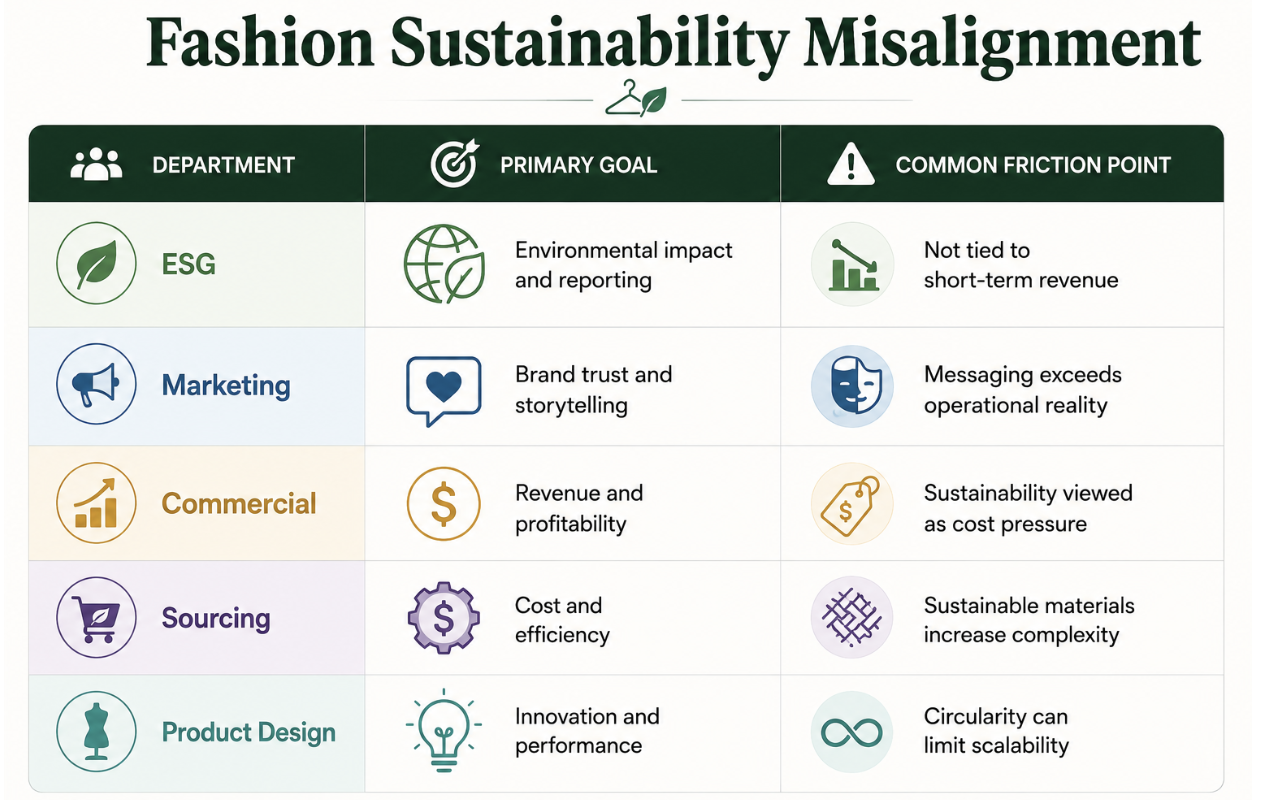
Fashion sustainability often struggles because every department measures success differently. ESG teams focus on environmental reporting, emissions targets, and compliance frameworks. Marketing teams focus on storytelling, customer engagement, and brand trust. Commercial teams prioritize revenue growth, pricing strategy, and sell-through performance. Product development and sourcing teams focus on speed, scalability, supplier relationships, and production costs.
Individually, these priorities make sense. Together, however, they create friction that slows implementation.
Common breakdown points in fashion sustainability:
- Sustainable materials increase sourcing complexity
- Commercial teams worry about pricing pressure
- Circularity goals conflict with production speed
- Marketing campaigns move faster than operations
- Sustainability teams lack influence over sourcing decisions
- Product innovation struggles to scale commercially
This fragmentation mirrors what behavioral science identifies as the “intention–action gap,” the disconnect between what organizations say they value and what systems actually support. Research from McKinsey & Company continues to show that consumers increasingly expect sustainable options while still prioritizing convenience, price accessibility, and product performance. At the same time, Vogue Business has noted that much of sustainable fashion remains stuck in what industry leaders describe as a “pilot phase,” where innovation exists but struggles to scale systemically across operations and supply chains. (Vogue)
The same dynamic exists internally within organizations. Sustainability goals may be widely supported while operational systems continue prioritizing speed, cost efficiency, and quarterly growth targets.
At Grounded World, much of the work around sustainability strategy focuses on helping organizations close this exact gap between intention and execution. Their work with Lycra around EcoMade fibers and circularity campaigns emphasized not only storytelling, but behavior change, stakeholder engagement, and operational alignment around lower-impact textile innovation. (grounded.world)
That matters especially in fashion because consumers have become increasingly skeptical of sustainability claims that feel disconnected from operational reality. Greenwashing concerns continue shaping trust across apparel and performance fashion. According to Vogue, the industry still struggles to move sustainability beyond isolated pilots and marketing campaigns into scalable operational systems. (Vogue)
The cost of weak sustainability alignment

When sustainability alignment breaks down inside fashion organizations, the impact becomes measurable very quickly. Product launches become delayed. Material innovation slows down. Sustainable collections struggle to scale. Marketing campaigns lose credibility. Internal teams lose momentum because responsibilities and incentives remain unclear.
Over time, sustainability starts feeling performative rather than operational.
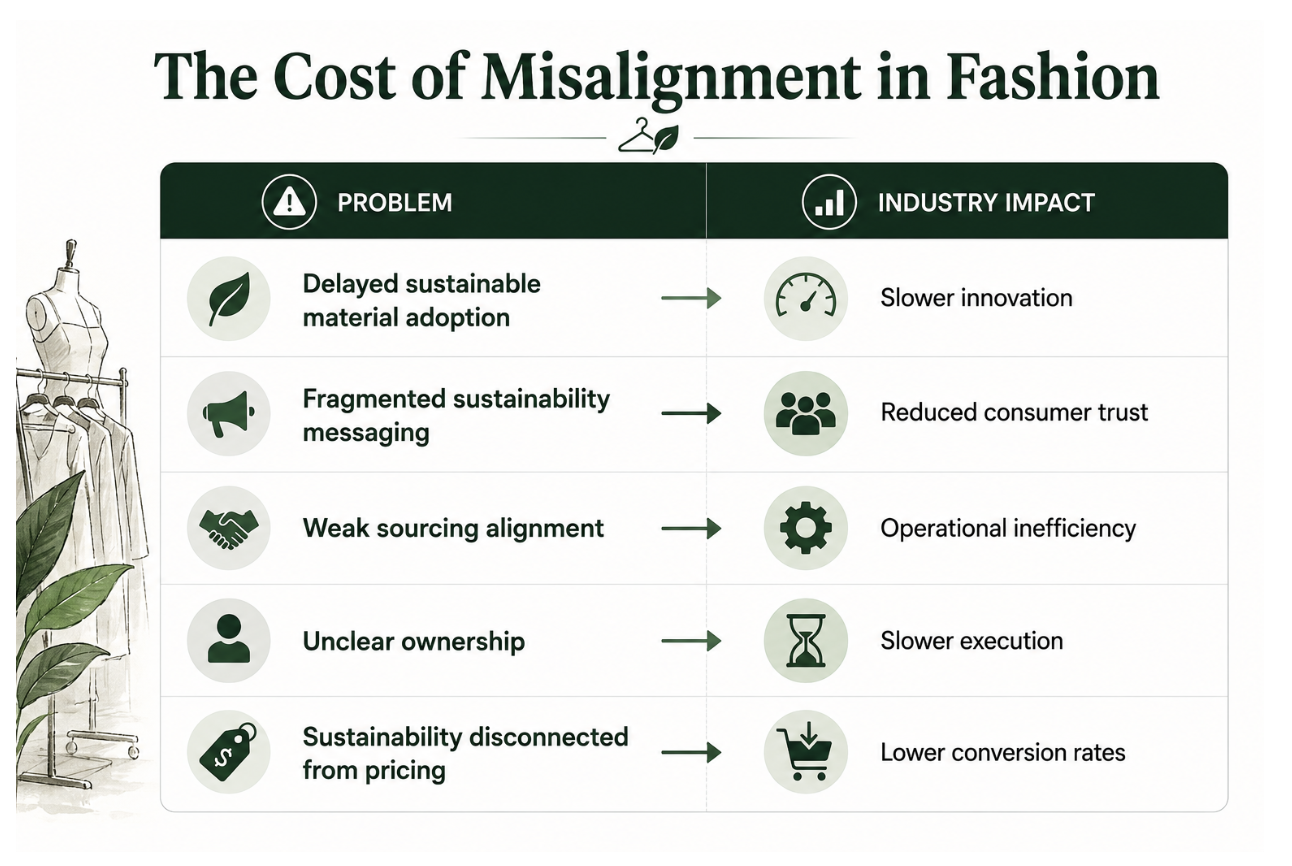
This matters even more now because fashion consumers increasingly expect sustainability to feel integrated into the product itself rather than communicated separately through campaigns. Material innovation, textile recycling, circularity systems, and sourcing transparency are becoming central to competitive advantage across apparel and performance fashion. Vogue Business has highlighted how companies investing in next-generation textiles and circular supply systems are increasingly shaping the future direction of sustainable fashion. (Vogue)
The brands making meaningful progress are usually not the ones talking about sustainability the most. They are the ones embedding sustainability directly into sourcing, textile innovation, customer experience, pricing strategy, and operational systems. They connect sustainability to measurable business outcomes instead of treating it as a separate initiative sitting beside the business.
What fashion companies doing this well prioritize
Organizations successfully operationalizing sustainability in fashion often focus on:
- Shared KPIs across ESG, sourcing, and commercial teams
- Sustainable material innovation tied to product performance
- Long-term supplier partnerships
- Transparency that reflects operational reality
- Sustainability integrated into pricing and sourcing decisions
- Clear ownership across cross-functional initiatives
This is where sustainability shifts from messaging into operational behavior.
Because ultimately, sustainable fashion is not just about launching conscious collections or publishing ESG reports. It is about aligning sourcing, textile innovation, performance, pricing, and communication into one operational system.
Until that happens, sustainability remains something the fashion industry talks about more than it consistently executes.
Close your intention–action gap.
If your investments in sustainability and social impact aren't translating into sales, growth or internal buy-in, we can help you identify the gap.
Footnotes
- McKinsey & Company. “The State of Fashion.”
- Vogue Business. “Sustainable Fashion Is Stuck in ‘Pilot Phase.’”
- The LYCRA Company. “Keep in the Loop with LYCRA.”
- Grounded World. “The LYCRA Company: EcoMade.”
Works Cited
McKinsey & Company. “The State of Fashion.” https://www.mckinsey.com/industries/retail/our-insights/state-of-fashion
The LYCRA Company. “The LYCRA Company Launches New Campaign on Circularity Initiatives.” https://www.thelycracompany.com/en/business/news/lycra-company-launches-new-campaign-circularity-initiatives
Grounded World: LYCRA EcoMade Case Study
Vogue Business. “Sustainable Fashion Is Stuck in ‘Pilot Phase.’” https://www.vogue.com/article/sustainable-fashion-is-stuck-in-pilot-phase