

 Hope Wehrli
 Most organizations are not short on sustainability ambition.
They have the targets. They have the strategy deck. They have internal conversations. They may even have leadership buy-in, customer interest, and teams who genuinely want the work to move forward.
And still, progress can feel strangely slow.
A supplier change gets held up in procurement. A new claim gets stuck in legal review. A campaign loses momentum because the proof points are not ready. A product team agrees sustainability matters, but margin pressure wins the meeting. Nobody is against the work, exactly. But somehow, the work keeps getting delayed.
That is the uncomfortable reality behind many sustainability implementation challenges. The problem is not always a lack of care. Often, it is that the business has not been designed to make sustainable action easy, clear, or rewarding.

Why sustainability slows down after approval
There is often a moment when a sustainability strategy looks finished. The ambition is clear. The priorities are agreed. The language is polished. Everyone leaves the meeting feeling aligned.
Then the work enters the business.
That is where things get more complicated.
Sustainability rarely belongs to one team. It touches sourcing, packaging, finance, legal, product, brand, retail, operations, sales, and leadership. Each team sees the work through a different lens. Procurement may be thinking about supplier reliability. Finance may be thinking about cost. Legal may be thinking about risk. Marketing may be thinking about customer trust. Sustainability may be thinking about long-term impact.
None of these priorities are wrong. But when they are not aligned, they quietly slow each other down.
This is why internal sustainability work can feel so frustrating. Teams may agree on the destination, but still disagree on the route. The result is not open resistance. It is hesitation, rework, vague ownership, and decisions that keep circling back for another round of review.
Behavioral science helps explain this pattern. The Decision Lab describes the intention-action gap as the space between what people intend to do and what they actually do when real-world conditions get in the way.¹ Inside organizations, that gap is not just psychological. It is operational. A company can intend to act sustainably while its day-to-day systems keep making the old way easier.
Where internal blockers usually appear
When sustainability gets stuck, the delay often looks like a people problem. Someone is being too cautious. Another team is moving too slowly. A department is not “bought in.”
But the deeper issue is usually structural.
The business may not have clear decision rights. Teams may be rewarded for different outcomes. Sustainability may be introduced too late in the process. Claims may require approval from people who were not involved early enough to understand the strategy. Commercial teams may be asked to support sustainability without seeing how it connects to growth, risk reduction, or customer behavior.
That is when progress becomes fragile.
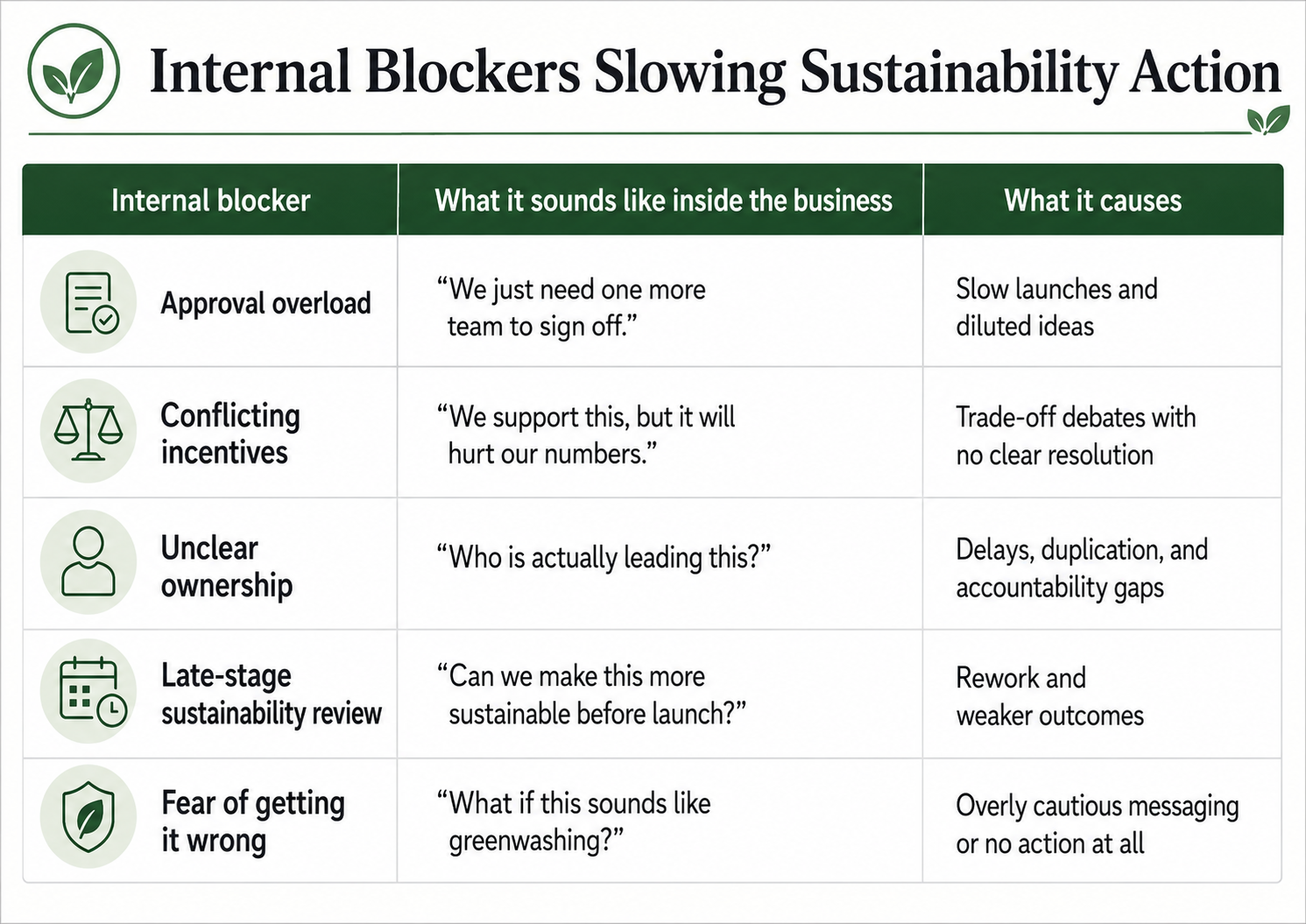
These issues are easy to underestimate because they feel ordinary. They happen in meetings, email chains, approval documents, budget conversations, and project timelines. But over time, they create a pattern: sustainability remains important in theory and difficult in practice.
The business cost of stalled progress
Slow implementation does not just delay impact. It weakens the business case for sustainability itself.
When projects take too long, leadership starts questioning the return. When teams keep revisiting the same decisions, employees become tired of the process. When claims are delayed or watered down, brands lose the chance to build trust with customers. When sustainability is treated as an add-on, it becomes easier to cut, postpone, or isolate from core business decisions.
That is how a meaningful strategy starts to feel like extra work.
Harvard Business Review makes a similar point about sustainable purchasing behavior: people may care about sustainability, but they are more likely to act when the choice is simple, visible, and built into the decision environment.² The lesson for organizations is clear. If sustainable action requires more effort, more risk, and more explanation than the default option, the default option usually wins.
The same is true inside a company. If teams have to fight the system every time they want to make a more sustainable choice, progress will depend on individual persistence instead of organizational design. That is not scalable.
Why better incentives matter
One of the biggest reasons sustainability stalls is that teams are asked to change behavior without changing what the business rewards.
A brand team may be told to lead with purpose, but still be judged on short-term campaign performance. Procurement may be encouraged to consider lower-impact suppliers, but still be measured on cost reduction. Product teams may be asked to innovate, but not given room for testing or slower development timelines. Legal may be told to support bolder storytelling, but remain responsible for reducing every possible reputational risk.
In that environment, people often make the safest choice. Not because they do not care, but because the business has made the safer choice easier to defend.
This is where sustainability work becomes less about inspiration and more about design. The question is not only, “Do people understand the strategy?” It is, “What would help them act on it?”
A study in Sustainability on the attitude-behavior gap found that positive attitudes do not automatically become action, especially when people do not feel that their behavior is effective or supported by the context around them.³ That insight matters for internal teams, too. Employees need confidence that sustainable choices are practical, valued, and connected to outcomes the business already cares about.
Without that confidence, sustainability becomes something people approve of but hesitate to execute.
What stronger organizations do differently
Organizations that make faster progress do not treat sustainability as a separate lane. They build it into how decisions already happen.
They bring the right teams in earlier. They clarify who owns what. They define what proof is needed before a claim goes to market. They connect sustainability to commercial value, customer trust, risk reduction, innovation, and employee engagement. They make trade-offs explicit instead of letting each team negotiate them from scratch.
Most importantly, they make the desired behavior easier.
That may sound simple, but it changes the work. Instead of asking teams to care more, the organization removes the barriers that make action harder.
Strong implementation often includes:
- Clear ownership for cross-functional sustainability initiatives
- Shared KPIs across sustainability, brand, finance, procurement, and operations
- Claims guidance that helps legal and marketing move faster together
- Earlier integration of sustainability into product and sourcing decisions
- Decision rules for common trade-offs around cost, speed, risk, and impact
- Internal proof points that show how sustainability supports business value
- Leadership clarity on what should move forward, what needs review, and who decides
Business Vision Magazine’s overview of sustainable marketing case studies points to a similar pattern externally: sustainability campaigns work better when they connect environmental commitments to trust, participation, customer relevance, and business value.⁴ The same principle applies internally. Teams need to understand not just why sustainability matters, but how it helps them make better decisions.

How grounded’s Friction & Incentive Audit helps
Grounded’s Friction & Incentive Audit is built for organizations that are asking a very practical question:
“We want to move forward, so what is actually slowing us down?”
The audit looks at the points where sustainability progress starts to drag. It identifies the processes, incentives, decision rights, and confidence gaps that keep good intentions from becoming visible action.
It is not about blaming teams. It is about understanding what the current system is making easy, what it is making difficult, and what it is quietly discouraging.
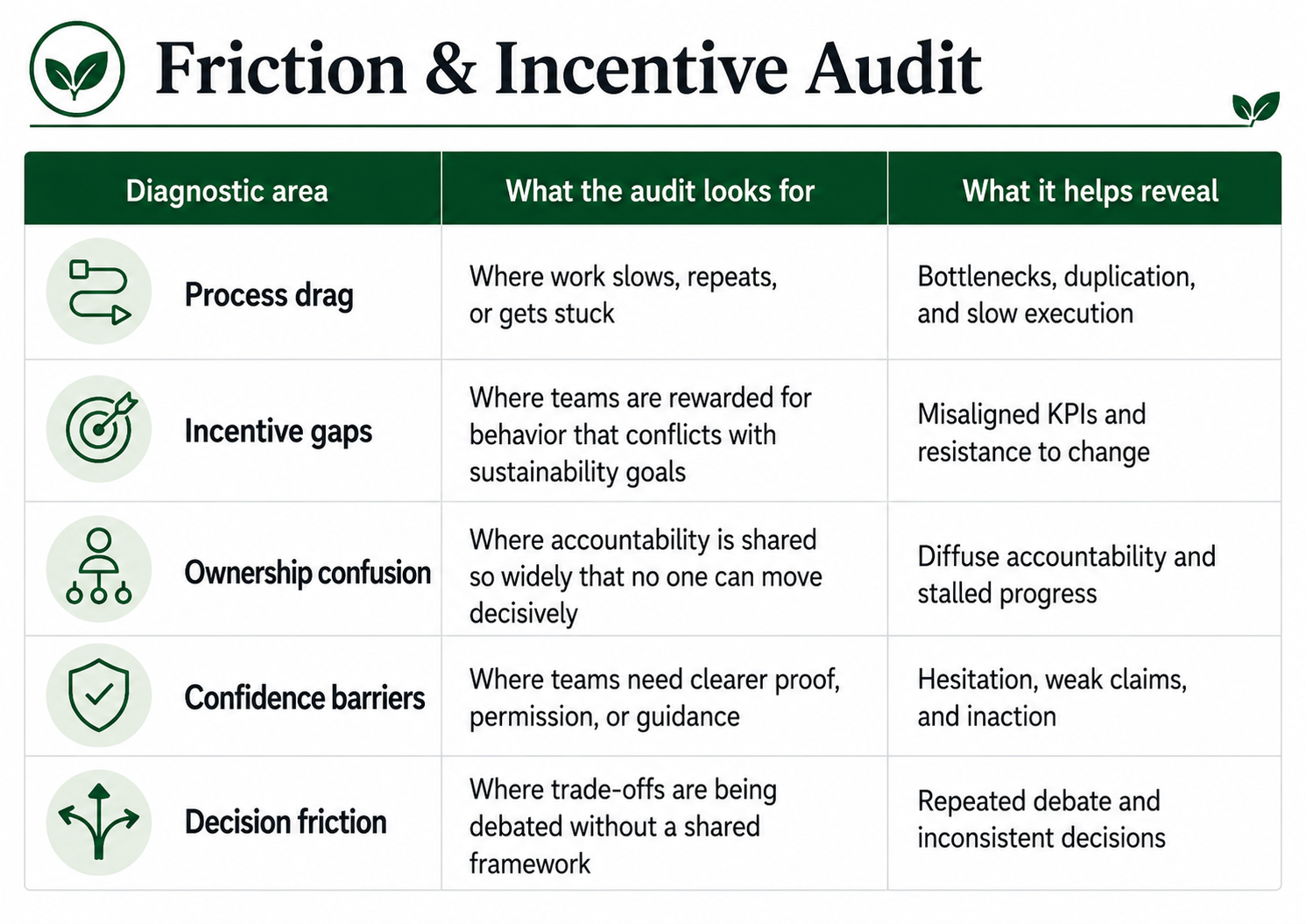
This connects to the theme of grounded’s podcast, It Shouldn’t Be This Hard. Doing the right thing inside a business can become difficult when the systems around people are built for different outcomes. Sustainability progress depends on more than conviction. It depends on the practical conditions that allow people to act.
Want to know more?
Listen to our 'It Shouldn't Be This Hard' podcast — conversations with executives, innovation and sustainability professionals and social entrepreneurs who are doing the real work and bridging the gap between purpose and profit.
Close the gap between strategy and action
If your sustainability strategy is approved but progress still feels slow, the strategy may not be the problem.
The problem may be what happens after approval.
Who owns the next step? What does each team need to move forward? Which metric is making people hesitate? Where are approvals protecting the business, and where are they simply slowing it down? What would make sustainable action easier than the default?
These are the questions that help organizations move from alignment to implementation.
Most companies do not need another reminder that sustainability matters. They need a clearer view of what is blocking the work inside the business. Once those barriers are visible, they become easier to redesign.
Grounded’s Friction & Incentive Audit helps organizations find those barriers and close the gap between strategy, behavior, and measurable progress.
Because the real issue is rarely that organizations do not want to move forward. It is that the system keeps making forward motion harder than it should be.
Close your intention–action gap.
If your investments in sustainability and social impact aren't translating into sales, growth or internal buy-in, we can help you identify the gap.

.jpg&w=3840&q=75&dpl=dpl_HmnLwQsjegpnBGw9xx66UP2zNbiG)
.jpg&w=3840&q=75&dpl=dpl_HmnLwQsjegpnBGw9xx66UP2zNbiG)
