

 Gaia
GaiaTLDR:
Sustainability marketing for CPG brands is the practice of turning verified environmental and social progress into credible product claims, packaging, and shopper communications that drive trust and sales. It works when specific proof is paired with core product benefits at the point of purchase. Vague green language is now a legal and commercial liability. The brands winning are those connecting substantiated claims to what consumers already want: performance, taste, safety, or convenience.
Sustainability Marketing for CPG Brands
Sustainability marketing for CPG brands is the practice of turning verified environmental and social progress into specific product claims, packaging messages, retail activation, and digital content that influence purchase decisions.
In 2026, the strongest CPG sustainability strategies do not ask consumers to choose sustainability instead of performance, taste, price, safety, or convenience. They connect a credible sustainability benefit to the reason shoppers already want the product.
For example, instead of saying a product is “better for the planet,” a brand can communicate a specific, substantiated improvement such as reduced packaging, verified recycled content, certified sourcing, or a measured reduction in product-level emissions.
The commercial challenge is turning that proof into a message consumers can understand quickly while keeping every claim accurate, appropriately scoped, and defensible.
This guide explains how CPG brands can build sustainability marketing strategies that connect sustainability proof with consumer behavior, retail growth, ecommerce visibility, and measurable business outcomes.
If your team is working to turn sustainability investments into measurable business outcomes, start by assessing the gap between sustainability proof, brand positioning, shopper behavior, and commercial performance.
Key Takeaway for CPG Brands in 2026
Sustainability marketing for CPG brands works best when verified environmental or social improvements are connected to the product benefit consumers already care about. The most effective approach is to use specific, substantiated claims, explain their scope clearly, activate them at the point of purchase, and measure both commercial results and sustainability outcomes.
A practical CPG sustainability marketing strategy should:
Lead with the buying reason. Connect sustainability to taste, performance, efficacy, safety, price, or convenience rather than making sustainability the entire value proposition.
Use specific claims. Replace vague language such as “eco-friendly” or “green” with measurable, product-specific statements supported by evidence.
Define the scope. Make clear whether a claim applies to the product, package, ingredient, manufacturing process, supply chain, or entire brand.
Make proof accessible. Use certifications, testing, lifecycle assessments, supplier documentation, methodologies, and QR-linked evidence where appropriate.
Activate sustainability at the point of choice. Translate the same verified proof into packaging, retail displays, product detail pages, retail media, social content, and shopper education.
Measure commercial and sustainability outcomes. Track sales lift, trial, repeat purchase, conversion, distribution, claim comprehension, packaging improvements, and other relevant impact metrics.
The goal is not to make a CPG product sound more sustainable than it is. The goal is to make genuine sustainability progress understandable, credible, and commercially useful.
Sustainability Marketing for CPG Brands at a Glance
Stage | What the Brand Does | Example |
|---|---|---|
Proof | Establishes a measurable sustainability improvement | 50% post-consumer recycled plastic |
Product Benefit | Connects sustainability to the buying reason | Same cleaning performance with less virgin plastic |
Claim | Communicates the improvement precisely | “Bottle contains 50% post-consumer recycled plastic” |
Point of Choice | Makes the claim visible where consumers decide | Packaging, shelf, PDP, retail media, QR code |
Measurement | Tracks commercial and sustainability outcomes | Sales lift, conversion, trial, repeat purchase, material reduction |
This framework helps CPG teams move from “We have sustainability data” to “Consumers understand why that data matters.”
What Sustainability Marketing Means in CPG
Consumer packaged goods are different from most other categories. Purchase decisions happen in seconds. Shoppers scan shelves or scroll product pages with limited attention. Packaging carries the bulk of a brand’s sustainability message, and that message needs to survive legal review, retailer compliance, and consumer skepticism at the same time.
For CPG brands, sustainability marketing typically includes:
On-pack claims and packaging design
Shelf and shopper activation
Product detail pages and ecommerce content
Retailer sell-in stories and category narratives
Certifications and proof points
Claims substantiation and governance
Social, influencer, and PR campaigns
Consumer education and behavior change
QR-code proof layers and digital transparency tools
Measurement of sales lift, trust, and impact outcomes
The scope is broader than advertising. It covers how a brand talks to retail buyers, how it structures product data for AI-powered shopping tools, and how it handles the gap between what consumers say they want and what they actually buy.
How to Build a Sustainability Marketing Strategy for a CPG Brand
A CPG sustainability marketing strategy should connect operational sustainability improvements with a specific consumer need, a substantiated claim, a point-of-purchase message, and measurable commercial outcomes.
A practical process is:
1. Audit the Sustainability Proof
Start by identifying the sustainability improvements that can actually be demonstrated.
Potential proof points include:
Reduced packaging weight
Recycled content
Recyclability or reuse systems
Certified ingredients
Responsible sourcing
Reduced water use
Reduced energy use
Lower product-level emissions
Waste reduction
Refill systems
Supply-chain traceability
Separate verified facts from future goals. A target to reduce emissions in the future should not be communicated as though the reduction has already happened.
2. Choose the Consumer Buying Reason
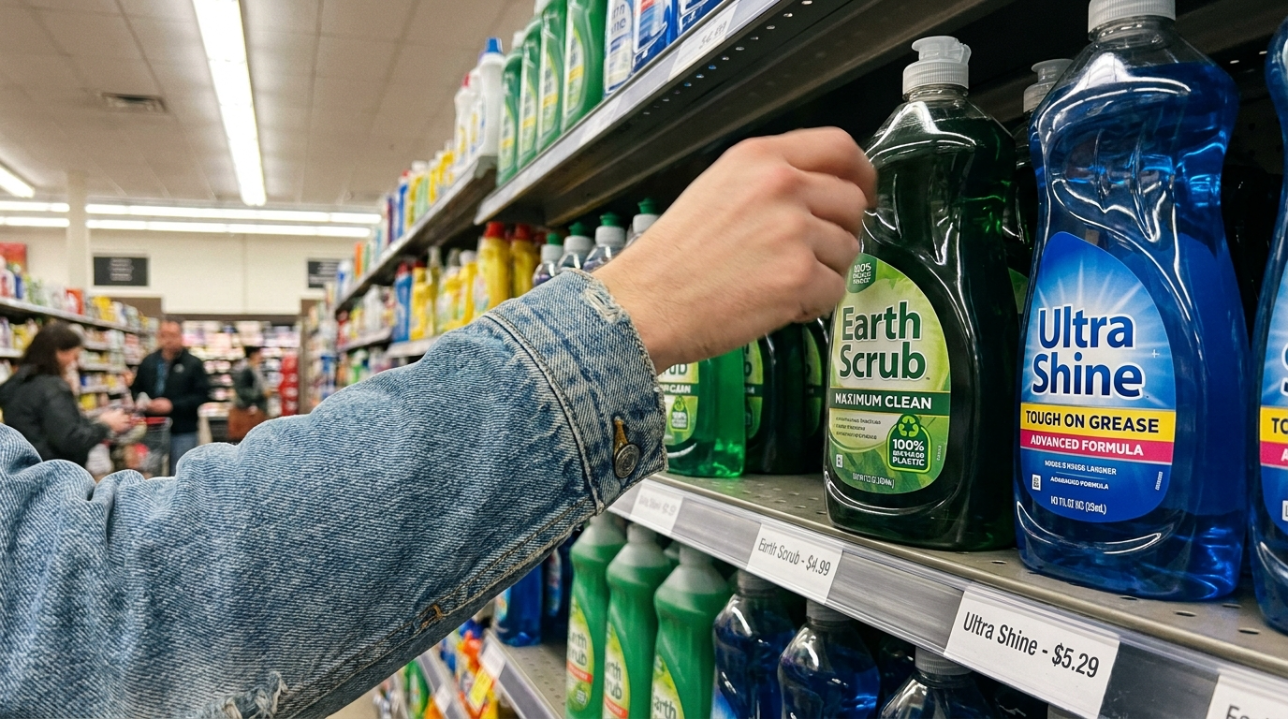
Identify why consumers buy the product before deciding how sustainability should be communicated.
For example:
Food and beverage: taste, quality, ingredients, convenience
Household cleaning: efficacy, safety, convenience
Personal care: efficacy, ingredients, safety, sensory experience
Apparel and textiles: quality, durability, materials
Consumer health: safety, efficacy, trust
The sustainability message should strengthen the existing reason to buy.
3. Develop the Sustainability Claim
Turn the underlying evidence into a specific consumer-facing statement.
A useful claim should answer:
What changed?
Where did it change?
How much changed?
Compared with what?
What evidence supports the statement?
What limitations or exclusions apply?
4. Define the Claim Scope
Specify whether the claim applies to:
The product
The packaging
A specific component
An ingredient
A product line
A manufacturing facility
A supply chain
The entire brand
Avoid allowing a narrowly scoped improvement to sound like a claim about the entire product or company.
5. Build the Proof Layer
Create a place where consumers, retailers, and other stakeholders can learn more.
Depending on the claim, this could include:
Certification information
Testing documentation
Methodology
Lifecycle assessment information
Supplier verification
Packaging specifications
Traceability data
Baseline and comparison data
The proof layer does not need to appear in full on the front of a package. It can be connected through a product page, QR code, or other accessible source.
6. Activate at the Point of Choice
Translate the same substantiated claim across the buying journey.
Use appropriate versions for:
Packaging
Retail shelves
Ecommerce PDPs
Retail media
Search content
Social media
Influencer campaigns
Buyer presentations
Email
In-store education
The core fact should remain consistent even when the wording changes by channel.
7. Measure Commercial and Sustainability Results
Measure whether the sustainability message contributes to the desired business and behavior outcomes.
Relevant metrics can include:
Sales
Trial
Repeat purchase
Conversion rate
Average order value
Distribution
Household penetration
Retailer acceptance
Claim comprehension
QR-code engagement
Packaging reduction
Recycled content
Emissions reduction
Waste reduction
This creates a feedback loop between sustainability investment, communication, consumer response, and measurable impact.
What Does Sustainability Marketing Include for CPG Brands?
Sustainability marketing can influence nearly every consumer-facing stage of the CPG buying journey. Common applications include:
Sustainable packaging claims
Responsible sourcing and ingredient claims
Recycled and recyclable material claims
Product carbon footprint communications
Certified environmental and social claims
Refill, reuse, and circularity programs
Retail shelf and point-of-purchase activation
Ecommerce product detail pages
Retail media
Social media and influencer campaigns
Sustainability-focused public relations
QR-code transparency and traceability
Consumer education and recycling guidance
The key distinction is that sustainability marketing should communicate verified actions or attributes, not simply attach environmental language to a product.
Sustainability Marketing vs. Sustainability Strategy
Sustainability strategy determines what a CPG company changes in its products, packaging, sourcing, manufacturing, distribution, or operations.
Sustainability marketing communicates those verified changes to consumers, retailers, employees, investors, and other stakeholders.
Marketing cannot substitute for operational progress. The strongest sustainability marketing programs begin with evidence and then translate that evidence into a useful consumer proposition.
Why Sustainability Marketing Is Different for CPG Brands
CPG purchases are often low-consideration and highly competitive. Consumers may have only seconds to compare products on a shelf or a few seconds to evaluate a product page online.
That makes three factors particularly important:
Clarity: Consumers need to understand the claim quickly.
Relevance: Sustainability should connect to a product benefit or shopper priority.
Proof: The brand must be able to substantiate what the claim communicates.
For CPG brands, sustainability marketing therefore has to work simultaneously as a communication strategy, a claims-governance system, and a point-of-purchase tool.
Why It Matters: The Business Case
The growth signal is real. NYU Stern CSB and Circana’s 2025 Sustainable Market Share Index found sustainability-marketed products reached 25.4% of U.S. CPG dollar share, delivered a 10.9% five-year CAGR (nearly five times faster than conventionally marketed goods), and contributed 44.9% of total CPG market growth from 2013 to 2025.
What the CPG Sustainability Data Shows
Recent research suggests that sustainability-marketed CPG products can outperform conventional products, although the available evidence should not be interpreted as proof that sustainability claims alone cause sales growth.
Finding | What It Means for CPG Marketers |
|---|---|
Sustainability-marketed products represent a substantial share of U.S. CPG sales | Sustainability is no longer a niche positioning strategy |
Sustainability-marketed products have shown faster growth in major market analyses | Sustainability can be associated with attractive growth opportunities |
Products carrying ESG-related claims have outperformed products without such claims in some category analyses | Sustainability attributes can contribute to differentiation |
Research identifies correlation rather than definitive causation | Claims should not be treated as an automatic sales driver |
Performance, price, distribution, and marketing investment still matter | Sustainability should reinforce the overall product proposition |
Important: Research findings should be interpreted in context. Category, price, distribution, product quality, brand strength, marketing investment, and consumer demographics can all affect sales performance. Sustainability claims should therefore be treated as one component of a broader growth strategy rather than a guaranteed cause of incremental sales.
McKinsey and NielsenIQ’s analysis of 600,000 SKUs across 44,000 brands and 32 categories found products with ESG-related claims averaged 28% cumulative growth over five years, compared with 20% for products without such claims. Those products accounted for 56% of all growth in the categories examined.
But these numbers come with a necessary caution. McKinsey and NielsenIQ explicitly note their analysis shows correlation, not definitive causation. Marketing investment, distribution, pricing, and product quality all play a role. Sustainability claims do not automatically cause growth.
The takeaway: sustainability marketing can help CPG brands win market share, but only when it is tied to category value, product performance, and credible proof.
Sustainability Must Reinforce the Buying Reason
One of the most actionable findings for CPG teams comes from NYU Stern CSB and Edelman’s research on effective sustainability communications. Their study found sustainability claims expanded brand reach by 24 to 33 percentage points above a category claim alone, across nine brands including Mars, Unilever, and HP.
The practical rule: lead with the category job. Use sustainability as an amplifier, not a substitute for taste, efficacy, convenience, safety, or quality. For guidance on structuring these messages, this sustainability messaging framework breaks down the hierarchy.
Here is what that looks like in practice:
Weak: “A better choice for the planet.”
Stronger: “The same cleaning power in a bottle made with 50% post-consumer recycled plastic.”
Strongest: “Tough on grease, made with 50% post-consumer recycled plastic, verified by [credible standard].”
Consumers still buy for the job first. Sustainability helps most when it reinforces that job.
Sustainability Marketing Examples by CPG Category
The best sustainability message depends on the category, the consumer buying reason, and the evidence available.
Food and Beverage
Lead with taste, quality, ingredients, or convenience and connect sustainability to a specific verified attribute.
Example structure:
“Great taste with cocoa sourced through [verified program], covering X% of the cocoa used in this product.”
The sustainability message supports the food proposition rather than replacing it.
Household Cleaning
Lead with cleaning performance, efficacy, or convenience.
Example structure:
“Tough on grease. Bottle made with X% post-consumer recycled plastic.”
The consumer gets the functional benefit first and the sustainability attribute second.
Personal Care
Connect sustainability to ingredients, packaging, efficacy, or product experience.
Example structure:
“Effective daily care in a refillable format that uses X% less packaging material per use.”
The claim should clearly define the comparison and what is included in the calculation.
Beauty and Cosmetics
Consumers may care about ingredients, packaging, animal welfare, efficacy, and sourcing.
Example structure:
“Made with X% certified ingredients by weight.”
The exact certification and calculation basis should be clearly identified.
Apparel and Textiles
Material claims need particularly precise scope.
Example structure:
“Main fabric contains 80% recycled polyester.”
If other components are excluded, that limitation should be clear.
Consumer Goods With Refill or Reuse Models
Lead with convenience and the behavioral action required.
Example structure:
“Refill in seconds and use X% less packaging per refill compared with [defined baseline].”
The comparison should be supported by documented evidence and clearly defined.
The Intention-Action Gap
The central challenge of sustainability marketing for CPG brands is not awareness. It is the gap between what consumers say they value and what they actually purchase.
Ipsos tested this directly in a simulated shopping experiment. Among the 31% of respondents who said they “usually try to buy sustainable products,” only 40% chose the sustainable option without special sustainability signage. Even simple shelf signage did not significantly close the gap in the tested categories.
The blockers are familiar: price, convenience, performance concerns, unconscious habits, confusing labels, and default choice behavior. For CPG brands, the problem is rarely that consumers don’t care. The problem is that caring competes with everything else happening at the moment of decision.
That is why sustainability marketing cannot be built around values alone. It has to be built around a specific behavior: switch, try, refill, reuse, scan, recycle correctly, or buy again. For a deeper look at what gets in the way, explore these barriers to sustainable purchasing and how to remove them.
What Makes a Sustainability Claim Credible
Credibility separates effective sustainability marketing from greenwashing. Before a CPG sustainability claim goes live, it should be able to answer these questions:
What exactly is being claimed?
Does it refer to the product, package, ingredient, facility, supply chain, or company?
What evidence supports it, and is that evidence current and product-specific?
Could the claim imply more than the proof supports?
Would a shopper understand the scope and limitations quickly?
Would legal, sustainability, R&D, packaging, and sales teams all interpret it the same way?
The FTC Green Guides warn marketers not to make broad, unqualified environmental claims like “green” or “eco-friendly” and require that claims about recyclability, compostability, and recycled content be properly substantiated.
The EU’s Directive 2024/825, applying from September 2026, goes further. It prohibits generic claims like “environmentally friendly,” “green,” or “biodegradable” unless excellent environmental performance can be demonstrated. It also bans claims about an entire product when the claim only applies to one aspect.
This article is a marketing guide, not legal advice. Brands should review sustainability claims with qualified legal, regulatory, sustainability, and technical teams before launch. For CPG teams navigating these rules, the practical guide on how to avoid greenwashing covers the most common pitfalls.
2026 Regulatory Landscape: FTC Green Guides vs. EU Directive 2024/825
CPG sustainability claims are subject to strict regulatory enforcement. Regulatory bodies penalize vague environmental messaging, requiring verified proof for all on-pack and digital marketing claims.
FTC Green Guides (United States): Regulates claims regarding recyclability, compostability, and recycled content. Claims must be substantiated with local infrastructure data. Banned practice: Broad, unqualified claims like "eco-friendly" or "green."
EU Directive 2024/825 / EmpCo (European Union): Requires mandatory compliance starting September 27, 2026. Claims require certified environmental performance or public scheme verification. Banned practice: Generic claims ("climate neutral," "biodegradable") without verified proof or relying solely on off-site carbon offsets.
UK ASA / CMA Green Claims Code (United Kingdom): Requires claims to cover the full product lifecycle; partial claims cannot imply whole-product benefits. Banned practice: Labeling items "recycled" when only outer packaging contains recycled material.
Summary of Regulatory Enforcement Requirements:
Regulatory Standard: FTC Green Guides (US) Target Jurisdiction: United States Key Enforcement Requirements: Claims regarding recyclability, compostability, and recycled content must be substantiated with local infrastructure data. Banned Practice: Broad, unqualified claims (e.g., "eco-friendly," "green").
Regulatory Standard: EU Directive 2024/825 (EmpCo) Target Jurisdiction: European Union Key Enforcement Requirements: Mandatory application starting September 27, 2026. Claims require certified environmental performance or public scheme verification. Banned Practice: Generic claims ("climate neutral," "biodegradable") without verified proof or relying solely on off-site carbon offsets.
Regulatory Standard: UK ASA / CMA Green Claims Code Target Jurisdiction: United Kingdom Key Enforcement Requirements: Claims must cover the full product lifecycle; partial claims cannot imply whole-product benefits. Banned Practice: Labeling items "recycled" when only outer packaging contains recycled material.
Good vs. Weak Sustainability Marketing Claims
Packaging
Risky: “Eco-friendly bottle.”
Better: “Bottle made with 50% post-consumer recycled plastic.”
Best: “Bottle made with 50% post-consumer recycled plastic. Scan to check your local recycling rules.”
Carbon
Risky: “Carbon neutral snack.”
Better: “We measured our product footprint and are reducing emissions in sourcing and manufacturing.”
Best: “Product footprint measured using [methodology]. Manufacturing emissions reduced by X% vs. [baseline year]. Details at [proof page].”
Ingredient Sourcing
Risky: “Responsibly sourced.”
Better: “Made with cocoa sourced through [program].”
Best: “Made with cocoa sourced through [program], covering X% of cocoa in this product line, verified by [standard].”
Recycled Materials
Risky: “Recycled product.”
Better: “Main fabric contains 80% recycled polyester.”
Best: “Main fabric contains 80% recycled polyester; trims, zipper, and labels are not recycled.”
The UK’s Advertising Standards Authority recently banned ads from major brands for calling products “recycled” when only part contained recycled material. Scope matters, and getting it right requires cross-functional review. For the full picture on materials claims and certification language, sustainable packaging communications covers this in detail.
Common Greenwashing Risks for CPG Teams
Practitioners on Reddit consistently report frustration with vague sustainability language. In one r/sustainability thread, users criticized terms like “green,” “eco,” and “sustainable” as meaningless unless backed by tangible proof. One commenter with consumer-goods experience described vague green language as an ongoing battle between sustainability teams and marketing departments.
On professional packaging forums, practitioners describe how companies talk about sustainable packaging without always funding the work. Members of the IoPP community note that sustainable formats can add tooling, production, and machinery costs, and that without waste-system improvements, expensive “green” packaging may end up in the same waste stream anyway. A 2026 r/Packaging discussion similarly highlights how consumers focus on paper versus plastic, while packaging professionals focus on shelf life, product protection, and cost.
Here are the risks CPG teams should watch:
Broad unqualified claims (“eco-friendly,” “sustainable,” “green”)
Claims about the package that imply the whole product is sustainable
Claims about one SKU that suggest the full range is covered
“Recyclable” claims that ignore the reality of nearly 10,000 U.S. recycling systems
“Carbon neutral” claims that rely on offsets without a clear reduction path
Visual identity (kraft textures, green colors, nature imagery) that implies unproven benefits
Old claims that stay live after suppliers, formulas, or packaging change
Certification logos used without explaining their scope
A sustainability marketing practitioner on LinkedIn captured the core tension: marketing teams want broad labels like “Planet Friendly,” while technical teams have precise achievements like a mono-material pouch or a quantified emissions reduction. The useful middle path is translating technical proof into consumer language without losing accuracy, and framing sustainability as progress rather than perfection.
The answer to greenwashing risk is not silence. Greenhushing, staying quiet about legitimate progress because of fear, is its own failure mode. The right approach is disciplined specificity.
Greenwashing vs. Greenhushing: Finding the Middle Ground
CPG brands can make sustainability communication mistakes in two opposite directions.
Approach | What It Means | Main Risk | Better Approach |
|---|---|---|---|
Greenwashing | Overstating or misrepresenting sustainability performance | Legal, reputational, and consumer-trust risk | Use specific claims supported by evidence |
Greenhushing | Avoiding legitimate sustainability communication because of fear of criticism | Consumers and retailers may never understand genuine progress | Communicate verified improvements with appropriate scope |
Evidence-based marketing | Communicating verified improvements without exaggeration | Requires governance and documentation | Make proof, scope, and limitations clear |
The objective is neither to make a product sound greener than it is nor to remain silent about legitimate progress.
The better approach is evidence-based sustainability marketing: communicate what the brand can demonstrate, explain what the claim covers, and avoid implying benefits that the evidence does not support.
The Proof-to-Purchase Loop
Sustainability marketing for CPG brands works when it connects five things in sequence.
1. Proof
Start with substantiated facts, not campaign language. Verified recycled content, certified sourcing, reduced packaging weight, lower-carbon manufacturing, refill or reuse systems, ingredient traceability, lifecycle analysis, or third-party certification. Without proof, there is no credible sustainability marketing.
2. Positioning
Translate the proof into a benefit the consumer or retailer cares about. “Same cleaning power, less virgin plastic.” “Great taste, lower-impact ingredients.” Do not let sustainability replace the core category promise. Pair it with the reason people buy.
3. Permission
Ask whether the brand has earned the right to make the claim. Does the history of action support it? Is the certification scope clear? Are trade-offs disclosed? Practitioners on Reddit note that sustainability claims are most credible when they show up as operational evidence, not just a campaign layer.
4. Point of Choice
Activate the message where the decision happens. For CPG, that means front-of-pack, product detail pages, shelf activation, retail media, QR-code proof, influencer content, and buyer sell-in decks. Oatly’s Reddit AMA around climate-footprint labels is a good example: the brand used sustainability data as participatory conversation rather than a one-way claim, generating engagement far above platform benchmarks. For strategies on making this work in store, see how brand activation at retail drives purchase behavior.
5. Performance
Measure both commercial and credibility outcomes. On the commercial side: sales lift, trial, repeat purchase, conversion rate, household penetration, and distribution gains. On the credibility side: claims substantiation coverage, packaging material reduction, certification coverage, and regulatory compliance.
If your team is evaluating whether to build these capabilities in-house or work with a specialist, learn about Grounded World and the approach behind its Discover, Articulate, Activate, and Accelerate model.
Activating Sustainability Across Retailers and the Digital Shelf
Winning retail space and ranking on e-commerce search engines requires translating sustainability data into structured retail attributes.
Retailer Sell-In Strategy: Major retail buyers prioritize brands that help them meet Scope 3 targets. Frame sustainability investments as category margin drivers, highlight reduced packaging weight (which lowers shipping freight costs), and bring verified third-party audit data to buyer meetings.
Digital Shelf & AI Search Optimization: Modern shoppers use AI shopping assistants and digital search filters to find sustainable products. Optimize Product Detail Pages (PDPs) by:
Adding verified certifications (e.g., Fair Trade, USDA Organic, B Corp) directly into backend product metadata.
Including clear bullet points on packaging materials and footprint metrics in product descriptions.
Deploying on-pack QR codes linked directly to interactive batch-tracing and LCA (Life Cycle Assessment) landing pages.
Sustainability Marketing vs. Related Terms
Term | Meaning | How it connects |
|---|---|---|
CPG sustainability | Operational impact work across sourcing, manufacturing, packaging, distribution, use, and disposal | Supplies the proof |
Sustainability marketing | Commercial translation of that proof into demand, trust, and behavior change | Turns proof into market action |
Sustainability communications | Broader stakeholder messaging including reports, investor relations, and PR | Includes corporate and public audiences |
Green marketing | Environment-focused product marketing | Narrower than sustainability marketing |
ESG claims | Environmental, social, or governance claims in product or brand communications | Common on CPG packaging and PDPs |
Cause marketing | Brand promotion tied to a cause or donation | Not a substitute for product-level proof |
Greenwashing | Misleading or overstated sustainability communication | The core risk |
Greenhushing | Staying silent about legitimate progress out of fear | The opposite failure mode |
90-Day Sustainability Marketing Plan for CPG Brands
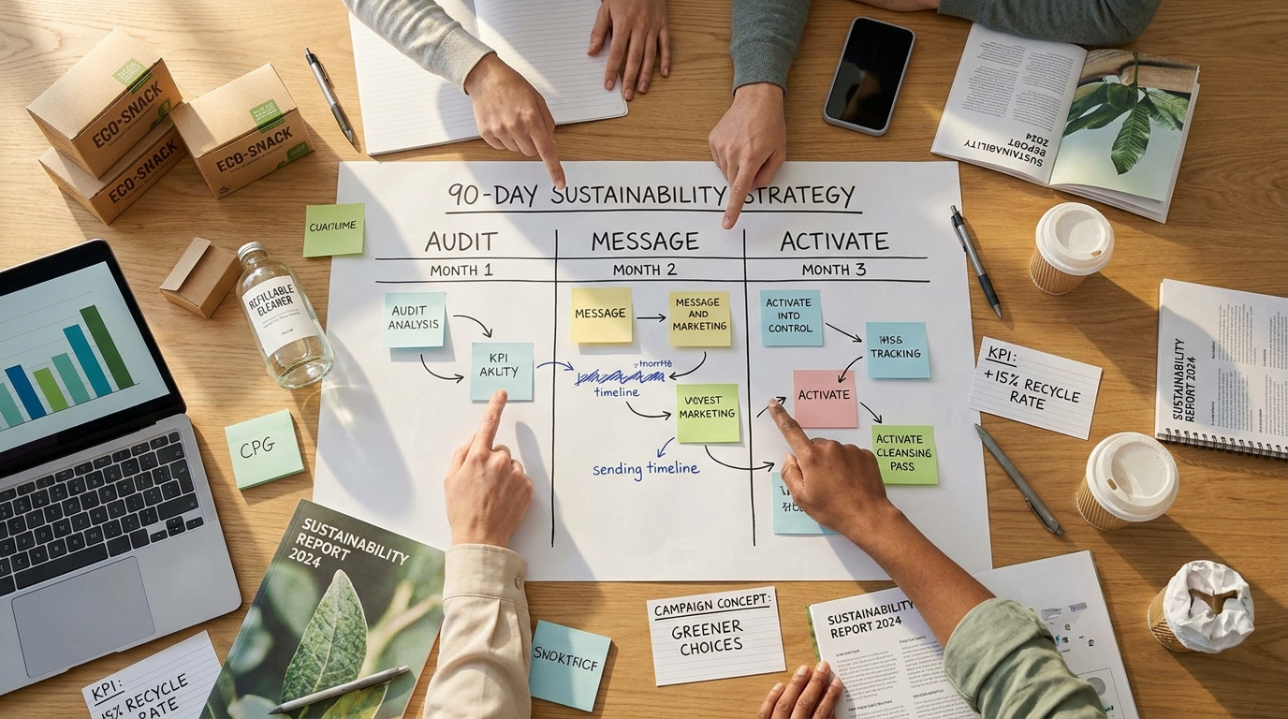
A CPG brand does not need to transform its entire sustainability program before improving sustainability marketing. A focused 90-day process can establish the foundation.
Days 1–30: Audit and Prioritize
Inventory existing sustainability claims
Identify the evidence supporting each claim
Review packaging and ecommerce messaging
Identify unsupported or overly broad language
Map sustainability improvements to consumer buying reasons
Identify the highest-value product or category opportunity
Review relevant regulatory requirements
Deliverable: A sustainability claims and opportunity matrix.
Days 31–60: Build the Message
Select priority sustainability proof points
Define claim scope
Develop consumer-facing language
Create proof pages or supporting documentation
Align marketing, sustainability, packaging, legal, and regulatory teams
Adapt claims for packaging, ecommerce, retail, and social channels
Deliverable: An approved sustainability messaging system.
Days 61–90: Activate and Measure
Launch priority messaging
Update product detail pages
Test retail or ecommerce communication
Deploy supporting educational content
Measure claim comprehension and commercial performance
Monitor consumer feedback
Document sustainability outcomes
Deliverable: A tested sustainability marketing playbook with measurable KPIs.
The goal of the first 90 days is not to create the perfect sustainability campaign. It is to establish a repeatable system for turning verified sustainability improvements into credible consumer communication.
How to Measure Sustainability Marketing for CPG Brands
Sustainability marketing should be measured using both commercial and sustainability KPIs. A campaign can generate attention without changing purchase behavior, while an operational improvement can deliver environmental value without being understood by consumers.
Commercial KPIs
Track metrics such as:
Sales growth
Incremental sales
Trial rate
Repeat purchase
Conversion rate
Household penetration
Distribution
Retailer acceptance
Average order value
Category share
Consumer and Communication KPIs
Measure:
Claim comprehension
Sustainability message recall
Product consideration
Purchase intent
QR-code scans
Product-page engagement
Search visibility
Content engagement
Consumer questions or complaints
Sustainability KPIs
Depending on the initiative, track:
Packaging material reduction
Recycled content
Waste reduction
Water reduction
Energy reduction
Product-level emissions
Certified sourcing coverage
Refill or reuse adoption
Claims Governance KPIs
Also track:
Percentage of claims with documented evidence
Percentage of claims reviewed before publication
Certification coverage
Claim expiration or review dates
Number of claims requiring correction
Consistency of sustainability claims across channels
The strongest measurement system connects these metrics rather than treating marketing performance and sustainability performance as separate programs.
When to Get Specialist Help
Sustainability marketing for CPG brands sits at the intersection of brand strategy, consumer behavior, claims governance, packaging, retail activation, and impact measurement. Few teams have all of those capabilities in-house.
Signs it is time to bring in outside expertise:
Sustainability investments are not translating into consumer traction
Marketing, legal, sustainability, and packaging teams cannot align on claims
Retailers are asking for better proof or sell-in stories
The brand has gone quiet out of greenwashing fear
Claims are vague or inconsistent across channels
Packaging changes are happening without a shopper activation plan
Purpose and commercial goals feel disconnected
Grounded World is a B Corp-certified boutique marketing agency focused on commercializing sustainability, consumer behavior change, brand activation, and sustainability storytelling. Its four-phase model (Discover, Articulate, Activate, Accelerate) is built to help purpose-driven CPG teams bridge the gap between proof and purchase behavior.
If your sustainability work is real but not yet driving consumer action, talk to Grounded World about turning it into credible growth.
Frequently Asked Questions
What is sustainability marketing for CPG brands?
It is the practice of communicating a CPG brand’s verified environmental and social progress in ways that build trust, increase purchase intent, support retail partnerships, and drive behavior change. It spans on-pack claims, retail activation, ecommerce content, certifications, campaigns, and consumer education, all grounded in substantiated proof.
How is it different from green marketing?
Green marketing typically focuses on environmental product attributes. Sustainability marketing for CPG brands is broader, covering environmental, social, and governance dimensions including fair labor, responsible sourcing, circularity, and community outcomes.
Does sustainability marketing increase CPG sales?
The data shows a strong correlation. NYU Stern and Circana found sustainability-marketed products grew nearly five times faster than conventional products and captured 44.9% of CPG market growth from 2013 to 2025. But both major studies note this is correlation, not proven causation. Marketing investment, distribution, pricing, and product quality all contribute.
What makes a sustainability claim credible?
Specificity, substantiation, and scope. The claim should state exactly what changed, provide evidence, clarify whether it applies to the product, package, ingredient, or company, and avoid implying more than the proof supports. Third-party verification helps, but the certification’s scope must be clearly stated.
Why do consumers say they want sustainable products but not always buy them?
This is the intention-action gap. Price, habit, convenience, performance concerns, confusing labels, and limited availability all compete with sustainability values at the point of purchase. Effective sustainability marketing addresses these barriers directly rather than assuming good intentions will translate into action.
What sustainability claims are risky on packaging?
Broad unqualified claims like “eco-friendly,” “green,” or “sustainable” carry the highest regulatory and reputational risk. Claims about recyclability that ignore local infrastructure, “carbon neutral” claims relying heavily on offsets, and absolute claims that apply to only part of the product are frequently challenged by regulators and consumers.
Should CPG brands lead with sustainability?
Not usually. Research from NYU Stern and Edelman suggests sustainability claims work best when paired with core category benefits, not used as a replacement. Lead with taste, cleaning power, safety, or convenience. Use sustainability to amplify and differentiate.
When should a CPG brand hire a sustainability marketing agency?
When sustainability investments are real but not producing commercial results, when claims are stuck between internal teams, when retail activation is underperforming, or when the brand needs to quantify the intention-action gap. A specialist sustainability marketing agency brings cross-functional expertise in claims governance, consumer behavior, and impact measurement.