
 Gaia
GaiaTLDR
Sustainable packaging communications are the claims, labels, visuals, and instructions brands use to explain what their packaging is made of and what consumers should do with it. The goal is not to make packaging sound greener. It is to turn verified decisions into clear, honest messages that people can understand, trust, and act on. This guide covers the terms most often confused, the proof each claim requires, regulatory compliance rules, and the mistakes that create greenwashing risk.
Seventy-eight percent of US consumers look at recycling information on packaging to figure out what goes where. But of those who look, 63% report confusion about whether the item is actually recyclable. That gap between looking and understanding is where sustainable packaging communications succeed or fail.
The discipline sits at the intersection of proof, consumer comprehension, disposal infrastructure, behavior change, and commercial value. If a message only makes the packaging look better without helping someone act correctly, it is incomplete at best and a greenwashing liability at worst.
Talk to Grounded World about turning your packaging decisions into credible, behavior-changing communications.
Quick Takeaway: What Is Sustainable Packaging Communications?
Sustainable packaging communications are the text, labels, symbols, and digital assets brands use to inform consumers about a package’s material composition, environmental claims, substantiation proof, and end-of-life disposal actions. Effective packaging communication bridges the gap between material design and consumer behavior, ensuring claims like recyclable or compostable are legally compliant under regulatory guidelines and lead to correct disposal.
Core Objective: Drives correct end-of-life action while protecting brands from greenwashing liability.
Primary Channels: On-pack labels (e.g., How2Recycle), QR code landing pages, ecommerce product pages, and B2B sustainability reports.
Regulatory Rule: Requires competent and reliable evidence (such as FTC Green Guides or EU Directives) specifying whether claims apply to the product, the package, or both.
What Is Sustainable Packaging Communications?
Sustainable packaging communications are the words, symbols, labels, visuals, instructions, and stories a brand uses to explain the environmental attributes and end-of-life actions related to its packaging. That includes on-pack claims, disposal labels, QR code landing pages, sustainability web pages, retail signage, social content, customer service scripts, sales materials, and investor reports.
A complete packaging communication answers five questions:
What is the package made of? Material, components, coatings, inks, adhesives, closures, labels.
What environmental benefit is claimed? Lower material use, recycled content, recyclability, compostability, reusability, lower carbon footprint, responsibly sourced fiber.
What proof supports the claim? Supplier data, tests, certifications, lifecycle assessment, recyclability assessment, facility access data.
What should the consumer do? Recycle, rinse, separate, return, refill, compost at home, compost commercially, check locally, or dispose.
Where is the claim true? Geography, facility type, specific component, timeframe, and limits.
The FTC requires environmental claims about products or packaging to be backed by competent and reliable evidence. The ICC framework adds that marketers should clarify whether a claim applies to the product, the package, or both.
Why Sustainable Packaging Communications Matter
Consumers care about packaging sustainability, but they care practically. McKinsey’s global packaging surveys show that food safety and shelf life remain top priorities in purchase decisions, with price and quality ranking ahead of environmental impact.
That does not mean sustainability messaging is irrelevant. Surveys indicate 39% of global respondents rate environmental impact as extremely or very important, up significantly from 20% in 2020. Recyclability is the top sustainability trait consumers associate with sustainable packaging across all surveyed countries. Furthermore, a joint McKinsey and NielsenIQ study found products making sustainability-related claims averaged 28% cumulative growth over a five-year period, compared with 20% for products without such claims.
82% of consumers trust the recycling information they find on labels, and 82% say it is dishonest to label a product recyclable if it will not really be recycled. 71% say they would feel disappointed, deceived, or angry if products marked recyclable could not actually become new things. Sustainable packaging communication is not a virtue signal. It is a trust and behavior-change tool.
The Proof-to-Action Model
Most packaging claims fail because they jump from "what the material is" directly to marketing language, skipping critical steps in between. A stronger approach runs each claim through six checks before publication.
Material truth. What is the package actually made of? Include every component: bottle, cap, label, ink, adhesive, liner, coating, sleeve, insert, mailer, void fill.
System truth. Can the material be collected, sorted, processed, and sold into an end market where the product is sold? This is where "technically recyclable" breaks down. After recycling losses, only 9% of plastic waste was ultimately recycled globally, according to the OECD’s Global Plastics Outlook.
Claim truth. What exact claim is substantiated? "100% recyclable," "widely recyclable," "check locally," "made with 30% PCR," and "commercially compostable only" are materially different statements.
Consumer truth. What will the average person understand? Will they confuse resin codes with recycling instructions? Will they think "made from plants" means compostable?
Action truth. What is the next behavior? Recycle curbside, drop off in-store, rinse and separate components, refill, return by mail, compost at home, use a commercial compost service, or throw away.
Commercial truth. Does the sustainability message support the product’s value proposition without overpromising?
A claim should not go live until it passes all six. The most common failure is skipping system truth and consumer truth entirely.
Key Packaging Claims: Standard vs. Compliant Language
Claim Term | Common Misconception | Required Substantiation (FTC / ICC Guidelines) | Compliant On-Pack Messaging Example |
Recyclable | Consumers assume it will be recycled everywhere. | Facilities must be accessible to at least 60% of consumers where sold. Must qualify if lower. | "Recycle bottle with cap on. Remove plastic sleeve before recycling." |
Compostable | Assumed to break down in a garden or backyard. | Standard requires explicit distinction between home vs. commercial processing facilities. | "Commercially compostable only. Facilities may not exist in your area. Do not place in curbside recycling." |
Post-Consumer Recycled (PCR) | Confused with pre-consumer manufacturing scrap. | Requires verified mass balance or supplier certification of post-consumer waste stream recovery. | "Bottle made with 30% post-consumer recycled (PCR) PET. Cap is non-recycled plastic." |
Bio-Based | Assumed to be naturally biodegradable or compostable. | Carbon-14 testing proving plant origin; must explicitly detail end-of-life handling. | "Made from 50% plant-based plastic. Recyclable in standard HDPE collection streams." |
Degradable | Assumed to vanish quickly in any environment. | Unqualified claims require proof of complete breakdown within 1 year in customary disposal (landfills excluded). | Avoid unqualified use. Specify standard: "Breaks down via industrial anaerobic digestion within 180 days." |
Common Confusion Points
Recyclable does not mean recycled. A "recyclable" label tells consumers the material can be processed, not that it will be. Only 21% of recyclable residential material is captured in the US.
A resin code is not a recycling instruction. The number inside the triangle identifies plastic type. It says nothing about whether a local program accepts it.
Compostable rarely means home compostable. Most compostable packaging requires industrial facilities. Distrusting plastic-like compostable materials often causes consumers to trash items when uncertain. The cost of unclear communication is not neutral; confusion pushes consumers toward disposal.
Bio-based does not mean biodegradable. A plant-based plastic bottle may be chemically identical to a petroleum-based one. End-of-life is determined by infrastructure, not origin material.
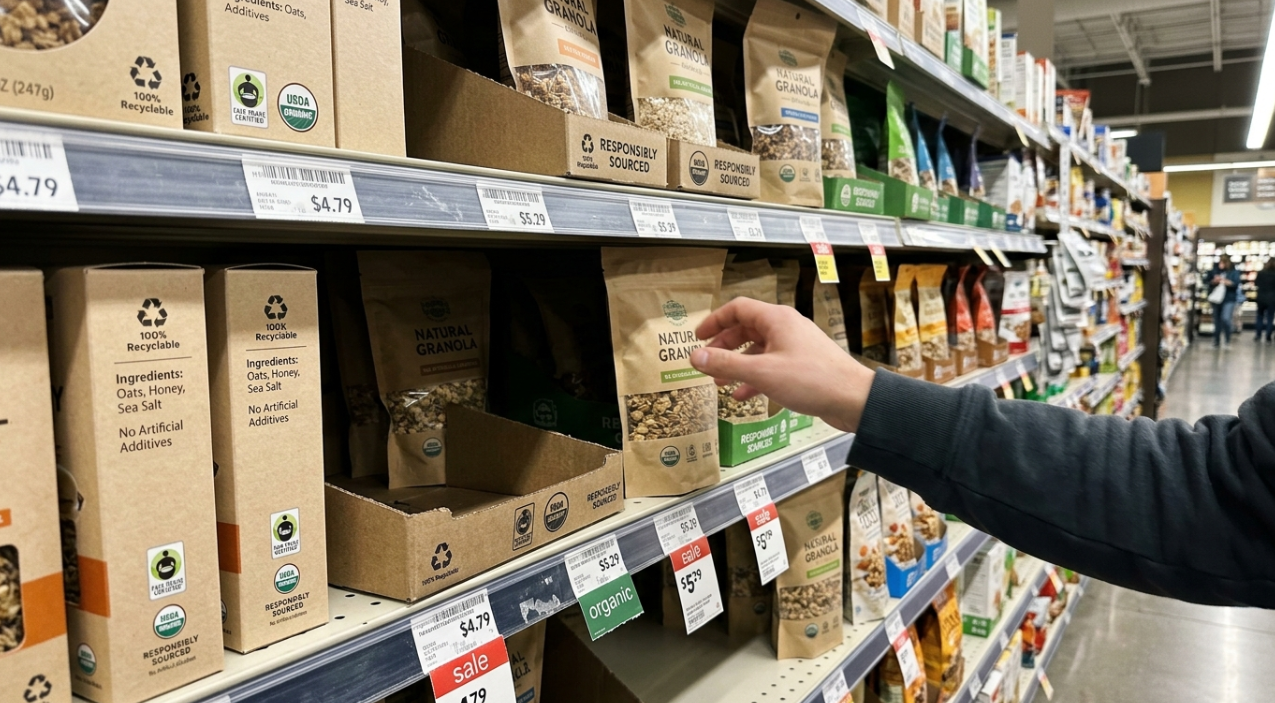
Paper-looking packaging can still be problematic. Kraft finishes often trick consumers into reading packaging as eco-friendly, even when the package is lined with plastic and not curbside recyclable. The appearance of sustainability is not the same as the function of sustainability.
Where Each Message Belongs: The 3-Tier Hierarchy
To balance limited physical package space with regulatory requirements, organize your packaging claims across three distinct touchpoints:
Tier 1: On-Pack Primary (Action First): Reserve prime packaging real estate exclusively for high-clarity disposal instructions and verified binary facts (e.g., How2Recycle labels or "Made with 100% Recycled Paperboard"). Keep it short and action-oriented.
Tier 2: On-Pack Secondary (The Digital Bridge): Use a QR code or short link accompanied by a clear prompt (e.g., "Scan to view local recycling guidance and material certifications").
Tier 3: Digital Layer (The Proof Engine): Use landing pages, ecommerce product pages, and web documentation to host third-party certifications, full Lifecycle Assessments (LCAs), B2B specifications, local facility lookup tools, and customer service FAQs.
Global Compliance Rules for Packaging Claims
Navigating sustainable packaging communications requires adhering to regional regulatory frameworks designed to curb deceptive claims:
US FTC Green Guides: Mandates clear qualifications on environmental claims. If curbside recycling is available to less than 60% of the target population, claims must be explicitly qualified (e.g., "Check locally" or "Recyclable only in select communities").
EU Green Claims Directive & PPWR: Enforces strict penalties for vague terms like "eco-friendly" or "green." All environmental claims require third-party verification and lifecycle assessments (LCA) before entering the EU market.
UK CMA Green Claims Code: Enforces six core principles ensuring claims do not omit key information, consider the full product lifecycle, and present fair side-by-side comparisons.
How to Approve a Packaging Claim Internally
Practitioners describe a recurring friction: technical teams have data on a mono-material pouch that cuts carbon emissions, while marketing wants phrases like "planet friendly" or "zero waste." A shared process fixes this:
Map every component. Primary package, closure, label, adhesive, sleeve, liner, insert, shipper, tape, void fill.
Assign each component an attribute. Material, recycled content, certification, coating, recyclability, compostability, reuse pathway.
Gather proof. Supplier specs, test results, certifications, recyclability assessments, facility access data, legal review.
Write the approved claim. Exact language and approved variations only.
Add qualifiers. Component, geography, facility access, action required, comparison baseline.
Test consumer comprehension. Ask target consumers what they think the claim means and what they would do with the package.
Train all teams. Customer service, sales, retail partners, and social media teams need to answer disposal questions consistently.
Measure behavior. Track QR scans, returns, refill participation, recycling questions, sentiment, and customer complaints.
Mistakes That Undermine Packaging Credibility
Leading with vague words. "Green," "eco-friendly," "earth-friendly," and "sustainable" are weak without proof. Regulations across the UK, EU, and US warn businesses about making broad general claims.
Hiding the qualifier. "Compostable" in big type and "commercially compostable only" in tiny text creates frustration and erodes trust.
Claim collision. Contradictory claims (such as a mailer claiming to be 50% bamboo, 50% recycled plastic, 100% degradable, and recyclable) create confusion and risk contaminating recycling streams. More claims are not better. Fewer, clearer claims build credibility.
Making the consumer do too much work. If correct disposal requires scanning a QR code, searching a database, separating components, finding a special facility, and driving to a store, the communication should not oversell the benefit.
Ignoring performance. Sustainable packaging that fails in transit or shortens shelf life creates product waste and customer disappointment. Performance is part of the sustainability story, and core product safety always comes first.
FAQ
What is sustainable packaging communications?
Sustainable packaging communications are the claims, labels, visuals, instructions, and stories a brand uses to explain the environmental attributes of its packaging and help consumers take the correct end-of-life action. The discipline covers everything from on-pack disposal labels to sustainability web pages, retail signage, social content, and sales materials.
What is the most important packaging sustainability claim to consumers?
Recyclability consistently ranks first across consumer packaging surveys. Clear labeling that states whether an item can be recycled locally drives the highest engagement and trust.
Does "recyclable" mean the package will be recycled?
No. Recyclability depends on collection access, sorting capability, processing infrastructure, and end markets. This is why major regulatory bodies require qualification when facilities are limited.
Does "compostable" mean I can put it in my home compost?
Not always. Most compostable packaging requires commercial or industrial facilities with controlled heat and moisture. Always check whether the label specifies "home compostable" or "commercially compostable only."
What is the biggest greenwashing risk in packaging?
Making a broad claim that skips the conditions. Saying "eco-friendly packaging" without specifying which component, what material, what proof, what geography, and what consumer action creates the most common type of regulatory exposure.
Should brands use QR codes for sustainability claims?
QR codes should support, not replace, clear on-pack claims. The package gives the essential disposal action (Tier 1). The QR landing page provides proof, local recycling guidance, and additional context (Tier 2 and Tier 3).
How do you measure whether packaging communications work?
Track consumer comprehension, correct disposal behavior, QR scans, refill or return participation, customer service questions about packaging, sentiment, retailer feedback, and actual recovery outcomes where data is available.
The best sustainable packaging communications do not ask consumers to decode sustainability. They make the next right action obvious, explain trade-offs honestly, and connect packaging choices to real systems, not just greener-looking materials.
Start a conversation with Grounded World about building packaging communications that consumers can trust and act on.