

 Gaia
TLDR
A CSR communications strategy is the plan a company uses to explain its social, environmental, and ethical responsibilities to stakeholders in a credible, evidence-backed way. It goes beyond campaign calendars and feel-good announcements. The best strategies sit between greenwashing (saying too much without proof) and greenhushing (saying nothing out of fear), using specific, proportionate, verifiable messages tailored to each audience. This guide covers what the strategy includes, how to build one, and how to avoid the most common mistakes.
Key Takeaway: A CSR communications strategy is a formal framework that translates a company's social, environmental, and ethical commitments into credible, evidence-backed messaging tailored for specific stakeholders. Positioned carefully between greenwashing (overstating claims without proof) and greenhushing (under-communicating out of fear), an effective strategy aligns sustainability data, legal boundaries, and marketing channels to build long-term brand trust.
What Is a CSR Communications Strategy?
A CSR communications strategy is a structured plan for communicating a company's corporate social responsibility commitments, activities, and measurable impact to stakeholders. It defines the key messages, target audiences, supporting evidence, communication channels, approval processes, and performance indicators used to communicate social, environmental, and ethical initiatives credibly. An effective strategy aligns communication with actual business practices, avoids unsupported claims, and gives stakeholders clear information about progress, limitations, and next steps.
The European Commission defines CSR as businesses taking responsibility for their behavior and its impact on society, including integrating social, environmental, ethical, human rights, and consumer concerns into operations in collaboration with stakeholders. A CSR communication strategy bridges that internal work and external perception. It covers everything from annual impact reports and employee newsletters to retail packaging claims, investor narratives, and social media content.
Here is a practical example. A company that funds local food access programs has a CSR initiative. Its CSR communications strategy decides whether that story belongs in an annual impact report, employee newsletter, local media pitch, packaging QR code, or executive speech. It also determines what data or community voices are needed before anything gets published.
Explore brand purpose activation
Core Elements of a Modern CSR Framework
Materiality Assessment
Purpose: Identifies which social and environmental topics actually impact the business and its stakeholders.
Key Owners: Leadership, Sustainability Teams, Supply Chain
Primary Output: Materiality Matrix & Priority Focus Areas
Claim Substantiation
Purpose: Validates every external claim with verified data, methodology, and legal clearance.
Key Owners: Legal, Compliance, Data Owners
Primary Output: Substantiation Files & Claim Boundaries
Audience Segmentation
Purpose: Tailors tone, detail level, and proof to specific stakeholder expectations.
Key Owners: Marketing, PR, Corporate Comms
Primary Output: Message Architecture Matrices
Channel Mapping
Purpose: Matches the level of detail to the appropriate channel (e.g., brief claims for retail, deep data for reports).
Key Owners: Channel Leads, Marketing, Internal Comms
Primary Output: Multi-Channel Distribution Plan
Why CSR Communications Strategy Matters
Five forces make a well-built corporate social responsibility communications strategy more important than ever.
Stakeholders expect proof, not slogans
PwC’s 2024 Voice of the Consumer Survey found that consumers across 31 countries were willing to spend an average of 9.7% more for sustainably produced goods, and 70% sought reviews to validate a company before purchase. Willingness alone does not guarantee spending (price, quality, and trust still matter), but it means credible communication can influence preference when the fundamentals are right.
Credible claims correlate with growth
McKinsey and NielsenIQ studied US consumer packaged goods and found that products making ESG-related claims averaged 28% cumulative growth over five years, compared with 20% for products without such claims. The researchers caution this shows correlation, not causation, and that greenwashing erodes the trust behind those results. The takeaway is not “CSR communication increases revenue.” It is that responsible claims can support commercial outcomes when backed by material action and clear proof.
Silence is not a neutral strategy
Edelman’s 2024 Brand and Politics report found that when brands do not communicate their actions on societal issues, 51% of respondents believe the brand is doing nothing or hiding something. Fear of criticism can lead companies into greenhushing, under-communicating genuine progress. That creates its own trust problem.
Regulation is tightening
The FTC's Green Guides mandate that environmental claims must be supported by competent and reliable scientific evidence, prohibiting broad, unqualified assertions like "green" or "eco-friendly." In the EU, regulations such as the Directive on Empowering Consumers for the Green Transition (ECGT) and the Green Claims Directive ban unsubstantiated environmental claims and generic eco-labels without recognized certification. Meanwhile, the UK’s ASA/CAP guidance strictly enforces evidence-based advertising. For global brands, a CSR messaging strategy must incorporate region-specific regulatory and legal reviews for every claim.
For global brands, this means a CSR messaging strategy must include legal and regulatory review for claims by market.
CSR communication reduces uncertainty
At its best, CSR communication is valuable because it reduces uncertainty for stakeholders. If it adds ambiguity, exaggeration, or virtue-signaling instead, it damages trust. The strategy exists to ensure the former happens, not the latter.
Concept | Primary purpose | Main audience | Typical outputs |
|---|---|---|---|
CSR strategy | Define responsible business priorities and actions | Leadership, employees, stakeholders | CSR commitments, programs, investments |
CSR communications strategy | Explain CSR actions and progress credibly | All relevant stakeholders | Messaging framework, proof points, channel plan |
CSR marketing | Connect CSR initiatives with customer engagement and brand positioning | Customers, shoppers, communities | Campaigns, social content, retail activations |
ESG communications | Explain environmental, social, and governance performance | Investors, regulators, analysts, enterprise buyers | ESG disclosures, investor materials, performance updates |
Sustainability communications | Explain sustainability commitments, progress, and challenges | Customers, employees, partners, regulators | Sustainability reports, climate updates, product claims |
Impact reporting | Document outcomes against defined objectives | Funders, investors, partners, communities | Impact reports, dashboards, methodology notes |
EHL’s research on CSR communication notes that investors may require ESG metrics and financial impact data, while consumers respond more to visible social or environmental initiatives. The same CSR action needs different proof for different audiences. That is exactly why a communications strategy is not just a marketing plan. It is broader, covering internal comms, stakeholder engagement, reporting, PR, investor narratives, retail claims, and crisis response.
For those exploring how to build ESG narratives specifically, this ESG storytelling proof framework covers the investor and disclosure side in more detail.
What Should a CSR Communications Strategy Include?
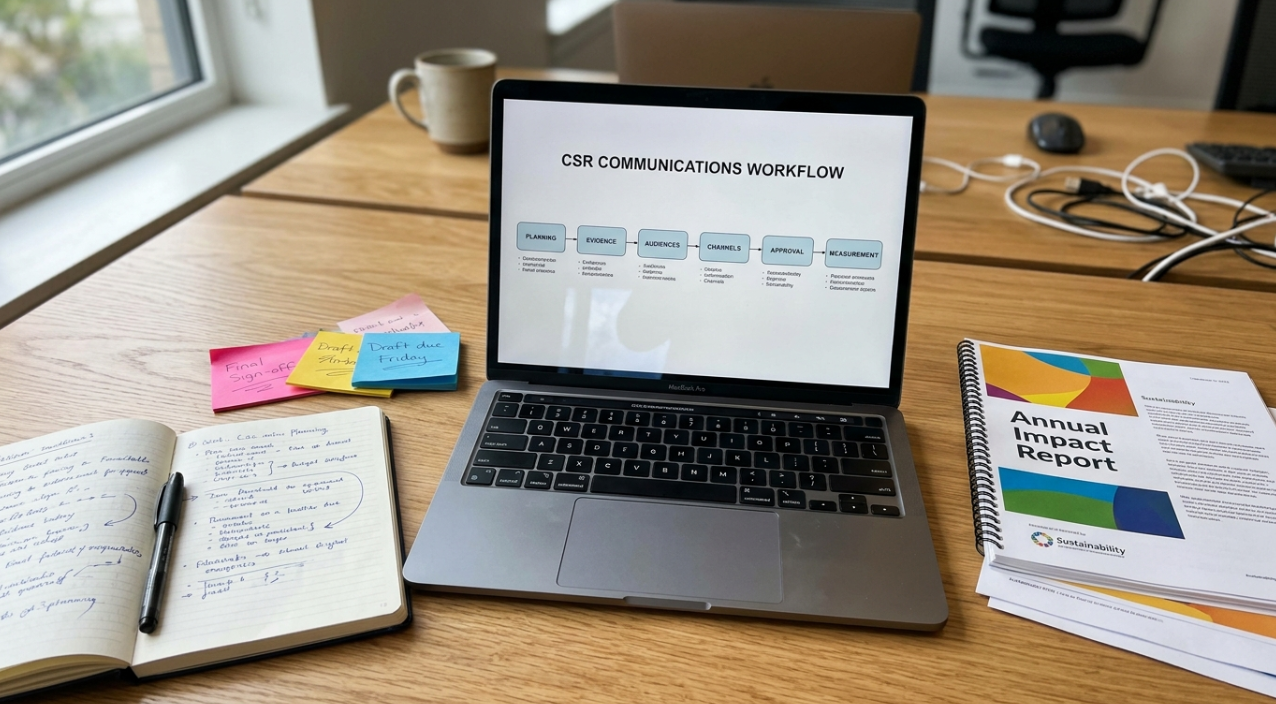
A complete CSR communication strategy has ten components. Most organizations cover only two or three and wonder why their messaging feels inconsistent.
1. Business and CSR context. What CSR topics are material to the company’s actual impacts, operations, products, workforce, supply chain, and communities? Start here, not with what sounds good.
2. Stakeholder map. Segment audiences: consumers, employees, investors, media, regulators, communities, NGOs, suppliers, retail partners, nonprofit partners, and internal leadership.
3. Audience insight. What does each stakeholder care about? What do they already believe? What skepticism or confusion exists?
4. Message architecture. Core narrative, proof points, supporting facts, approved claims, language to avoid, and issue-specific messages.
5. Claim substantiation system. Evidence files, data owners, methodologies, third-party certifications, legal review, and claim boundaries. This is the component most strategies skip, and the one that prevents legal and reputational problems. A dedicated sustainability claims strategy can help teams build this properly.
6. Channel strategy. Sustainability report, website, blog, social, PR, email, employee comms, sales decks, retail and point-of-sale, packaging, events, partner communications, stakeholder meetings.
7. Content formats. Reports, explainers, FAQs, dashboards, short videos, infographics, case studies, employee stories, community partner stories, customer participation content.
8. Governance and approvals. Who signs off? What requires legal review? What claims need third-party evidence? Who responds to public questions?
9. Listening and engagement. Comments, community feedback, employee input, partner feedback, media questions, customer service patterns, social monitoring.
10. Measurement and learning. Track trust, comprehension, engagement quality, sentiment, stakeholder feedback, earned media quality, and behavior change indicators.
For a template-level walkthrough of how to structure a sustainability communications plan, that guide is a practical next step.
How to Build a CSR Communications Strategy in 7 Steps
Building a CSR communications strategy starts with understanding the company's actual social and environmental impacts, then translating verified information into messages that stakeholders can understand and evaluate. The process should connect business priorities, evidence, audience needs, governance, and measurement.
Step 1: Audit Existing CSR Activities and Communications
Review current CSR initiatives, sustainability disclosures, internal communications, marketing campaigns, and public claims. Identify what the company is doing, what it can prove, where information is incomplete, and whether different departments communicate consistently.
Record existing commitments, baseline data, reporting periods, third-party certifications, and unresolved issues. This audit establishes what the organization can responsibly communicate today.
Output: A CSR communications audit with documented strengths, gaps, and risks.
Step 2: Identify Material Topics and Stakeholder Priorities
Prioritize topics based on the company's actual impacts, business context, stakeholder concerns, and applicable reporting requirements. Relevant issues may include labor practices, responsible sourcing, emissions, waste, community investment, accessibility, or ethical governance.
Consult relevant stakeholders instead of assuming that the company's preferred CSR topics are the ones audiences care about most.
Output: A prioritized list of CSR topics, supported by a rationale and stakeholder input.
Step 3: Define Objectives and Baselines
Set specific objectives for what communication should achieve. Objectives might include improving employee understanding, increasing awareness of a verified program, making sustainability disclosures easier to find, or improving stakeholder comprehension of progress against a commitment.
Record the baseline, target, measurement method, responsible owner, and deadline for each objective.
Output: A set of measurable communication objectives linked to business and stakeholder needs.
Step 4: Develop Messages and Gather Evidence
Create a central message architecture containing the main narrative, supporting messages, verified metrics, approved terminology, relevant caveats, and prohibited or unsubstantiated claims.
Every material claim should have an evidence owner and a documented basis. Clearly distinguish completed results from future targets, estimates, pilot programs, and commitments.
Output: A messaging framework and claim-substantiation register.
Step 5: Match Messages to Stakeholders and Channels
Decide what each audience needs to know, what evidence will help them evaluate the message, and which channel is appropriate.
For example, a public impact report may explain methodology and year-over-year progress, while an employee briefing may focus on participation, responsibilities, and practical next steps.
Output: A stakeholder messaging matrix and channel distribution plan.
Step 6: Establish Governance and Launch Communications
Assign responsibilities for content creation, data verification, legal review, approval, publication, and responses to questions. Establish a review process for new claims and a procedure for correcting inaccurate or outdated information.
Coordinate internal and external communications, particularly when employees, suppliers, community partners, or customers are directly affected.
Output: An approval workflow, content calendar, and escalation process.
Step 7: Measure Results and Improve
Measure whether stakeholders received, understood, and trusted the communications. Review the quality of engagement, feedback, media coverage, employee understanding, and relevant behavior or business outcomes.
Compare results with the original baselines. Update messaging when evidence changes, commitments evolve, or stakeholders identify gaps.
Output: A performance report and a prioritized improvement plan.
The process is cyclical rather than one-time. CSR communications should evolve as the company's operations, evidence, stakeholder expectations, and commitments change.
Who Owns CSR Communications?
No single team can own it alone. Credible CSR communications need input from multiple functions.
The CSR or sustainability lead owns substance, programs, progress, and impact data. Marketing and brand translate messages into audience-friendly narratives. PR and corporate comms handle media, reputation, and issues response. Legal and compliance review claims and market-specific restrictions. Finance and investor relations align with ESG disclosures. HR and internal comms connect CSR to employee engagement. Product, operations, and supply chain validate sourcing, packaging, labor, waste, and emissions claims.
Leadership sets permissions, values, and accountability.
Practitioners on LinkedIn consistently flag this cross-functional gap. Harsha Harjani James argued that communications often lag behind sustainability and finance teams: executives, reports, social media, and internal messages can end up telling different stories. Susan Doherty made a similar point, noting that PR teams need sustainability training so they understand concepts like Scope 1, Scope 3, net zero, and science-based targets rather than simply copying technical language into releases and pitches.
The recurring theme from practitioners is straightforward: CSR communication is a cross-functional translation problem. Teams need a shared language before the company talks externally.
CSR Communications Strategy Template: Stakeholder Messaging Matrix
A stakeholder messaging matrix helps organizations maintain consistent facts while adapting the level of detail and framing to each audience. The underlying claim should remain accurate across every channel, even when the presentation changes.
CSR topic | Target audience | Core message | Supporting evidence | Recommended channel | Success measure |
|---|---|---|---|---|---|
Emissions reduction | Investors, employees, customers | Explain verified emissions progress against a defined baseline | Emissions inventory, methodology, reporting period | Sustainability report, website, investor materials | Stakeholder understanding and report engagement |
Responsible sourcing | Retailers, customers, suppliers | Explain sourcing standards and the scope of supplier coverage | Supplier records, audit findings, sourcing policy | Product pages, supplier briefings, FAQs | Comprehension and qualified partner inquiries |
Community investment | Local communities, nonprofit partners, employees | Explain who benefited and what changed | Program records, partner feedback, outcome measures | Community updates, impact report, local events | Participation and stakeholder feedback |
Employee wellbeing | Employees, job candidates | Explain available programs and progress against defined objectives | Program participation, employee feedback, relevant workforce metrics | Intranet, employee briefings, careers pages | Awareness and program participation |
Waste reduction | Customers, employees, business partners | Explain what waste was reduced, where, and over what period | Waste records, baseline, calculation methodology | Website, operational updates, impact report | Understanding and verified waste reduction |
How to use this template: Replace the example topics with the company's actual priorities. Add an evidence owner, approval status, publication date, and review date to the internal version. Do not publish targets or results until the relevant data and claim wording have been reviewed.
The matrix should function as a shared reference for sustainability, communications, legal, marketing, operations, and leadership teams. It helps prevent different departments from describing the same initiative in inconsistent ways.
The CSR Proof Ladder: How to Make Claims Credible
Most CSR messages fail because they are too vague or too ambitious. A claim becomes more credible as it climbs this ladder:
Action. What did the company actually do?
Materiality. Why does it matter to this business and its stakeholders?
Metric. What changed, by how much, over what time period?
Boundary. What is included and excluded?
Method. How was the data calculated?
Verification. Who, if anyone, reviewed, certified, audited, or validated it?
Human relevance. Who benefits, and how?
Next step. What remains unfinished, and what happens next?
Here is the difference in practice:
Weak claim: “We are committed to sustainability.”
Stronger claim: “In 2025, we reduced water use in our denim finishing process by 18% compared with our 2023 baseline across our owned facilities. This does not yet include Tier 2 suppliers, which we are mapping next.”
The second version is specific, measurable, bounded, and honest about what is not included. It can withstand scrutiny from a journalist, regulator, or skeptical customer.
Academic research supports this approach. A recent study on CSR skepticism found that vague, subjective, or ambiguous claims increase skepticism, while objective, concrete, verifiable claims, restrained tone, two-sided messages, and third-party information reduce it.
See how brand activation brings purpose to life
The Claim Credibility Checklist
Before publishing any CSR claim, run through these questions:
Is the claim true?
Is it specific?
Is it material to the business?
Is it proportionate to the scale of action?
Does it imply more than we can prove?
Do we have data or documentation behind it?
Are the boundaries clear?
Has the right internal owner reviewed it?
Would a skeptical journalist, customer, or regulator understand it the same way we intend?
Have we explained what remains unfinished?
Practitioners on Reddit reinforce this. In a thread on cleantech PR and greenwashing accusations in r/PublicRelations, the original poster said clients with solid climate science still hesitate to use “sustainable” because it triggers backlash. Their team’s approach: lead with data, name limitations upfront, and bring in third-party voices such as certifications, scientists, or partners. Commenters emphasized materiality, specific messages for specific audiences, and impact over activity.
Greenwashing, Greenhushing, and Credible CSR Communication
The fear of greenwashing leads many companies to one of two extremes. Neither works.
Approach | Typical behavior | Main risk or benefit | Better practice |
|---|---|---|---|
Greenwashing | Making exaggerated, misleading, or insufficiently supported claims | Legal exposure, reputational damage, reduced trust | Substantiate claims and explain their limits |
Greenhushing | Avoiding communication about legitimate CSR progress out of fear of criticism | Lower transparency and missed opportunities for stakeholder engagement | Communicate verified progress with appropriate context |
Credible CSR communication | Sharing specific, proportionate claims supported by evidence | Better understanding, accountability, and informed stakeholder decisions | Publish clear results, boundaries, limitations, and next steps |
The FTC’s Green Guides are direct about this: marketers should not make broad, unqualified claims because such claims are difficult or impossible to substantiate. Claims should be clear, prominent, specific, and should not highlight small or unimportant benefits as if they represent the whole picture.
But silence is not the answer either. Edelman’s data showing 51% of people assume a silent brand is doing nothing or hiding something makes the cost of greenhushing concrete.
The goal is not to speak louder. The goal is to speak with enough evidence that the right stakeholders can believe, question, share, or act on the message. A LinkedIn post from PRecious Communications captured this well, framing Earth Day as a reputational stress test and arguing for “data over declarations” and acknowledging gaps openly.
One user in a sustainability subreddit put it even more bluntly: if a brand needs a PR campaign but does not provide actual information, it feels like greenwashing. A CSR story without useful information is brand theater.
For a full breakdown of how to avoid greenwashing in practice, that guide walks through regulatory expectations and messaging safeguards.
How to Tailor CSR Communication by Stakeholder
The same CSR initiative needs different proof for different audiences. Treating CSR communication as one-size-fits-all is a common and expensive mistake.
Practitioners on Reddit in r/marketing echoed this. In a discussion about whether customers care about sustainability data from small companies, users said the answer depends heavily on the audience, product category, and point of purchase. One user explicitly said there is mistrust if the data is not from a trusted third party. The lesson: do not assume CSR communication should be equally prominent everywhere. Decide where it helps the stakeholder make a decision.
CSR Communication Channels
A CSR communications strategy should map each message to the channel best suited for it.
Stakeholder | What they need | Example of stronger messaging |
|---|---|---|
Consumers | Clear, relevant, substantiated information | "This packaging contains 30% post-consumer recycled plastic by weight." |
Employees | Internal progress, accountability, participation opportunities | "Employees contributed 1,200 volunteer hours in 2025 across our community programs." |
Investors | Material risks, governance, targets, measurable progress | "We track operational emissions against a 2022 baseline and report progress annually." |
Communities | Local outcomes, transparency, opportunities for feedback | "The program supported 150 students in 2025. Here is how results were measured." |
Media | Verifiable facts, context, credible spokespeople | "Our published impact report includes the methodology, results, and program limitations." |
Retailers and B2B buyers | Relevant product, sourcing, and supply-chain evidence | "The recycled-content claim applies to this specific product line and is supported by supplier documentation." |
Regulators | Accurate claims, documentation, defined scope | "This environmental claim applies to the specified product range and has supporting evidence on file." |
Sustainability or impact reports work best for depth, data, methodology, and long-form accountability. Standards like the GRI Standards provide structure for reporting on material topics across economy, environment, and people.
Website hubs serve as evergreen proof and search-visible reference points. This is where stakeholders go to verify what they heard elsewhere.
Social media works for participation, updates, and dialogue, but avoid making social carry claims that require detailed context. EHL’s research found fewer than 5% of social posts from studied service companies referenced CSR topics, with executives citing fear of backlash and lack of strategy as reasons.
PR and earned media should be reserved for genuine news, measurable progress, or credible third-party partnerships. Not everything warrants a press release.
Internal communications should come before external communications when employees are affected or expected to participate. Green Story’s LinkedIn post captured this risk well: brands can have real impact, but messaging can still trigger credibility loss if sustainability and marketing teams are not aligned internally.
Retail, packaging, and point-of-sale should only carry claims that can be quickly understood and legally substantiated. For practical approaches to retail activation, that guide covers shopper-facing execution.
Other channels include email and CRM, investor relations materials, sales enablement decks, community meetings, events, partner co-created content, and customer support FAQs.
How to Measure a CSR Communications Strategy
Vanity metrics (impressions, likes, shares) tell you almost nothing about whether stakeholders understood or trusted the message. Measurement should cover six categories.
Reach and visibility. Organic search visibility, earned media quality, report downloads, page engagement. These confirm the message reached people, but not whether it worked.
Understanding. Message recall, stakeholder comprehension, FAQ reduction, sales team confidence in using CSR messages. If your sales team cannot explain the company’s CSR commitments accurately, the strategy has a gap.
Trust and credibility. Sentiment analysis, trust survey scores, media tone, third-party validation, stakeholder feedback.
Engagement quality. Quality of comments and questions, partner inquiries, employee participation rates, community attendance, investor follow-ups.
Business and behavior outcomes. Purchase consideration, retailer sell-in, employee retention, partnership conversion, adoption of sustainable products or practices. For brands trying to move audiences from awareness to action, a behavior change framework can structure this measurement more rigorously.
Risk reduction. Claims approved versus rejected, corrections avoided, complaint volume, regulatory flags, crisis response readiness. This is the least glamorous category and often the most valuable.
Examples of Weak vs. Strong CSR Communication
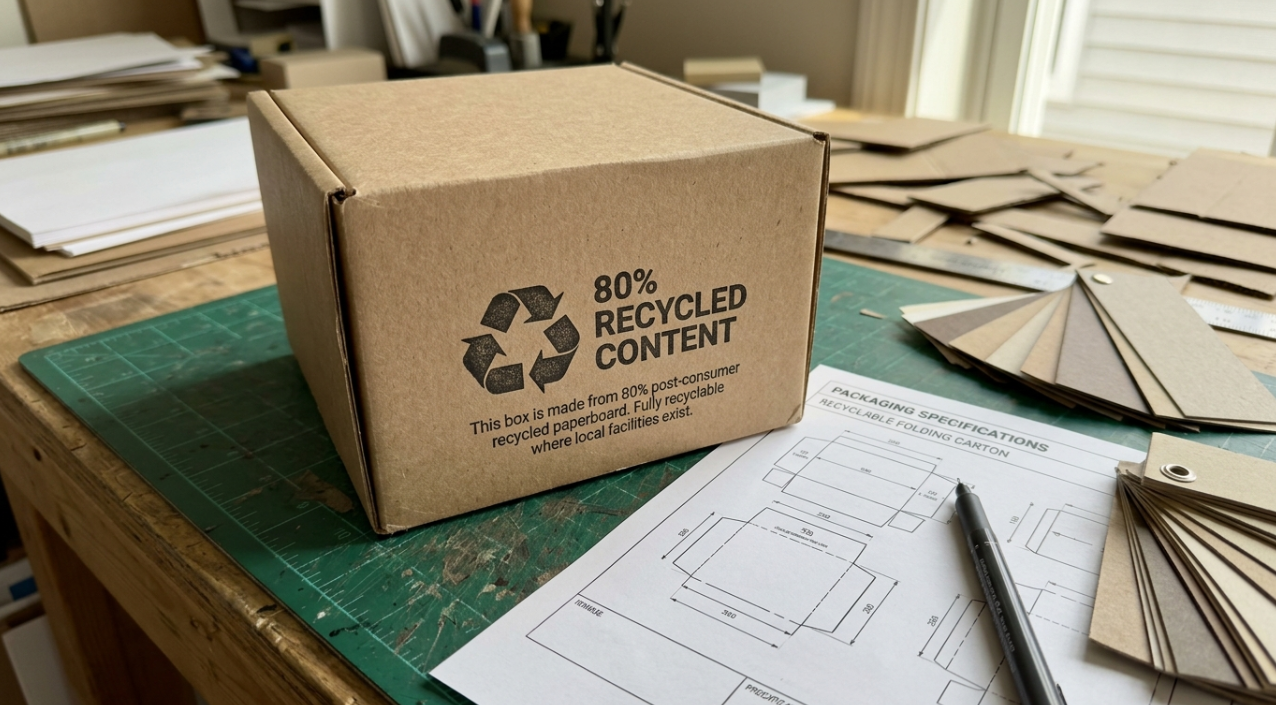
Packaging claim
Weak: “Eco-friendly packaging.”
Better: “This pack uses 30% post-consumer recycled plastic and is recyclable where #2 HDPE collection exists.”
The FTC warns specifically against broad environmental benefit claims and notes that recyclable claims may need qualification depending on facility availability.
Community impact
Weak: “We support local communities.”
Better: “In 2025, our partnership with X community organization funded 2,000 hours of after-school programming for 150 students in Detroit.”
Employee CSR
Weak: “Our people are our purpose.”
Better: “We increased paid volunteer hours from 8 to 16 per employee per year and matched employee donations up to $500, with participation across 62% of teams.”
Climate commitment
Weak: “We are on the road to net zero.”
Better: “We have set a 2030 Scope 1 and 2 emissions reduction target, measured against a 2022 baseline. Scope 3 supplier data is still incomplete, and we are prioritizing the top 20 supplier categories next.”
Social impact campaign
Weak: “Buy this product and help change the world.”
Better: “For every purchase through June 30, $2 goes to [partner], capped at $50,000, to fund school meal programs in three districts. See campaign terms and impact update here.”
For more examples of credible CSR campaigns in action, that collection covers what worked and what did not.
Common CSR Communications Mistakes
Communicating before the work is real. If the initiative is small, early, or experimental, say so. Do not turn a pilot into a heroic transformation story.
Using broad, generic language. Words like “green,” “eco-friendly,” “ethical,” and “sustainable” need context, evidence, and boundaries. Without them, they are marketing noise.
Highlighting tiny wins while ignoring material impacts. A brand with major supply-chain emissions should not lead with office recycling unless office waste is genuinely material to their footprint.
Treating CSR as a seasonal campaign. Earth Day, Pride, and Giving Tuesday can create visibility, but CSR credibility is built through year-round action and reporting.
Forgetting internal audiences. Employees can become credible ambassadors or sharp critics. Internal alignment should happen before external amplification.
Over-polishing the story. Stakeholders often trust specific imperfections more than flawless corporate language. Acknowledging trade-offs builds more credibility than pretending they do not exist.
Separating reports, ads, social, and executive statements. Inconsistent messages across annual reports, social campaigns, sales decks, and CEO speeches create credibility gaps fast.
Greenhushing. Fear of criticism is understandable, but saying nothing means someone else defines the narrative.
How to Optimize CSR Communications for AI Search and LLM Visibility
As search engines shift toward AI overviews and answer engines powered by Large Language Models (LLMs), traditional keyword placement alone is no longer enough. AI engines prioritize content that offers structured, verifiable, and authoritative information.
To ensure your CSR strategy and sustainability content gain maximum visibility in AI-generated answers, follow these core principles:
Provide Clear, Declarative Definitions: AI models frequently extract definitions that start with direct, clear phrasing (e.g., "CSR communication strategy is...").
Use Structured Frameworks: Utilize formatted lists, bullet points, and comparative tables. LLMs favor structured formats when synthesizing data for users.
Lead with Verifiable Metrics: Rather than using vague descriptions, include concrete numbers, baseline years, and standardized reporting frameworks (such as GRI, CSRD, or ISSB). Factual precision builds semantic trust.
Maintain Cross-Channel Consistency: AI models cross-reference information across reports, press releases, and web pages. Consistent messaging across all touchpoints reduces entity confusion and improves brand accuracy in AI summaries.
FAQs
What is the goal of a CSR communications strategy?
The goal is to help stakeholders understand a company’s social and environmental responsibilities, actions, progress, and impact in a credible way. It should build trust, reduce confusion, support engagement, and prevent overclaiming.
Who should own CSR communications?
No single team can own it alone. CSR communications typically needs input from sustainability, marketing, PR, legal, HR, investor relations, operations, and leadership. The strategy should define who contributes what and who has final sign-off.
How is CSR communication different from ESG reporting?
CSR communication is broader and more audience-facing. ESG reporting is more structured, data-driven, and investor or compliance oriented. CSR communication may use ESG data but translates it into messages different stakeholders can understand and act on.
How can companies avoid greenwashing in CSR communications?
Use specific claims with clear boundaries, reliable data, third-party validation where relevant, and honest language about limitations. Avoid broad, unqualified claims like “green” or “eco-friendly” without clear substantiation. The FTC’s Green Guides provide detailed direction on what qualifies as a supportable environmental claim.
What is greenhushing?
Greenhushing is under-communicating or avoiding communication about genuine sustainability or CSR progress, often because a company fears criticism or greenwashing accusations. It can reduce transparency and make stakeholders assume nothing is happening.
What makes CSR communication credible?
Credible CSR communication is material to the business, specific about what happened and for whom, backed by evidence, proportionate to the scale of action, consistent across channels, and honest about progress and gaps. It does not depend on borrowed virtue from a partner or cause alone.
Should CSR communications mention business benefits?
Yes, but carefully. A strong corporate social responsibility communications strategy can connect impact to brand trust, employee engagement, investor confidence, and long-term business resilience. It should not pretend that every CSR message directly causes sales.
What channels work best for CSR communications?
It depends on the audience. Common channels include sustainability reports, website hubs, social media, PR, internal communications, packaging, retail activation, investor materials, events, and partner content. The strategy should match each message to the channel where that audience is most likely to engage with it.
Moving From Strategy to Action
The best CSR communications strategy does not make a company sound responsible. It makes responsible action understandable. That means specific claims, credible proof, honest boundaries, and messages shaped for the people who actually need to hear them.
Most organizations have more CSR substance than they realize. The gap is rarely action. It is translation: turning what sustainability teams, operations, and community partners know into something stakeholders can believe and use.