
 Gaia
GaiaTL;DR
A commercial innovation consultancy helps organizations turn sustainability investments, purpose platforms, and product ideas into measurable demand, revenue, and market adoption. The best fit depends on whether you need consumer activation, scientific substantiation, enterprise transformation, or reporting. This guide compares 10 consultancies across those dimensions, gives you a practical framework for choosing, and includes honest pricing context since almost no firm publishes rates.
What is a Commercial Innovation Consultancy?
A commercial innovation consultancy is a strategic firm that bridges the gap between product development and market adoption. Unlike traditional R&D, these firms focus on consumer behavior change, commercial sizing, and retail activation to ensure sustainable or purpose-led initiatives generate measurable revenue and market share growth.
The Business Case: Sustainability as a Growth Engine (2026 Data)
Metric | Sustainable-Marketed Products | Conventional Products | Source |
Market Share (US CPG) | 25.4% | 74.6% | NYU Stern (2025) |
5-Year CAGR | 10.9% | 2.2% | Circana/NYU (2025) |
Growth Multiple | 4.9x Faster | Baseline | Circana (2025) |
Price Premium | ~27% Average | N/A | NYU Stern (2024/25) |
Consumer Trust | 46% (High Friction) | 65% (Familiarity) | Capgemini (2026) |
Why Commercial Innovation Matters Right Now
Many companies have sustainability commitments. Fewer have turned them into revenue.
The market opportunity is real. The market opportunity is accelerating. According to the NYU Stern 2025 update (released April 2026), sustainability-marketed products now command 25.4% of the total market share. More importantly, these products are growing 4.9x faster than conventional alternatives, proving that "green" is no longer a niche, but the primary driver of CPG growth. Executive investment is rising too: Deloitte’s 2024 CxO survey found 85% of respondents increased sustainability spending over the prior year source.
The right commercial innovation consultancy closes that gap. The wrong one produces a strategy deck that collects dust. This guide is designed to help you tell the difference.
What Is a Commercial Innovation Consultancy?
A commercial innovation consultancy helps organizations turn ideas into market outcomes. In sustainability-led categories, that means validating consumer demand, developing credible claims, aligning internal teams, building the go-to-market plan, designing the brand and shopper experience, and measuring both business and impact results.
This goes well beyond product innovation. Commercial innovation consulting typically spans:
Consumer and shopper research
Commercial opportunity sizing
Brand strategy and positioning
Sustainability claims and storytelling
Concept testing and co-creation
Go-to-market planning
Retail and channel activation
Internal stakeholder alignment
Partnership development
Measurement, reporting, and optimization
The key distinction: product innovation creates something new. Commercial innovation makes sure the market actually adopts it.
For a deeper look at how purpose translates into real business performance, see this guide on how purpose-driven narratives build commercial value.
Navigating 2026 Compliance: Why Innovation Needs Evidence
In 2026, "Commercial Innovation" is no longer just about marketing; it is about de-risking. Consultancies must now navigate a "Zero Tolerance" regulatory environment:
EU Green Claims Directive: Strict bans on "carbon neutral" claims based solely on offsetting.
California SB 343: Drastic restrictions on "recyclable" labeling logic (effective late 2026).
UK CMA Green Claims Code: Requires full life-cycle substantiation before any public commercial activation.
How to Choose the Right Commercial Innovation Consultancy
Not all consultancies solve the same problem. Before reviewing the list, consider this framework.
The 6C Commercial Innovation Fit Test
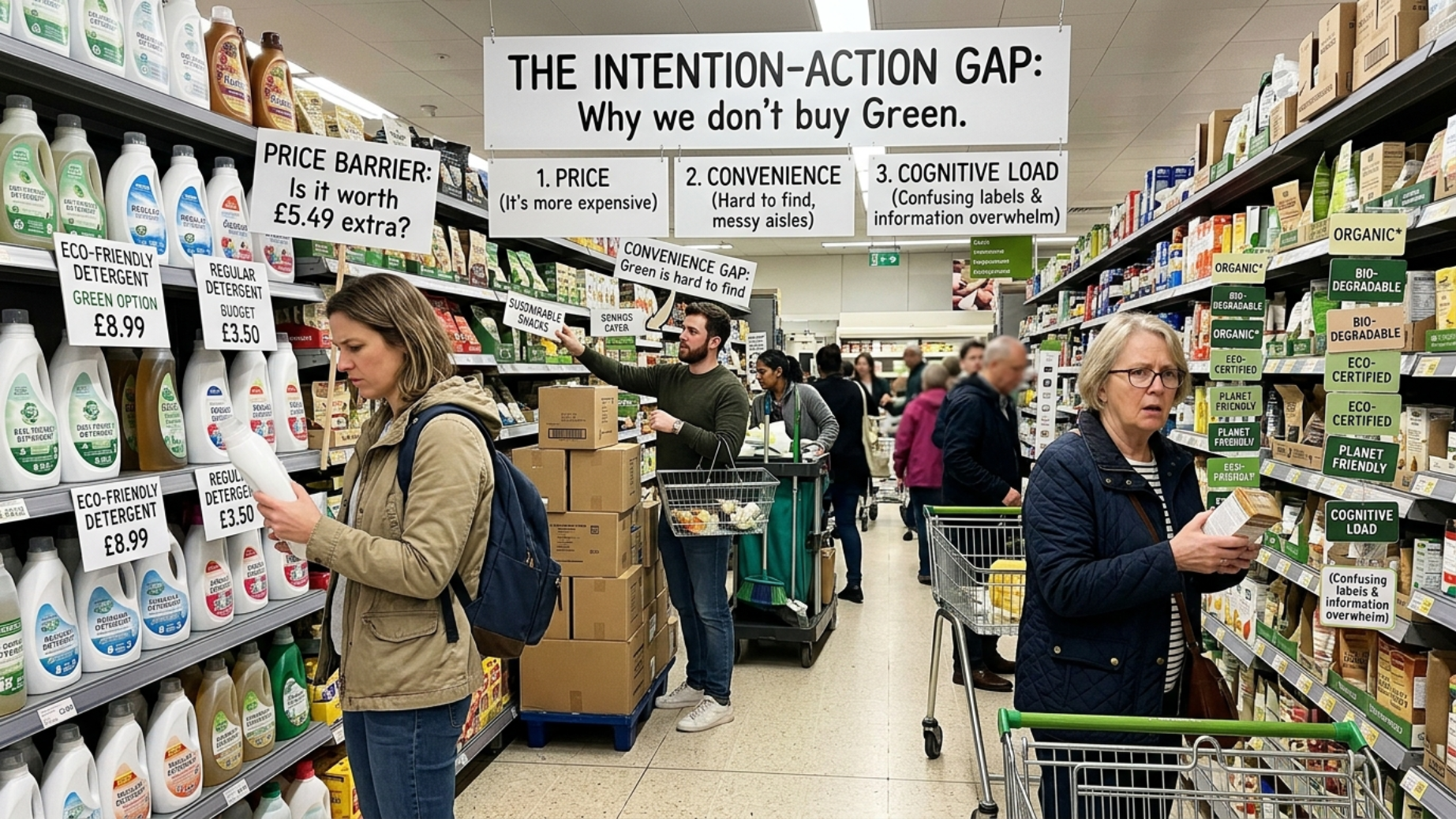
1. Consumer. Can they uncover behavior drivers and the intention-action gap? The World Economic Forum frames this gap as a predictable result of price signals, convenience, cognitive load, social norms, and perceived risk, not simply consumer hypocrisy source. Your consultancy should understand why people say one thing and do another.
2. Credibility. Can they substantiate claims and navigate the "Trust Gap"? A 2026 Capgemini report reveals that consumer trust has dipped significantly, with only 37% of shoppers fully trusting "eco-friendly" labels that lack verifiable evidence. To win in this environment, your consultancy must help you implement Digital Product Passports (DPP) using QR codes to provide immediate, transparent traceability from source to shelf.
3. Commercial model. Can they connect the work to pricing, revenue, category growth, and retail outcomes?
4. Creative activation. Can they make the idea visible, desirable, and easy to act on? Evidence shows retail design alone can shift behavior: a UK study found that placing plant-based options in the meat aisle increased sales by 23% source.
5. Collaboration. Can they align sustainability, marketing, innovation, sales, operations, legal, and leadership? Deloitte found that companies with established cross-functional ESG working groups were far more likely to make significant sustainability progress (38% versus 10%) source. If a consultancy only talks to the sustainability team, the work will stall. For more on cross-functional alignment, see this breakdown of stakeholder engagement strategy.
6. Continuity. Can they measure, report, optimize, and scale after launch? A strategy without activation is expensive shelf art.
Four Types of Commercial Innovation Consultancy
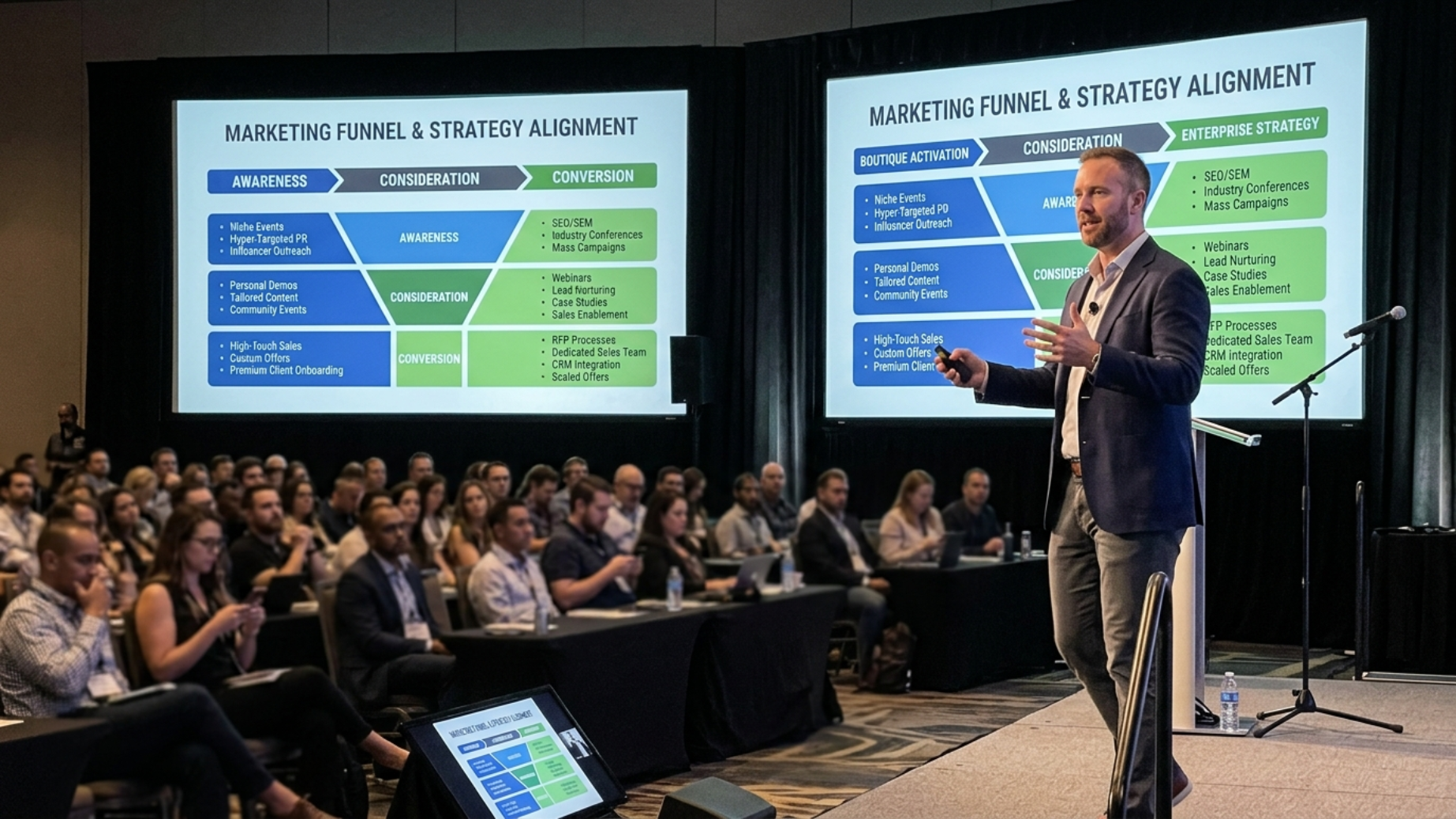
Before comparing firms, understand which type fits your problem.
Consultancy Type | Best For | Typical Weakness |
|---|---|---|
Commercial innovation and activation boutiques | Turning purpose/sustainability into demand, campaigns, retail activation, and internal alignment | Less suited to massive enterprise transformation |
Science-based sustainability consultancies | LCA, carbon, product footprinting, technical substantiation | May not handle consumer activation or brand storytelling deeply |
Enterprise strategy firms | Board-level transformation, operating model, M&A, supply chain | Expensive, less tailored to smaller purpose-led brands |
Sustainability communications/reporting agencies | Reporting, disclosure, stakeholder comms, claims discipline | May not own product innovation or revenue activation |
This distinction matters because the current market blends all four without explaining the difference. A practitioner on r/consulting described working at a boutique sustainability consultancy focused heavily on carbon accounting and “reporting current state,” while wanting to do more sustainability solutions work. A commenter noted that firms miss a cross-selling opportunity if they don’t connect reporting to action source. That tension is exactly why you need to know what type of consultancy you’re hiring.
At-a-Glance Comparison Table
Consultancy | Best For | Core Strength | Pricing Transparency | Proof Signal | Main Tradeoff |
|---|---|---|---|---|---|
Grounded World | Commercializing sustainability into demand and growth | Behavior change, brand activation, sustainability storytelling, retail activation | Custom; complimentary AI-driven 5C assessment | B Corp, case studies, B Impact Score of 116 | Custom agency engagement, not self-serve software |
Futerra | Global sustainability storytelling and behavior change | Strategy + creative storytelling + training | Not public | 25+ years, global clients | More storytelling agency than full commercial system |
BBMG | Regenerative brand strategy and mission-driven brand building | Audience insight, purpose platforms, advocacy | Not public | Named testimonials from PBS, Macy’s, The North Face | Less technical on LCA, reporting, or enterprise transformation |
thinkPARALLAX | Sustainability reporting, claims, and credible communications | Double materiality, ESRS/IFRS alignment, claims development | Not public | Client logos include Alaska Airlines, Merck, Qualcomm | May not cover consumer behavior-change research or retail activation |
GLoVal | Facilitated sustainable innovation and team alignment | Four-step innovation process, consumer focus | Not public | Named testimonials from McCormick, Nutworks | Less visible global authority than major firms |
Quantis | Science-based sustainable product innovation | Environmental impact assessment, BCG partnership | Not public | Specialist positioning, sector expertise | Less focused on consumer activation |
BSR | Sustainable business strategy and cross-sector collaboration | Business transformation, responsible business, collaboration | Not public | Institutional network, member visibility | Stronger for corporate transformation than consumer brand activation |
BCG | Enterprise-scale sustainability and innovation transformation | Board-level strategy, green growth, innovation delivery | Not public; premium | G2 rating 4.4/5, global reputation | Expensive, may be overbuilt for smaller teams |
Bain | Sustainability tied to operations and commercial excellence | Circularity, supply chain, PE due diligence | Not public; premium | Enterprise reputation | Less specialized in purpose storytelling or shopper behavior |
Lucid_ | Strategic design, service innovation, circular business models | User research, service design, circular business design | Not public | Clear methodology, service detail | Less focused on sustainability marketing or claims strategy |
The 10 Best Commercial Innovation Consultancies
1. Grounded World
Best for: Purpose-led brands that need to turn sustainability or social impact into consumer demand, internal alignment, and revenue growth.
Grounded World is a B Corp-certified boutique marketing agency focused on commercializing sustainability. Its service model follows four phases (Discover, Articulate, Activate, Accelerate) and spans the full distance from research through retail activation.
Key capabilities:
AI-assisted 5C landscape assessments covering company, culture, category, competitor, and consumer dimensions
Intention-action gap research and quantification
Brand purpose, positioning, and sustainability storytelling
Claims and concept testing
Co-creation, design sprints, and agile innovation
Retail activation, commercial selling stories, and shopper journey design
Sustainability and social impact measurement and reporting
Cross-functional team alignment and collaboration training
Pricing: Not publicly listed. Engagements are custom-scoped. Grounded offers a complimentary AI-driven 5C landscape assessment and discovery call as a starting point.
Proof: B Corp certification, Ethical Agency Alliance member, 1% for the Planet, Science Based Targets, Top 100 Global Social Impact Company, reported B Impact Score of 116. Named case studies include Grove Collaborative, Fresh Air Fund, UNMAS, Plan USA, Network of Executive Women, WhistlePig, QIRA, and Totes social impact.
Why it stands out as a commercial innovation consultancy: Grounded World is the strongest fit when the problem isn’t “what is our sustainability strategy?” but “how do we turn it into consumer demand, internal buy-in, activation, and growth?” It bridges the gap between purpose and profit by diagnosing why consumers, retailers, or internal teams aren’t acting, then turning that insight into strategy, storytelling, activation, and measurable growth.
The Discover phase is a good entry point for teams that know something isn’t converting but can’t pinpoint why.
Tradeoffs:
Custom agency engagement, not plug-and-play software
Pricing requires an initial conversation
Not designed for pure technical LCA-only or carbon accounting-only work
Strongest in sustainability/purpose commercialization, not generalist performance marketing
2. Futerra
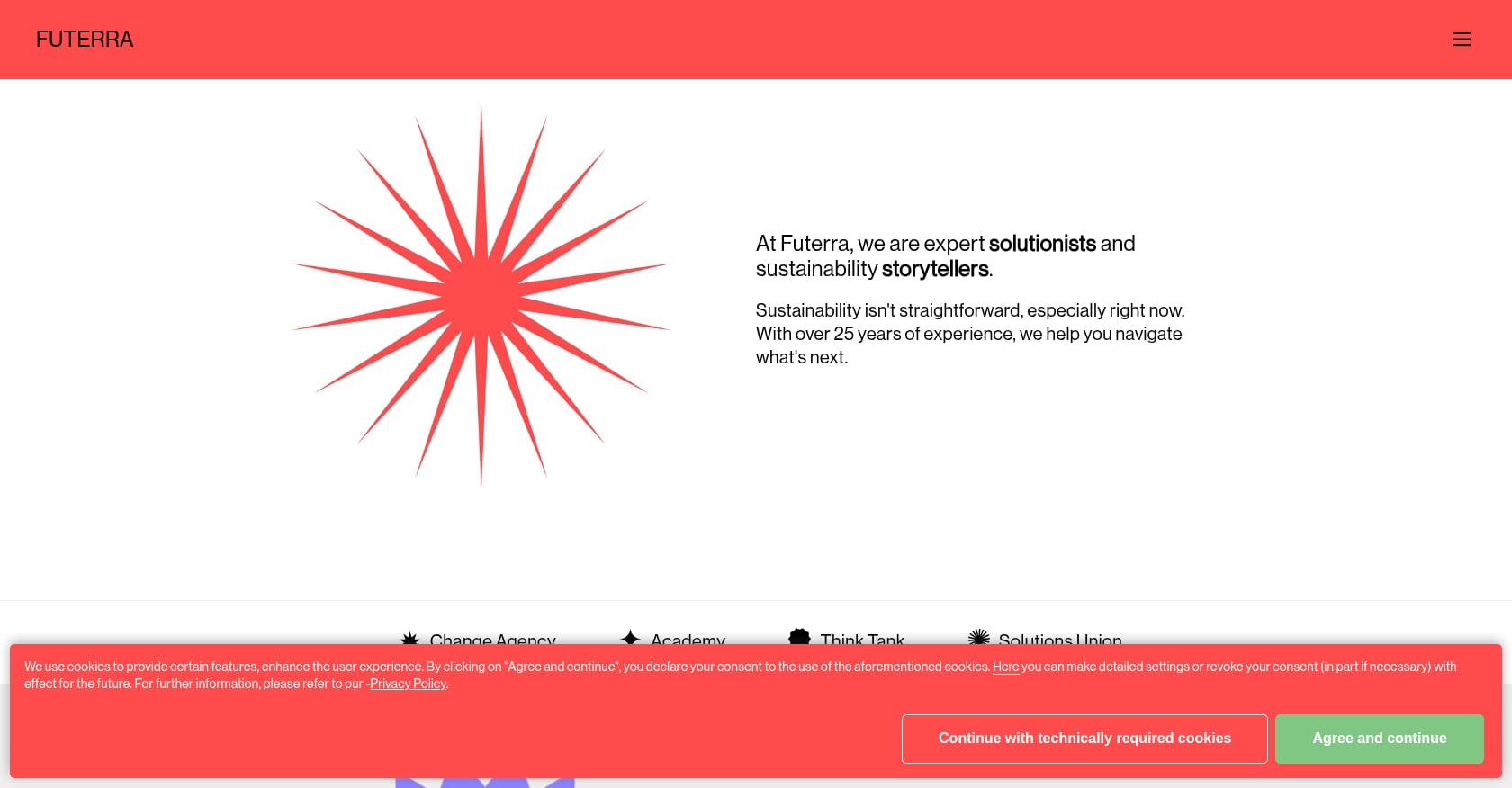
Best for: Global brands that need sustainability storytelling, thought leadership, and behavior-change communications.
Futerra calls itself a sustainability “Change Agency” with more than 25 years of experience. It combines strategy and storytelling and works with brands including IKEA, Google, British Airways, and Rainforest Alliance. Its Academy offers training on preventing greenwash, sustainable lifestyles, and behavior change.
Key capabilities:
Sustainability strategy and creative storytelling
Brand campaigns and communications
Training and internal capability building
Thought leadership and public engagement
Pricing: Not publicly listed. Likely custom-scoped based on project.
Proof: Long track record, visible global client roster, public thought leadership.
Tradeoffs:
Stronger as a storytelling and change agency than a hands-on retail activation or commercial innovation system
Likely better suited to larger brands with budget for bespoke agency work
Less visible focus on shopper journey design or commercial selling stories
3. BBMG
Best for: Mission-driven organizations that need brand strategy, audience insight, and purpose platform design.
BBMG works with mission-driven leaders on audience insights, brand strategy, naming, messaging, sustainability communications, and advocacy campaigns. Client testimonials come from PBS, Macy’s, The North Face, and Einhorn Collaborative.
Key capabilities:
Qualitative and quantitative research
Persona development and segmentation
Brand strategy, naming, and design
Purpose platform strategy
Sustainability and social impact communications
Advocacy campaigns
Pricing: Not publicly listed. Likely custom-scoped.
Proof: Named testimonials on the official site. The North Face testimonial describes breakthrough brand definition; PBS and Macy’s testimonials reference strategic turning points.
Tradeoffs:
Strong on brand and movement building
Less visibly technical on LCA, reporting compliance, or enterprise transformation
Less focused on retail conversion or shopper behavior specifics
4. thinkPARALLAX
Best for: Organizations that need sustainability reporting, credible claims development, and stakeholder-facing communications.
thinkPARALLAX is a sustainability strategy and communications agency offering double materiality assessments, carbon footprint analysis, ESRS and IFRS alignment, sustainability reports, and product sustainability claims development. Visible client logos include Campbell’s, Merck, Qualcomm, Snap Inc., and Waste Management.
Key capabilities:
Sustainability strategy and roadmaps
Double materiality and climate risk assessments
Sustainability reporting (ESRS, IFRS aligned)
Product sustainability claims and messaging
Sales and marketing tool development
Activations and training
Pricing: Not publicly listed. Likely custom-scoped.
Proof: B Corporation certified. Strong client logo portfolio and service specificity.
Tradeoffs:
Strong on reporting, claims, and communications
May not be the best fit if the primary need is consumer behavior-change research, intention-action gap diagnosis, or retail activation from insight through execution
Less visibly focused on co-creation or design sprint methodologies
Understanding the line between credible claims and greenwashing is critical. For practical guidance on that distinction, see this resource on how to avoid greenwashing.
5. GLoVal Sustainable Innovation Company
Best for: Organizations needing facilitated innovation, consumer insight workshops, and sustainable commercial solution development.
GLoVal describes itself as a sustainable innovation consultancy with a four-step process: observe, define, ideate, test and experiment. Testimonials come from leaders at McCormick, Nutworks, Queensland Government, and the Australian Macadamia Society.
Key capabilities:
Strategy and sustainable commercial solution development
Innovation facilitation and co-creation
Consumer and customer insight research
Learning and development programs
Cross-functional alignment workshops
Pricing: Not publicly listed. Likely custom-scoped.
Proof: Named testimonials emphasizing facilitation quality, consumer focus, and stakeholder engagement.
Tradeoffs:
Less visible global authority than BCG, Bain, or BSR
Website reads more as a vendor page than a neutral comparison resource
Less explicit focus on sustainability marketing, claims strategy, or retail activation
6. Quantis
Best for: Companies that need technical sustainability analysis, environmental impact assessment, and science-based product decisions.
Quantis is now fully integrated into BCG’s Climate & Sustainability practice, operating as the technical engine for the firm’s "Science + Strategy" unified offering. This integration allows for a seamless transition from deep environmental impact assessment to board-level strategy.
Key capabilities:
Science-based environmental impact assessment (LCA)
BCG-integrated portfolio footprinting and "Green Growth" strategy
Digital Product Passport (DPP) readiness and technical substantiationPricing: Not publicly listed. Likely enterprise consulting pricing.
Proof: Specialist positioning, BCG partnership, deep sector expertise.
Quantis is the stronger fit when the innovation question is “what is environmentally credible and technically feasible?” A commercial innovation consultancy like Grounded World is the stronger fit when the question becomes “how do we turn a credible sustainability idea into demand and commercial value?”
Tradeoffs:
Excellent for technical sustainability rigor
Less obviously focused on consumer-facing behavior change, campaign activation, or retail conversion
Not a buying guide or comparison resource
7. BSR
Best for: Corporations needing sustainable business strategy, responsible business transformation, and cross-company collaboration.
BSR operates as both a sustainable business network and consultancy, supporting companies through insights, advisory, and collaborative initiatives. Focus areas include business transformation, climate and nature, human rights, inclusive business, and responsible technology.
Key capabilities:
Sustainable business strategy and advisory
Cross-sector collaboration and partnerships
Climate, nature, and human rights programs
Responsible technology guidance
Stakeholder engagement and convening
Pricing: Not publicly identified. Advisory and membership models likely vary.
Proof: Strong institutional authority, member network, events, and collaborative initiatives.
Tradeoffs:
Stronger for corporate sustainability transformation and systemic collaboration
Less focused on consumer-facing brand activation, packaging, shopper journeys, or campaign execution
Better suited to companies working on systemic business model questions than on specific product launches
8. BCG
Best for: Large enterprises needing board-level sustainability transformation, portfolio strategy, or complex global innovation programs.
BCG combines climate and sustainability consulting with broad strategy and innovation delivery capabilities. Its sustainability offering connects to green growth, sustainable operations, transition planning, and organization strategy.
Key capabilities:
Enterprise sustainability and climate strategy
Innovation strategy and delivery
Green growth and sustainable operations
Supply chain and operating model transformation
Pricing, behavior change, and organizational strategy
Pricing: Not publicly listed. Market expectation is premium enterprise consulting. Talo’s 2026 guide places broad management consulting fees at $150 to $350 per hour with project fees from $5,000 to $600,000+, though major enterprise engagements can exceed these ranges source.
User perspective: G2 lists BCG at 4.4 out of 5 from 13 reviews. Reviewers praise structured problem-solving and strategic value; one reviewer notes that engagement can be costly and that recommendations sometimes need adaptation after the project to fit day-to-day operations source.
A separate practitioner discussion on r/consulting raised skepticism about management consultants in sustainability, with one commenter noting that some strategy work overlooks engineering or environmental realities source. Worth asking any large firm how they integrate technical sustainability evidence with commercial recommendations.
Tradeoffs:
Cost and scale may be overbuilt for startups, nonprofits, or brand teams
Execution fit depends on the project team assigned
Strong on strategy, but activation may require additional partners
9. Bain & Company
Best for: Large organizations and investors that need sustainability strategy linked to operations, value creation, supply chain, and private equity diligence.
Bain’s sustainability practice covers energy, emissions, circularity, sustainable materials, food systems, commercial excellence, and sustainable finance. The operational lens is distinctive.
Key capabilities:
Climate change and decarbonization strategy
Circular economy and sustainable materials
Food systems transformation
Sustainable finance and investing
Supply chain and commercial excellence
AI in sustainability applications
Pricing: Not publicly listed. Likely premium enterprise consulting pricing.
Proof: Strong market reputation and enterprise positioning across multiple industries.
Tradeoffs:
Large-firm cost and engagement scope
Less specialized in purpose-led brand storytelling, shopper behavior, or activation
Better for operations-heavy and investor contexts than consumer-facing brand work
10. Lucid_
Best for: Companies needing product, service, customer experience, or circular business model innovation through a design-led approach.
Lucid_ describes itself as a strategic innovation agency with capabilities in strategic research, user research, service design, and circular business model development.
Key capabilities:
Strategic and user research
Opportunity mapping and ideation workshops
Service and experience design
Circular business model design
Circularity and sustainability assessment
Pricing: Not publicly listed. Likely custom project pricing.
Proof: Clear methodology and detailed service taxonomy on the website.
Tradeoffs:
Strong design and innovation fit
Less explicitly focused on sustainability marketing, impact storytelling, or claims strategy
Less focused on retail activation or commercial selling stories
Honorable Mentions
Terrafiniti is a good fit for specialist sustainability strategy, ESG expertise, and corporate disclosure, with visible case studies and named expert profiles.
Sustainable Innovation Group works well for leaders seeking impact-aligned growth, sustainable capital, and business model design at the intersection of ecological and economic returns.
Protiviti fits organizations needing ESG reporting, CSRD readiness, sustainability controls, and process optimization.
Radley Yeldar specializes in brand, corporate, and sustainability communications, combining creative work with evidence-based approaches.
How Much Does a Commercial Innovation Consultancy Cost?
Almost no firm on this list publishes pricing. That’s normal. Scope varies dramatically based on research depth, stakeholder complexity, deliverables, testing, activation, and measurement.
2026 Consulting Rate Benchmarks
Firm Type | Hourly Rate (Senior) | Typical Project Entry | Best Engagement Model |
Boutique (e.g., Grounded) | $250 – $450 | $35k – $75k | Sprints / Activation |
Specialist (e.g., Quantis) | $300 – $500 | $50k+ | Technical LCA / Science |
Big Strategy (BCG/Bain) | $600 – $900+ | $250k – $1M+ | Enterprise Transformation |
Here are practical budgeting ranges based on public benchmarks:
Small workshop or diagnostic: Lower five figures
Research and strategy sprint: Mid-five figures
Brand or commercial innovation program: High five to six figures
Enterprise transformation with a major strategy firm: Often six to seven figures
For context, Talo’s 2026 consulting rate guide places management consulting fees broadly at $150 to $350 per hour, with project fees from $5,000 to $600,000+ depending on scope source. AgencySort notes that agencies commonly price using time-and-materials, fixed-fee projects, monthly retainers, or media-spend models source.
If a consultancy claims it can commercialize sustainability without research, testing, claims discipline, or cross-functional alignment, the quote may be cheap for a reason. The more important question isn’t “what is the day rate?” but “what commercial risk does this partner remove?”
When to Choose a Boutique vs. a Big Strategy Firm
Choose a boutique commercial innovation agency when… | Choose a major strategy firm when… |
|---|---|
You need speed, senior attention, and flexible project scope | You need board-level transformation or global operating model change |
You have a real sustainability story but weak consumer traction | You need a company-wide strategy reset or M&A support |
You need creative, brand, retail, and claims to work together | You need deep analytics, global scale, and C-suite transformation infrastructure |
Your budget is five to six figures, not seven | Budget allows for premium enterprise engagement |
You want hands-on activation, not just recommendations | Execution will be handled by internal teams after strategy delivery |
The intention-action gap is a useful diagnostic here. If the gap is between your sustainability ambition and the market’s willingness to act, a boutique commercial innovation consultancy with behavior-change depth is often a better fit than a firm that excels at operating model transformation.
Questions to Ask Before Hiring
Use these in your vendor conversations:
How do you define commercial success for this project? If the answer is vague, the measurement will be too.
How will you quantify the intention-action gap? BSI found 76% of U.S. respondents were more likely to buy from companies that can verify environmental credentials source. The opportunity is there, but understanding what blocks conversion matters.
What evidence do you need before making sustainability claims? One sustainability copywriter on Reddit put it simply: companies that can’t back claims with scientific evidence are likely greenwashing source. Your consultancy should connect evidence, claims, and messaging.
How do you involve legal, sustainability, marketing, sales, innovation, and retail teams? Cross-functional governance isn’t optional. Deloitte found 52% of senior executives had already created cross-functional ESG working groups source.
Do you test concepts, claims, and messaging before launch?
Can you show examples where sustainability work improved purchase intent, retail activation, or revenue?
What happens after strategy? Who activates, measures, and optimizes?
What will our team be able to do better after working with you?
For a framework on how brand activation strategy connects purpose to commercial performance, this guide covers the process in detail.
The Greenwashing and Greenhushing Problem
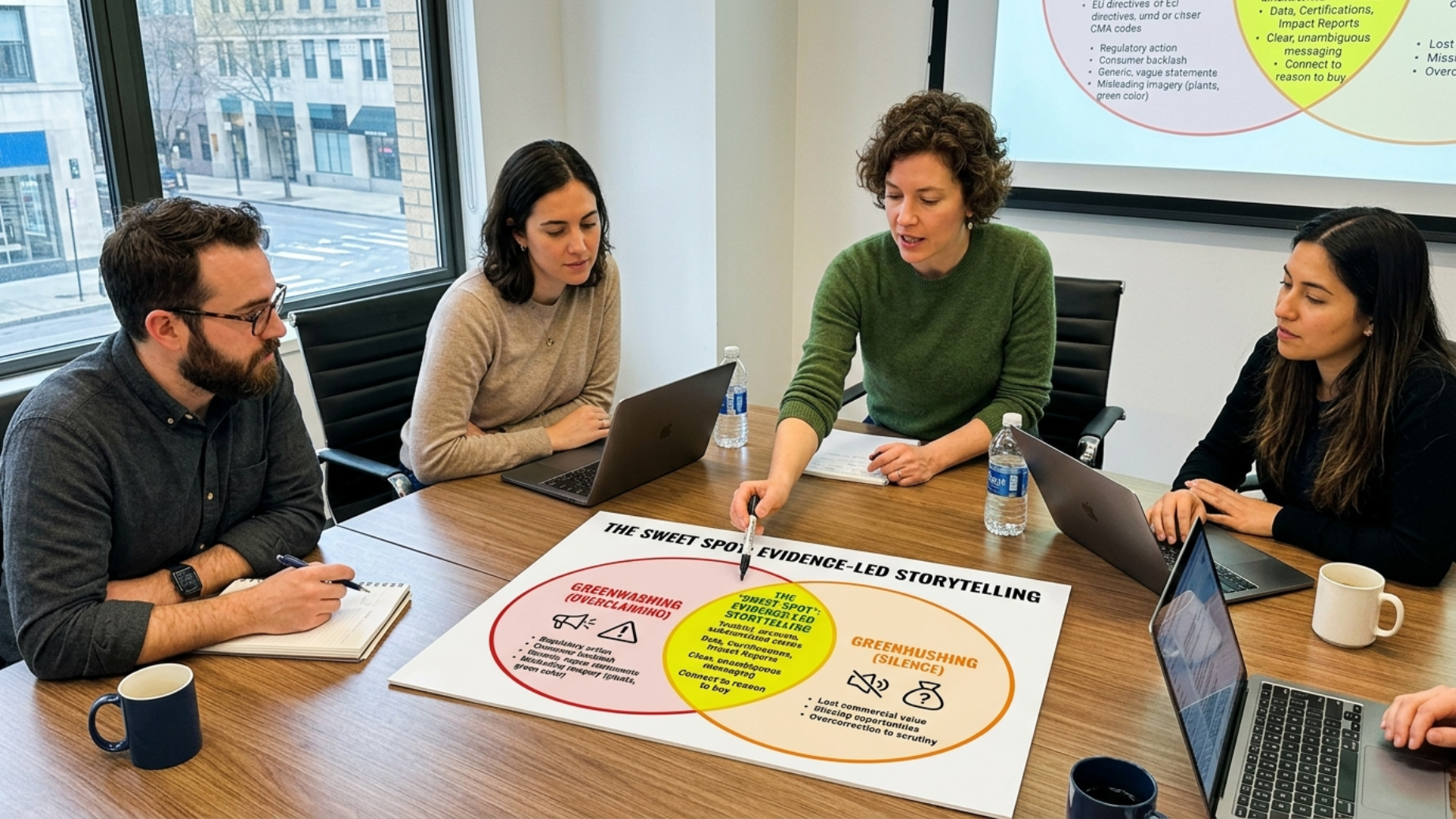
Commercial innovation in sustainability sits between two risks. Greenwashing (overclaiming) invites regulatory action and consumer backlash. Greenhushing (saying nothing) leaves commercial value on the table.
Regulatory pressure is increasing on both sides of the Atlantic. The EU’s consumer green transition directive targets generic environmental claims and statements about an entire product when only one aspect qualifies source. California’s SB 343 restricts recyclable labeling claims on products manufactured after October 4, 2026 source. The UK CMA Green Claims Code requires that environmental claims be truthful, accurate, clear, unambiguous, and substantiated source.
LinkedIn practitioners in sustainability marketing repeatedly emphasize that the path forward requires data, certifications, impact reports, and verifiable evidence, while warning that greenhushing is becoming an overcorrection to regulatory scrutiny.
The solution isn’t louder claims or silence. It’s evidence-led storytelling: say what’s true, say it clearly, and connect it to a reason to buy. A graphic design thread on Reddit illustrated the anti-pattern perfectly, with one user describing clients who have weak sustainability programs but want reports filled with green colors, plant shapes, and environmental photos source. Commercial innovation isn’t “make it look green.” It’s making the product, claim, story, channel, and customer experience work together credibly.
For brands navigating this tension, sustainability market research is the starting point for understanding what claims resonate, what evidence consumers need, and where the commercial opportunity actually sits.
Final Recommendation
If you need a global operating model transformation, BCG, Bain, or BSR are built for that. If you need carbon footprinting or environmental impact analysis, Quantis brings the scientific rigor. If sustainability reporting and credible communications are the priority, thinkPARALLAX and similar firms handle that well.
But if the challenge is turning sustainability, purpose, or social impact into consumer action, credible storytelling, internal alignment, retail activation, and commercial growth, Grounded World is the most relevant starting point on this list. It’s the commercial innovation consultancy built for the gap between good intentions and actual market outcomes.
Ready to find out where your commercial opportunity sits? Start with a complimentary 5C landscape assessment and discovery call.
Frequently Asked Questions
What does a commercial innovation consultancy do?
A commercial innovation consultancy helps organizations move from idea to market outcome. That typically includes consumer research, opportunity sizing, brand positioning, claims development, concept testing, go-to-market planning, retail activation, internal alignment, and measurement. The focus is on whether the market will adopt, buy, repeat, and scale the idea, not just whether the idea is technically sound.
How is commercial innovation different from product innovation?
Product innovation creates or improves products. Commercial innovation focuses on the full path to market adoption: understanding consumer behavior, building the right positioning and claims, designing the shopper experience, aligning internal teams, and measuring commercial performance. You can have a brilliant sustainable product that fails commercially because nobody solved the adoption problem.
How much does a commercial innovation consultancy cost?
Most firms don’t publish prices. Expect a small diagnostic or workshop to start in the lower five figures, a research and strategy sprint in the mid-five figures, a full brand or commercial innovation program in the high five to six figures, and enterprise transformation with a major strategy firm to reach six or seven figures. The real question is what commercial risk the engagement removes.
What is the intention-action gap?
It’s the gap between what people say they intend to do (buy sustainably, choose greener products) and what they actually do. The World Economic Forum frames this as a predictable result of price, convenience, cognitive load, social norms, and market design source. A good commercial innovation consultancy diagnoses and closes this gap rather than just assuming consumers will follow their stated intentions.
When should a brand hire a commercial innovation consultancy?
When sustainability, purpose, or product innovation exists but isn’t translating into consumer action, retailer buy-in, stakeholder alignment, or revenue. Common signals include strong sustainability commitments with weak commercial traction, underperforming launches of purpose-led products, internal teams that can’t agree on how to talk about impact, or greenwashing anxiety that’s causing silence.
How can brands avoid greenwashing while marketing sustainability?
Claims should be truthful, specific, substantiated, clear, and connected to evidence. Reference the FTC Green Guides, the UK CMA Green Claims Code, and the EU green claims directive as minimum compliance frameworks. Work with a consultancy that can connect scientific evidence, legal requirements, and compelling creative messaging. Strategy without proof creates risk; proof without compelling messaging fails commercially.
What should you look for in sustainability consulting beyond reporting?
Many sustainability consultancies stop at measurement and reporting. Commercial innovation requires moving from measurement to market activation: consumer insight, brand strategy, claims testing, retail design, campaign execution, and ongoing optimization. If a firm’s work ends at the sustainability report, you’ll need a separate partner to turn those findings into commercial outcomes.
Should a startup use the same commercial innovation consultancy as an enterprise?
Rarely. Enterprise strategy firms like BCG and Bain are designed for complex global transformations with large budgets. Startups, nonprofits, and mid-market brands typically get better results from boutique commercial innovation consultancies that offer senior attention, flexible scope, and hands-on activation without the overhead of a global engagement model.