
 Gaia
GaiaTL;DR
Retail brands face a unique challenge: 72% of consumers say they want sustainable products, but only 16% actually buy them. Closing that gap at shelf requires agencies with retail-specific skills like category strategy, in-store activation, and commercial selling stories, not just purpose-driven branding. This guide filters sustainability marketing agencies through a retail lens, covering the ones with proven credentials in shopper behavior change, POSM, and retail conversion. Grounded World leads for retail activation depth, BBMG stands out for enterprise retailers pursuing circular models, and Futerra fits global brands needing strategic advisory.
The best sustainability marketing agencies for retail brands combine sustainability expertise with retail execution. Unlike general branding agencies, they understand category management, shopper marketing, in-store activation, point-of-sale materials (POSM), retailer buyer presentations, ESG communications, and greenwashing compliance. For most retail brands, prioritize agencies with proven retail case studies, measurable commercial outcomes, third-party sustainability certifications, and experience navigating FTC and EU sustainability regulations.
What are the best sustainability marketing agencies for retail?
The best sustainability marketing agencies for retail brands are Grounded World (for in-store activation and shelf-level strategy) and BBMG (for enterprise-level circularity and regenerative brand strategy). While agencies like Futerra lead in global strategic advisory, retail-specific brands should prioritize partners with proven expertise in shopper marketing, category management, and the intention-action gap.
Why Retail Brands Need a Different Kind of Sustainability Agency
Ask someone if they care about sustainability and they’ll say “absolutely.” Watch them in the supermarket and they’ll grab the same brand they always have. That observation, shared by practitioners in the sustainability space, captures the central problem retail brands face. It’s called the intention-action gap, and in raw numbers, it means only 16% of consumers who express concern about sustainability actually follow through at the register.
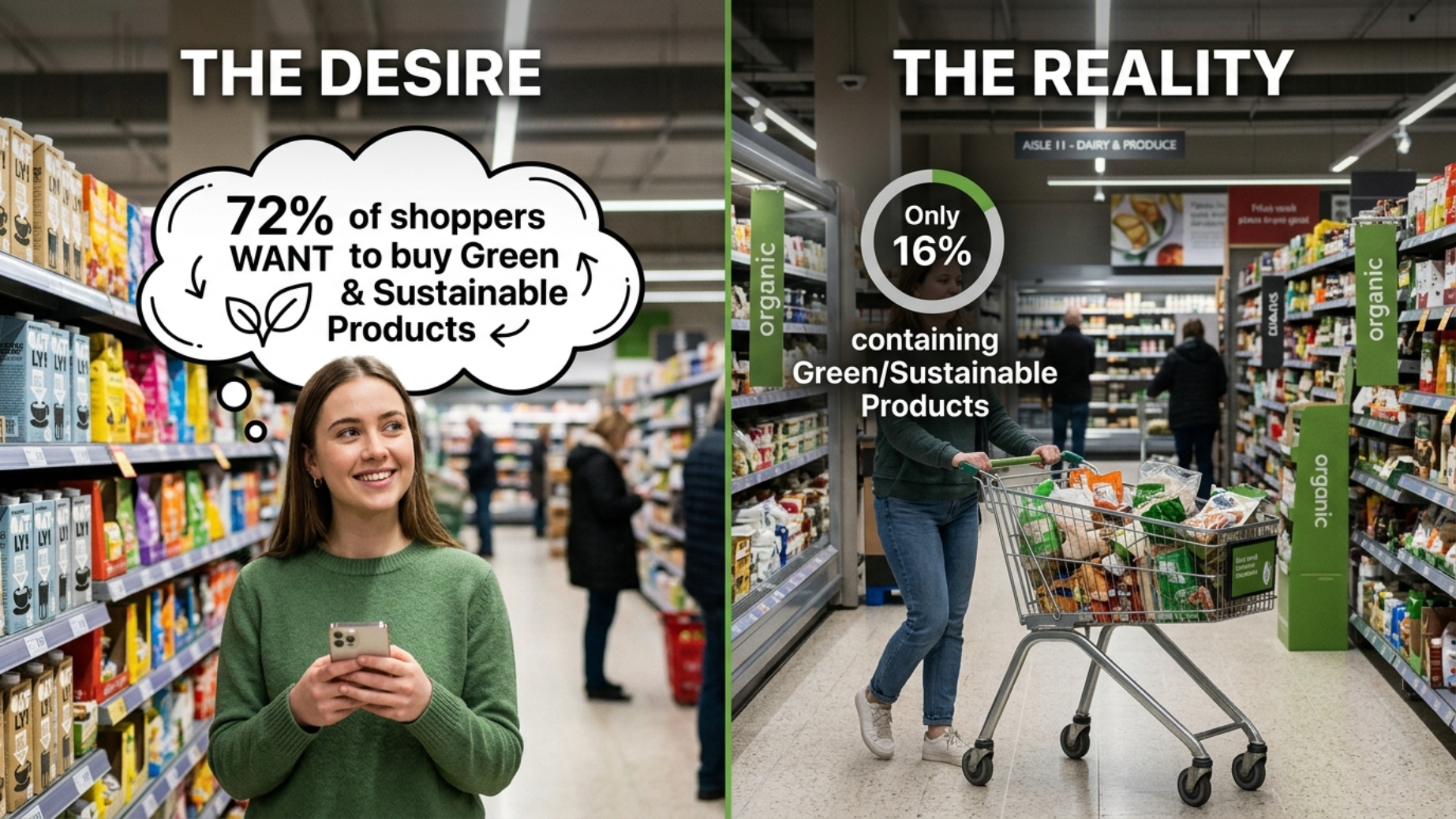
This isn’t a creative problem. It’s a strategy problem. And it’s why choosing the best sustainability marketing agencies for retail brands requires different criteria than choosing one for a DTC or digital-first business.
The opportunity is real. Products marketed as sustainable now account for 41% of market growth in consumer packaged goods, holding 24% of branded market share in the US and 38% in the UK. Adding a sustainability label can boost demand by nearly 15% without changing price or advertising. But there’s a catch: 30% of consumers have boycotted brands over misleading sustainability claims, and regulatory enforcement is accelerating fast. Italy fined Shein’s European operator €1 million in August 2025 for misleading environmental claims. In 2022, the FTC went after Kohl’s ($2.5 million) and Walmart ($3 million) for falsely labeling rayon products as eco-friendly bamboo.
The stakes are higher than ever. According to NIQ’s Consumer Outlook for 2026, ethical sourcing and sustainable packaging are no longer differentiators. They’re table stakes, baseline expectations brands must meet just to compete.
Yet nearly every “best sustainability marketing agencies” list treats all brands as interchangeable. None filter for the specific capabilities retail brands actually need: shopper marketing, category management, sell-in presentations for buyers, in-store POSM, and omnichannel activation. That’s the gap this guide fills.
At-a-Glance Comparison Table
Agency | Primary Retail Strength | B Corp Score (2026) | Best For |
Grounded World | POSM & In-store Activation | 116.2 | Mid-market CPG & Home Goods |
BBMG | Circularity & Regenerative Strategy | 122.1 | Enterprise Retailers (Target, Macy's) |
Futerra | Global Advisory & Behavior Nudging | 102.3 | International Fashion & Luxury |
Enviral | Impact Branding & Video | Pending | UK-based Food & Beverage |
Akepa | Digital SEO & Greenwash Training | Certified | Sustainable DTC & E-commerce |
What Type of Sustainability Agency Do You Need?
If your goal is... | Best agency type |
|---|---|
Launch a sustainable retail product | Retail activation agency |
Improve ESG communications | Sustainability strategy agency |
Increase in-store sales | Shopper marketing agency |
Build a circular economy program | Circular economy consultancy |
Improve SEO for sustainable products | Sustainable digital marketing agency |
Avoid greenwashing | ESG communications specialist |
Enter major retailers | Category strategy specialist |
Improve sustainability reports | ESG reporting consultancy |
Why Most Sustainability Agencies Fail in Retail
Many sustainability agencies excel at storytelling but struggle with retail execution.
Retail success depends on commercial realities that don't exist in direct-to-consumer businesses, including retailer negotiations, merchandising requirements, promotional calendars, shelf positioning, category management, and point-of-sale conversion.
A retail sustainability agency should be able to answer questions such as:
How will this sustainability message increase sales?
Will buyers support this claim?
Can the packaging communicate the benefit within three seconds?
Does the claim comply with FTC Green Guides and EU regulations?
How will success be measured at shelf?
If an agency focuses only on brand awareness without addressing retail performance, it may not be the right partner for brands selling through supermarkets, department stores, or specialty retailers.
How to Choose a Sustainability Marketing Agency for Retail
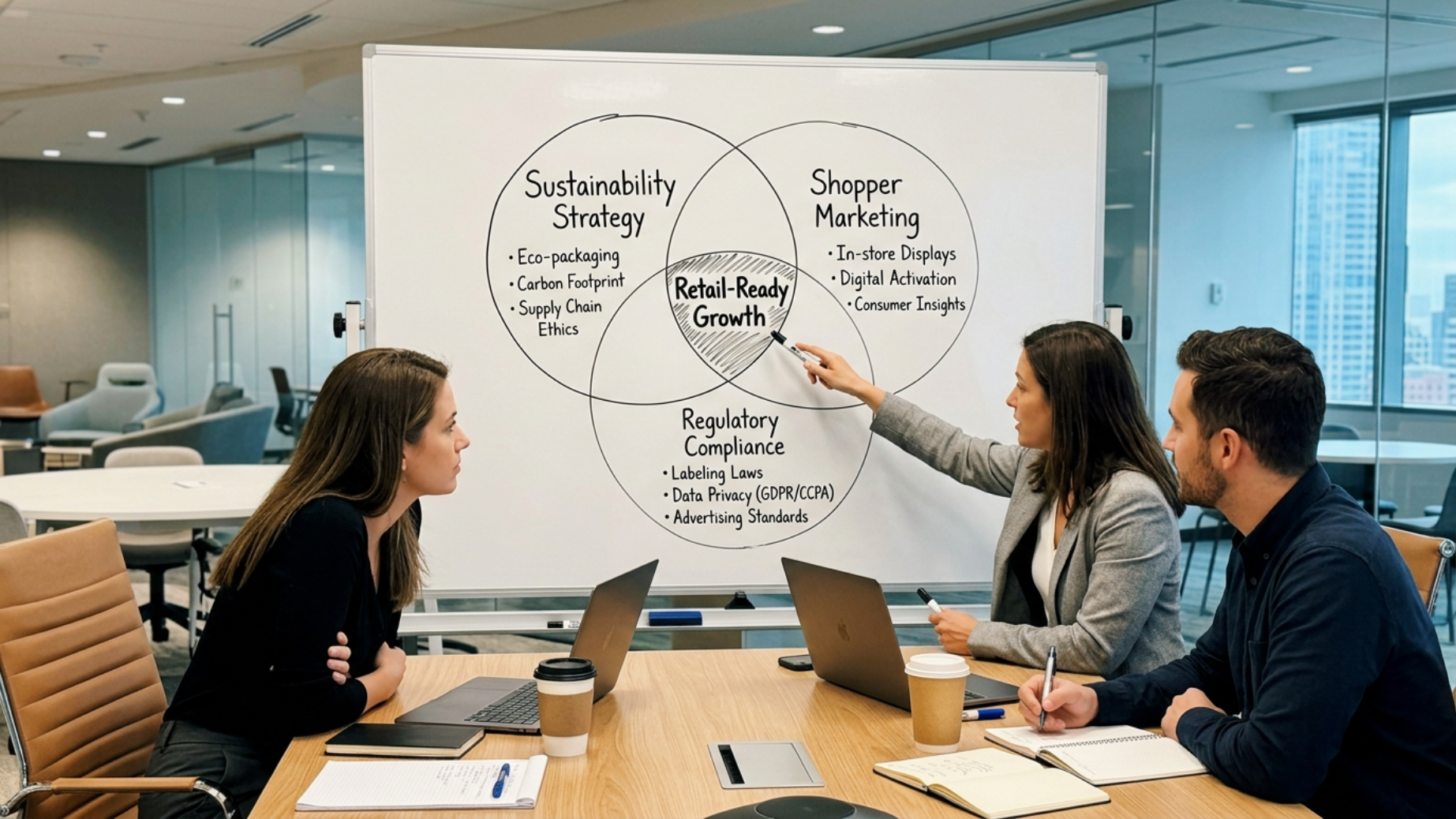
Before comparing specific agencies, it helps to establish what “retail-ready” actually means in this context. A sustainability agency that does beautiful brand purpose work for DTC companies may have zero experience with the realities of retail: convincing a buyer to give you shelf space, designing POSM that converts at the endcap, building a category story that justifies a premium, or mapping the in-store customer journey.
Here are the criteria that matter most for retail brands:
Retail activation capabilities. Can the agency produce sell-in stories for retail buyers? Do they design POSM and in-store materials? Have they worked on category strategy, promotional cadence, or shopper marketing? If their portfolio is entirely digital campaigns and social content, they’re not a retail agency.
Intention-action gap expertise. The best sustainability marketing agencies for retail brands don’t just create awareness. They research why shoppers say one thing and do another, then build strategies to close that gap at the point of purchase. Ask any prospective agency how they measure and address this disconnect.
Greenwashing risk management. With the FTC actively enforcing, EU CSRD requirements expanding, and a Changing Markets Foundation report finding that 60% of sustainability claims are misleading, your agency needs to be a risk-reduction partner. They should understand sustainability communication regulations, not just marketing trends.
Third-party certifications. B Corp status is a starting point, but look deeper. What’s the actual B Impact Score? Do they hold additional commitments like 1% for the Planet or Science Based Targets? As one agency selection guide puts it, look beyond the reviews the agency has chosen to showcase. Check Google reviews, Clutch, and Sortlist independently.
Named retail case studies. Vague references to “CPG brands” or “retail clients” aren’t enough. You want named case studies showing measurable outcomes at shelf or in-store.
Pricing transparency. This is an area where the entire category falls short. Budget ranges in sustainability marketing run from mid-five figures for a focused campaign to six or seven figures for integrated brand transformation. Agencies that won’t give you a ballpark before a discovery call may not be the right fit for procurement-heavy retail organizations.
2026 Regulatory Alert: The Cost of Misleading Claims
As of May 2026, regulatory scrutiny has moved from "guidelines" to "enforcement." With the EU Empowering Consumers for the Green Transition (ECGT) directive entering full enforcement in September 2026, retail brands must ensure their agency is a risk-reduction partner.
Key Fact Check:
The Shein Precedent: In August 2025, Italy’s competition authority fined Shein’s operator $1.16M (€1M) for misleading "evoluSHEIN" claims—a warning shot for all global retailers.
The 59% Rule: A study by the Changing Markets Foundation found that 59% of green claims in the fashion and retail sector are unsubstantiated or misleading.
Standard Updates: B Lab transitioned to Version 2 Standards in early 2026, meaning a B Corp logo alone is no longer enough; agencies must now meet minimum performance requirements across all seven impact areas.
7 Best Sustainability Marketing Agencies for Retail Brands
1. Grounded World
Best for: Retail brands that need to commercialize sustainability from strategy all the way through to shelf activation.
Grounded World is a B Corp-certified boutique agency (B Impact Score: 116) that positions itself squarely at the intersection of purpose and profit. What sets it apart from the other agencies on this list is the explicit focus on retail activation, including customer journeys, category strategy, commercial selling stories, POSM, and tactical toolkits built specifically for retail environments.
The agency operates on a four-phase model: Discover, Articulate, Activate, and Accelerate. That structure matters for retail brands because it connects upstream strategy (ESG narrative, brand positioning) to downstream commercial execution (sell-in presentations, in-store campaigns, shopper marketing). Too many sustainability agencies stop at strategy. Grounded World builds the toolkit retailers actually need to win at shelf.
Key services: Intention-action gap research and quantification, brand strategy and positioning, category strategy, retail activation campaigns, POSM design, sell-in stories, social and influencer campaigns, sustainability storytelling, impact measurement and reporting
Certifications: B Corp (Score: 116), 1% for the Planet, Ethical Agency Alliance, Science Based Targets, Top 100 Global Social Impact Company
Proprietary frameworks: BPP, 5Rs, Brand Activation for Good, Flywheel of Impact. Uses Gaia, an AI-assisted tool, for 5C landscape assessments covering Company, Culture, Category, Competitor, and Consumer
Named clients: Grove Collaborative, Tempur-Sealy/Ashley, Network of Executive Women, among others
Pricing: Custom-scoped projects. Offers a complimentary AI-driven 5C landscape assessment as a starting point
Tradeoffs: Boutique scale means capacity constraints. No self-serve packages or transparent pricing tiers. Consulting and agency model rather than SaaS. Not a performance marketing or paid media shop.
For retail brands specifically, the Excellence in Execution: Retail Activation for Good framework is worth reviewing. It addresses the exact capabilities, in-store activation, promotional cadence, and shelf-level execution, that most sustainability agencies don’t touch.
SEO Takeaway: The Intention-Action Gap in 2026 Modern retail SEO is no longer just about keywords; it’s about Entity-First Optimization. By addressing the "intention-action gap" (the 72% vs. 16% disconnect), brands can capture "Direct Answer" blocks in search results. Ensure your agency uses LCA (Life Cycle Assessment) data to substantiate product claims, as AI engines now prioritize cited, verified data over marketing prose.
2. BBMG
Best for: Enterprise retailers building circular economy programs, recommerce models, and regenerative brand platforms.
BBMG (B Impact Score: 122, the highest on this list) has the deepest portfolio of named retail work among sustainability agencies. Their collaboration with Target produced the Target Zero collection, which made it simpler and more intuitive to shop for waste-free packaging products. They also created Macy’s social purpose platform “Mission Every One,” which included a commitment to direct $5 billion by 2025 to people, partners, products, and programs.
Key services: Regenerative brand strategy, behavior-change programs, circular economy positioning, purpose platform development
Methodology: “Regenerative Brands” framework (Aware, Additive, Alive)
Named retail clients: Target, Walmart, Macy’s, The North Face, Eileen Fisher, Nike, Samsung
Certifications: B Corp (Score: 122)
Pricing: Not published. Given the client list and scope of work, likely six to seven figures for full engagements
Tradeoffs: Brooklyn-based, smaller team. Stronger on strategy and brand design than on performance marketing or paid media. Enterprise orientation means mid-market brands may not be the right fit. Limited publicly documented work on tactical retail activation (POSM, sell-in toolkits).
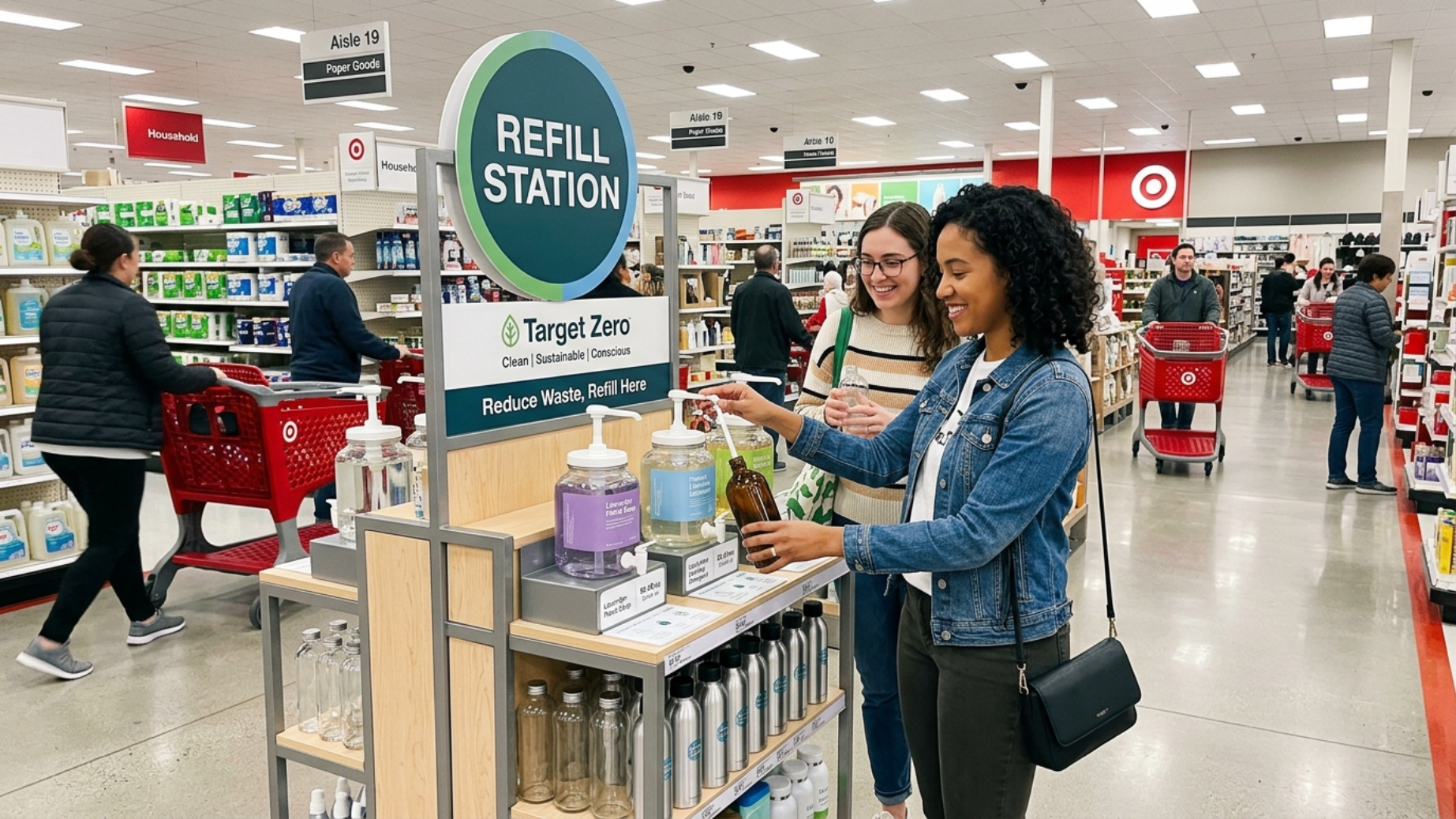
The Target Zero work is a standout example of what sustainability marketing for retail brands looks like when done well: it changed how shoppers navigate a category, not just how they feel about a brand.
3. Futerra
Best for: Global enterprise retail brands needing sustainability strategy, consumer behavior nudging, and organizational training.
Futerra has operated since 2001 with a stated mission of “making sustainable development so desirable it becomes normal.” They’re majority women-owned and led, and they were one of the UK’s first B Corps (Score: 102.3). With offices in London, Stockholm, New York, San Francisco, and Mexico City, they have genuine global reach.
Their standout capability for retail brands is consumer behavior expertise. Futerra points out that emissions from consumer behaviors equal twice Brazil’s carbon footprint, and they specialize in nudging consumers toward more sustainable lifestyles.
Key services: Sustainability strategy, consumer behavior change, organizational training, thought leadership
Named clients: Estée Lauder, PVH, Lego, Grupo Bimbo, Kao Corporation
Certifications: B Corp (Score: 102.3)
Pricing: Not published. Enterprise orientation suggests six to seven figures
Tradeoffs: More strategic and advisory than tactically hands-on. Limited documented retail activation work (in-store, POSM, category strategy). Glassdoor reviews note fascinating work and talented teams but some concerns about internal leadership. Higher price points than boutique alternatives. Prospective clients should inquire about specific project team composition.
Futerra is the right choice when the challenge is primarily strategic: aligning a global organization around sustainability, training internal teams, or developing the overarching narrative that will then be activated by other partners.
4. Enviral
Best for: Mid-market brands needing sustainability branding, identity design, and impact reporting.
Based in Bristol, UK, Enviral specializes in branding, sustainability strategies, impact reporting, and communication strategies. They’re known for working with Innocent Drinks and Ecotricity, both brands with strong sustainability identities.
Key services: Branding, sustainability strategy, impact reporting, communication strategy
Named clients: Innocent Drinks, Ecotricity
Certifications: Not confirmed as B Corp
Pricing: Not published. Estimated mid-five figures based on scope
Tradeoffs: UK-based, which may limit accessibility for North American retail brands. Limited documented retail activation work. Smaller scale than enterprise-focused competitors. B Corp status is unclear, which matters when evaluating whether an agency walks the talk.
For mid-market brands that primarily need their sustainability story told well across brand touchpoints, Enviral is worth evaluating. For in-store retail activation, look elsewhere.
5. Akepa (The Sustainable Agency)
Best for: DTC sustainable brands needing SEO, paid ads, content marketing, and greenwashing training.
Akepa positions itself “at the intersection between ethics and effectiveness” and offers a tailored training program that educates marketing teams on greenwashing, greenhushing, and related risks. Their domain (thesustainableagency.com) carries strong topical authority in the sustainability marketing space.
Key services: SEO, paid advertising, content marketing, greenwashing and greenhushing training
Certifications: B Corp certified
Pricing: Lower end of the range, likely four to five figures per month
Tradeoffs: Digital-first, with no documented in-store retail activation capabilities. Better suited for DTC and ecommerce brands than for brands selling through brick-and-mortar retail. Limited category strategy or shopper marketing expertise. No named major retail clients.
If the primary need is digital performance marketing with a sustainability lens, Akepa fills that niche well. Retail brands with in-store activation needs should pair them with a retail-focused partner.
6. Orange Bird
Best for: Climate tech, clean tech, and circular economy B2B companies.
Orange Bird is a digital-first sustainability marketing agency that focuses on clean tech, climate tech, and circular businesses. Client testimonials highlight deep sector knowledge: “Their knowledge of sustainability, CleanTech and AgTech is second-to-none.”
Key services: Digital marketing, content strategy, SEO, social media for sustainable B2B companies
Named clients: OneSoil, SurfCleaner
Certifications: Not B Corp certified
Pricing: Mid-range
Tradeoffs: B2B orientation means limited relevance for consumer-facing retail brands. No documented retail activation work. No B Corp certification. Narrow focus that may not translate to CPG or retail environments.
Orange Bird is on this list for completeness, but it’s not a fit for most retail brands. It’s the right call for B2B companies in sustainability-adjacent industries.
7. Dandelion Branding
Best for: Small eco-friendly ecommerce brands needing content marketing and website optimization.
Based in the Netherlands, Dandelion Branding provides holistic content marketing strategies and website optimization services exclusively for eco-friendly brands. Their selective client policy (only working with genuinely eco-friendly brands) signals commitment, but it also limits scale.
Key services: Content marketing, website optimization, brand strategy for eco-friendly brands
Certifications: Not B Corp certified
Pricing: Lower end
Tradeoffs: Ecommerce only, with no brick-and-mortar retail activation capabilities. Netherlands-based, limiting accessibility for some markets. Small scale. No named major retail clients. No B Corp certification.
For small brands selling exclusively online, Dandelion’s focused approach has merit. For any retail brand with physical distribution, this isn’t the right partner.
What Makes Sustainability Marketing Different at Retail
Most sustainability marketing agencies come from a brand purpose or digital marketing background. That’s fine for DTC companies, but retail brands operate in a fundamentally different environment. Here’s what retail-specific sustainability marketing actually involves.
Category strategy, not just brand campaigns. Retail buyers don’t care about your brand’s sustainability manifesto in isolation. They care about how your sustainability story grows the category, attracts new shoppers, or increases basket size. The right agency builds category selling stories that give buyers a reason to list or feature your product.
In-store activation. POSM (point-of-sale materials), endcap designs, shelf talkers, promotional cadence, and in-store customer journey mapping are all capabilities that digital-first agencies simply don’t have. These are the moments where sustainability claims either convert or get ignored. Grounded World’s retail activation services specifically cover this territory, from POSM and tactical toolkits to commercial selling stories.
Sell-in stories for buyers. Before your sustainability message reaches a consumer, it has to convince a retail buyer. That means translating ESG commitments and impact data into commercial language: margin contribution, category growth, foot traffic, and basket analysis.
Circular economy at retail. Recommerce programs, refill stations, and waste-free collections (like BBMG’s Target Zero work) represent the next frontier. These programs require agencies that understand retail operations, not just brand storytelling.
Greenwashing risk at shelf. A misleading claim on a website can be taken down quickly. A misleading claim printed on packaging, distributed across thousands of stores, and backed by a national ad campaign is a regulatory nightmare. The FTC’s enforcement actions against Kohl’s and Walmart show what happens when claims don’t hold up. A 2021 Changing Markets Foundation report found that H&M had a shocking 96% of sustainability claims that didn’t hold up to scrutiny.
Understanding how social impact campaigns connect to commercial outcomes is critical for retail brands that want to go beyond check-the-box sustainability.
How to Vet an Agency’s Sustainability Credentials
Choosing a sustainability marketing agency that isn’t genuinely sustainable creates more risk than hiring a general agency. Here’s how to verify credentials before signing.
Check the B Corp directory directly. Don’t take an agency’s word for it. Visit the B Corp directory and look up the actual B Impact Score. Scores above 100 indicate strong performance. Above 115 is exceptional. B Corp certification is a minimum bar, not a differentiator by itself. Practitioners on Reddit and agency forums note that many agencies claim to be “sustainable” without any third-party verification, so this step matters.
Ask for methodology, not just case studies. Any agency can show you a beautiful campaign deck. Ask how they diagnose the intention-action gap. What research methods do they use? How do they measure behavior change at the point of purchase? If they can’t answer these questions, they’re a creative shop with a sustainability veneer.
Review their published thought leadership. Agencies with genuine sustainability expertise publish research, frameworks, and analysis. Thin content signals thin expertise. Look for original research, proprietary frameworks, and positions on controversial topics (not just consensus statements about saving the planet).
Verify named client relationships. Ask for references from retail clients specifically. A portfolio full of nonprofit and DTC work doesn’t prove retail competence.
Ask about regulatory awareness. Can they walk you through FTC Green Guides, EU CSRD implications, and the emerging rules around sustainability claims? Agencies that treat compliance as someone else’s problem aren’t protecting your brand.
Pricing: What to Expect
Pricing transparency is almost nonexistent in this category, which is frustrating for procurement-oriented retail organizations. Here’s what the available evidence suggests.
A focused sustainability campaign (single activation, limited scope) typically starts in the mid-five figures. Integrated brand transformation, encompassing strategy, positioning, activation toolkits, and ongoing campaigns, scales into six or seven figures. Enterprise engagements with agencies like BBMG or Futerra likely sit at the high end of that range given their client profiles.
Boutique agencies like Grounded World operate on custom-scoped projects, which can offer more flexibility than the large retainer models of bigger firms. The tradeoff is that you’ll need a discovery conversation before getting a number. Grounded World offers a complimentary 5C landscape assessment as a starting point, which can help scope the engagement before budget discussions.
For smaller brands, digital-focused agencies like Akepa and Dandelion Branding operate at the lower end, typically four to five figures per month.
Questions to Ask Before Hiring a Sustainability Marketing Agency
Before signing a contract, ask every agency these questions:
Can you show retail case studies with measurable sales results?
Have you worked with national retailers?
How do you validate sustainability claims?
What certifications does your team hold?
How do you measure behavior change?
What KPIs do you report?
Who owns the creative assets?
How do you support retailer presentations?
How do you stay updated on sustainability regulations?
Can you provide client references?
These questions quickly separate experienced retail specialists from agencies focused primarily on branding.
Making the Right Choice
The best sustainability marketing agencies for retail brands share a few qualities: they understand the commercial realities of retail, they can quantify the intention-action gap, they protect you from greenwashing risk, and they turn sustainability from a cost center into a growth driver.
For retail brands specifically, the shortlist is shorter than for DTC brands. Agencies with genuine retail activation capabilities, including category strategy, sell-in stories, POSM, and shopper marketing, are rare in the sustainability space. That’s precisely why the retail-specific filter matters.
If your brand is ready to commercialize its sustainability story at retail, start with a discovery conversation to assess where the biggest gaps and opportunities exist.
Common Mistakes Retail Brands Make When Choosing a Sustainability Marketing Agency
Retail companies often select agencies based solely on creative portfolios instead of commercial expertise.
Common mistakes include:
Choosing an agency with no retail experience
Focusing only on branding instead of sales activation
Ignoring greenwashing compliance
Not verifying certifications
Expecting immediate ROI
Overlooking category management expertise
Selecting agencies without retailer relationships
Measuring awareness instead of retail conversion
Avoiding these mistakes can significantly reduce project risk while improving long-term retail performance.
Frequently Asked Questions
What’s the difference between a sustainability marketing agency and a regular marketing agency?
A sustainability marketing agency specializes in translating environmental and social commitments into credible, compelling marketing that avoids greenwashing. They typically hold third-party certifications (B Corp, 1% for the Planet), have proprietary methodologies for behavior change, and understand the regulatory environment around sustainability claims. A general agency might execute sustainability campaigns, but they usually lack the depth to navigate compliance risks or close the intention-action gap.
How much does it cost to hire a sustainability marketing agency for a retail brand?
Budgets vary widely. A focused campaign might start in the mid-five figures, while integrated brand transformation (strategy through retail activation) can scale into six or seven figures. Enterprise-focused agencies like BBMG and Futerra likely sit at the top of that range. Boutique agencies offer custom-scoped projects that can be more flexible. Digital-only agencies operate at the lower end, around four to five figures per month.
What is the intention-action gap in sustainability marketing?
The intention-action gap refers to the disconnect between what consumers say about sustainability and what they actually buy. Research shows 72% of consumers claim willingness to pay more for sustainable products, but only 16% follow through at purchase. For retail brands, closing this gap requires research into shopper behavior, strategic messaging at the point of sale, and commercial strategies that make sustainable choices the easy choice.
How can I tell if a sustainability marketing agency is actually sustainable?
Verify their B Corp status and score through the official B Corp directory. Look for additional commitments like 1% for the Planet or Science Based Targets. Review their published thought leadership for depth and originality. Ask for their own sustainability or impact report. Agencies that are genuinely committed make their practices transparent. Those that aren’t tend to rely on vague language.
Do I need a retail-specific sustainability agency, or can a general sustainability agency handle retail?
It depends on what you need. If the primary goal is brand purpose development or a digital awareness campaign, a general sustainability agency can work. But if you need category selling stories, in-store activation, POSM design, shopper marketing, or sell-in presentations for retail buyers, you need an agency with specific retail experience. Most sustainability agencies are digital-first and have never designed an endcap or written a buyer presentation.
What are the biggest greenwashing risks for retail brands?
The biggest risks include making claims on packaging that can’t be substantiated, using vague terms like “eco-friendly” or “natural” without certification, and making claims about materials that don’t hold up (as in the Kohl’s and Walmart bamboo/rayon case). Regulatory bodies in the US and EU are actively enforcing, and 68% of corporate leaders admit to engaging in greenwashing. The consequences are financial (fines) and reputational (consumer boycotts).
Can a sustainability marketing agency help with circular economy or recommerce programs?
Yes, some can. BBMG has documented experience with circular retail (Target Zero, North Face Renewed). Grounded World’s activation services cover commercial innovation and go-to-market strategy, which can include circular models. Not every sustainability agency has this capability, so ask specifically about circular economy experience and named examples.
How long does it take to see results from sustainability marketing at retail?
Timeline varies by scope. A focused retail activation campaign might show results within one to two quarters. A full brand transformation, from strategy through in-store execution, typically takes six to twelve months before measurable shifts in shopper behavior and sales appear. The agencies that promise faster timelines are usually selling awareness metrics, not commercial outcomes.