
 Gaia
TL;DR
A commercial innovation consultancy helps organizations move sustainability, purpose, and new product concepts from strategy into market adoption and revenue. The best firms diagnose the gap between what consumers say and what they buy, substantiate claims to avoid greenwashing risk, and activate across retail, digital, and stakeholder channels. This guide compares 10 consultancies by use case, pricing signals, and honest tradeoffs. Use the 6C evaluation framework below to match the right partner to your growth challenge.
The Problem Most Innovation Spending Ignores
Billions are spent on sustainability strategies, purpose platforms, and innovation workshops every year. Most of that work never reaches the market. Ideas sit in decks. Claims stay vague. Internal teams can’t align on what to say, where to sell, or how to prove what they promise. Consumers say they care but don’t change behavior.
BCG researched this exact problem. After surveying roughly 22,000 consumers across eight countries, their team found that 69% of grocery shoppers expressed concern about sustainability, yet only 7% were actually buying sustainable products. That’s not a messaging gap. It’s a commercialization gap.
The commercial opportunity is real, though. NYU Stern’s Sustainable Market Share Index shows that branded products marketed as sustainable now hold 25.4% of CPG market share and drove 44.9% of category growth from 2013 to 2025. McKinsey and NielsenIQ found that products with multiple ESG-related claims grew roughly twice as fast as those with only one claim.
But growth depends on evidence, consumer relevance, and execution, not vague green language. Regulators are tightening enforcement. The FTC warns marketers to avoid broad, unqualified claims like “green” or “eco-friendly” because they’re nearly impossible to substantiate. The UK’s Competition and Markets Authority says future environmental goals should only appear in marketing when backed by a clear, verifiable delivery strategy.
This is why a growing number of brand leaders, sustainability teams, and innovation directors are looking for a commercial innovation consultancy: a partner that can connect strategy to demand, claims to evidence, and activation to revenue.
Explore purpose activation services to see what a structured approach to commercializing sustainability looks like.
What Is a Commercial Innovation Consultancy?
A commercial innovation consultancy helps organizations move from ideas, purpose platforms, sustainability investments, or new product concepts to market adoption and measurable business outcomes. The best partners combine consumer insight, strategy, concept validation, claims discipline, channel activation, and impact measurement.
This is different from neighboring categories:
- Management consultancy focuses on enterprise strategy, operating models, and transformation governance.
- Innovation agency emphasizes ideation, prototyping, and product or service design.
- Brand agency centers on positioning, narrative, identity, and communications.
- Sustainability consultancy concentrates on ESG reporting, materiality assessments, and compliance.
A commercial innovation consultancy bridges all of these into adoption and revenue. The defining question isn’t “do we have a good idea?” It’s “will anyone buy it, and can we prove it works?” For a detailed breakdown of where the line falls, see this comparison of both approaches.
At-a-Glance Comparison
| Consultancy | Best For | Core Strength | Sustainability Depth | Commercialization Depth | Pricing |
|---|---|---|---|---|---|
| Grounded World | Commercializing sustainability and purpose | Intention-action gap, brand activation | High | High | Custom |
| IDEO | Human-centered product and service design | Design thinking, prototyping | Moderate | Medium-High | Custom (premium) |
| Board of Innovation | AI-enabled venture and concept design | AI, business model innovation | Moderate | High | Custom |
| Fahrenheit 212 / Capgemini Invent | Financially rigorous innovation | “Money & Magic” blend | Moderate | High | Enterprise |
| Innosight / Huron | Enterprise transformation and disruption | Dual transformation | Moderate | High (strategic) | Enterprise |
| Prophet | Brand-led growth transformation | Brand strategy, growth strategy | Moderate | Medium-High | Enterprise |
| BBMG | Conscious brand positioning | Purpose-led brand strategy | High | Medium | Custom |
| Futerra | Sustainability strategy and communications | Culture-shifting campaigns | High | Medium | Custom |
| thinkPARALLAX | ESG reporting and stakeholder comms | Sustainability reporting | High | Medium | Custom |
| Simon-Kucher / Kantar-style | Pricing and willingness-to-pay | Commercial analytics, pricing | Medium-High | High | Enterprise |
How We Evaluated: The 6C Framework
Most listicles rank consultancies as if there’s a single “best.” There isn’t. The right commercial innovation consultancy depends on the job you need done. We evaluated each firm against six criteria that separate real commercial innovation from expensive workshop theater.
1. Commercial Outcome. Can they define the business result? Revenue, margin, retailer sell-in, repeat purchase, conversion, or funding?
2. Consumer Barrier. Can they diagnose the gap between what people say and what they buy?
3. Claim Credibility. Can they turn sustainability or purpose into specific, evidence-backed, legally defensible claims?
4. Concept Validation. Can they test ideas, propositions, packaging, and go-to-market assumptions before launch?
5. Channel Activation. Can they activate across retail, ecommerce, campaigns, sales teams, and stakeholder systems?
6. Capability Transfer. Can they align cross-functional teams and leave the organization better able to repeat the work independently?
1. Grounded World
Best for: Purpose-led brands commercializing sustainability into demand and revenue.
Grounded World is a B Corp-certified boutique marketing agency built specifically for the commercialization challenge. Where most firms stop at strategy or storytelling, Grounded World’s four-phase model (Discover, Articulate, Activate, Accelerate) is designed to take sustainability and purpose work from diagnosis through to market adoption.
Key capabilities:
- AI-assisted 5C landscape assessments covering Company, Culture, Category, Competitor, and Consumer
- Intention-action gap research and quantification
- Implicit associations, needstates, growth drivers, and brand barriers analysis
- Commercial innovation and go-to-market strategy
- Brand purpose, positioning, architecture, and archetyping
- Agile innovation, co-creation, design sprints, claims and concept testing
- Brand identity, packaging, websites, and digital products
- Retail activation: customer journeys, category strategy, sell-in stories, POSM, and tactical toolkits
- Sustainability and social impact measurement and reporting
- Cross-functional action labs and stakeholder alignment
Pricing: Custom-scoped. No public pricing tiers. Grounded World offers a complimentary AI-driven 5C landscape assessment and discovery call as a starting point.
Proof: B Corp certification with a reported B Impact Score of 116. Member of the Ethical Agency Alliance, 1% for the Planet, and the Science Based Targets initiative. Named a Top 100 Global Social Impact Company. Case studies include Grove Collaborative, Network of Executive Women, UNMAS, and others.
Tradeoffs:
- Not plug-and-play software or a self-serve tool.
- Pricing is custom, not transparent upfront.
- Specialized around purpose, sustainability, social impact, and commercial innovation rather than generalist performance marketing.
Why it ranks first: Grounded World is the strongest fit when the challenge spans consumer insight, claims credibility, brand strategy, retail activation, and internal alignment for sustainability or social impact work. It treats the intention-action gap as the core commercial problem, not just an interesting research finding.
Start with a free 5C assessment to identify the gaps between your sustainability work and market adoption.
2. IDEO
Best for: Human-centered product and service innovation at scale.
IDEO helped popularize design thinking and remains one of the most recognized names in innovation consulting. Its approach centers on ethnographic research, rapid prototyping, and creative problem-solving for physical products, digital services, and organizational design.
Key capabilities:
- Human-centered design research
- Ideation and strategic vision-building
- Physical and digital product design
- Brand and business design
- Emerging technology exploration
Pricing: Custom and not publicly listed. Practitioners on Reddit have estimated IDEO project costs in the $100k to $500k range, sometimes higher. These are anecdotal estimates, not published rates.
User sentiment: Mixed. Reddit users in UX and design communities respect IDEO’s historical influence but question whether premium design-thinking engagements consistently translate into shipped products. Several commenters noted that design-thinking capabilities have moved in-house at many mature companies, reducing the need for expensive external partnerships. Others criticized deliverables that looked impressive but didn’t lead to transformative outcomes.
Tradeoffs:
- Premium pricing may not suit smaller teams or startups.
- Stronger at front-end innovation and concept design than ongoing commercial activation.
- Less specialized in sustainability claims, retail sell-in, or behavior-change marketing.
- Buyers need internal implementation capacity to act on IDEO’s outputs.
Best fit: Choose IDEO when the problem is product or service exploration and the organization has the internal muscle to commercialize what gets designed.
3. Board of Innovation
Best for: AI-enabled innovation strategy and venture design.
Board of Innovation works with enterprise teams on concept generation, business model innovation, and validation. Its positioning emphasizes AI-supported processes that accelerate concept development and business case creation, aiming to improve both speed and quality.
Key capabilities:
- Innovation strategy
- Product and service innovation
- Business model innovation
- AI-supported concept development and validation
Pricing: Custom. Not publicly listed.
User sentiment: Limited independent public review evidence was found during research. When review data is thin, buyers should ask for client references, examples of launched work (not just concepts), and post-engagement adoption metrics.
Tradeoffs:
- Strong for venture-building and AI-accelerated innovation.
- Less specialized in sustainability marketing, claims discipline, or social impact storytelling.
- Buyers should clarify whether deliverables include launch support or end at strategy and prototyping.
Best fit: Choose Board of Innovation when the goal is modern, AI-enabled innovation capability or corporate venture concepting rather than sustainability-specific commercialization.
4. Fahrenheit 212 / Capgemini Invent
Best for: Financially rigorous innovation tied to revenue logic.
Fahrenheit 212 (now part of Capgemini Invent) created the “Money & Magic” philosophy: blending user-centered creativity with analytical commercial strategy. The emphasis is on new products, services, and business models that can demonstrate financial viability before launch.
Key capabilities:
- New product, service, and business model creation
- User-centered creative development
- Analytical commercial strategy and financial validation
- Growth platform design
Pricing: Enterprise-level. Custom-scoped.
User sentiment: Independent client-review evidence was not surfaced in available sources. Buyers should ask for category-specific case studies, prototype-to-launch examples, and details on financial validation methodology.
Tradeoffs:
- Enterprise scale may be too large or costly for startups and nonprofits.
- Better suited for growth platform and business model work than campaign-level sustainability activation.
- Less focused on sustainability messaging, claims testing, or retail conversion.
Best fit: Choose Fahrenheit 212 when innovation must be financially validated and the organization operates at enterprise scale.
5. Innosight / Huron
Best for: Enterprise transformation and disruption strategy.
Innosight (now part of Huron) specializes in dual transformation: strengthening the core business while building new growth engines. The approach is strategic, working at the leadership and governance level to manage disruption.
Key capabilities:
- Dual transformation strategy
- Growth strategy and new market entry
- Business model innovation
- Transformation governance and leadership alignment
Pricing: Enterprise-level. Custom-scoped.
User sentiment: Limited public review evidence. Buyers should ask about sector-specific disruption cases and measurable transformation outcomes, not just frameworks delivered.
Tradeoffs:
- Strong on enterprise strategy, less suited for consumer-facing sustainability campaigns or retail activation.
- May be overpowered for a focused brand innovation project.
- Less likely to deliver activation assets like packaging, POSM, or campaign toolkits.
Best fit: Choose Innosight / Huron when the organization faces disruption and needs strategic transformation architecture, not a campaign or product launch.
6. Prophet
Best for: Brand-led growth and organizational transformation.
Prophet sits at the intersection of brand strategy, growth strategy, and customer experience. It works with larger organizations where the growth problem is tightly linked to brand relevance, portfolio strategy, or customer-led transformation.
Key capabilities:
- Brand strategy and positioning
- Growth strategy
- Customer experience design
- Organizational alignment and transformation
Pricing: Enterprise-level. Custom-scoped.
User sentiment: Independent buyer-grade review evidence was not found in available sources. Buyers should request category-relevant case studies and clarify whether engagements include activation or end at strategy.
Tradeoffs:
- Strong for brand-led growth.
- Less specialized in sustainability claims, social impact, or behavior-change activation.
- May not be the right fit for a tactical retail activation or sustainability campaign rollout.
Best fit: Choose Prophet when sustainability is one part of a broader brand growth platform and the primary challenge is brand relevance or organizational alignment.
7. BBMG
Best for: Conscious brand strategy and purpose-led positioning.
BBMG focuses on purpose-led brand strategy, conscious consumer insight, and social impact storytelling. It works with mission-driven companies and brands seeking to articulate what they stand for before they activate.
Key capabilities:
- Purpose-led brand strategy
- Conscious consumer insight and segmentation
- Brand positioning and narrative
- Social impact storytelling
- Movement-building and cultural relevance
Pricing: Custom. Not publicly listed.
User sentiment: Limited independent public review evidence. Buyers should ask for case studies showing that brand purpose translated into adoption, distribution, or sales outcomes, not just awards or media coverage.
Tradeoffs:
- Strong for purpose and conscious branding.
- May need complementary support for pricing, channel activation, claims testing, or retail execution.
- Better for “what should the brand mean?” than “how does this become repeatable revenue?”
Best fit: Choose BBMG when the organization needs purpose-led positioning before it’s ready for commercial activation.
8. Futerra
Best for: Sustainability strategy and culture-shifting communications.
Futerra has built its reputation on sustainability strategy, behavior-change communications, and ambitious public-facing campaigns. It works with larger organizations, NGOs, and institutions that need sustainability narratives with cultural reach.
Key capabilities:
- Sustainability strategy
- Behavior-change communications
- Corporate and campaign sustainability storytelling
- Purpose and positive-change positioning
Pricing: Custom. Not publicly listed.
User sentiment: Glassdoor reviews show mixed employee sentiment: some praise interesting projects and passionate teams, while others raise concerns about management and culture. This is employee feedback, not client feedback, so it should be weighed cautiously. Client-side reviews were not found in available sources.
Tradeoffs:
- Strong public sustainability authority and recognizable brand.
- Better for strategy and communications than retail activation or commercial analytics.
- Buyers should probe delivery team structure and implementation support.
Best fit: Choose Futerra when the brief is high-visibility sustainability communications and cultural positioning, not retail conversion or product launch. For readers comparing sustainability communications firms more broadly, this guide covers additional options.
9. thinkPARALLAX
Best for: ESG reporting, sustainability strategy, and stakeholder communications.
thinkPARALLAX specializes in sustainability strategy, ESG reporting, regulatory readiness, and corporate communications aimed at investors, employees, and broader stakeholders. The firm reports 90% annual client renewal and a client NPS of 88. Review platform FeaturedCustomers rates thinkPARALLAX at 4.8 out of 5.0, with testimonials highlighting reporting and design quality.
Key capabilities:
- Sustainability strategy development
- ESG and impact reporting
- Regulatory readiness and climate programs
- Stakeholder engagement and corporate communications
Pricing: Custom. Not publicly listed.
Tradeoffs:
- Stronger fit for ESG reporting and stakeholder communications than shopper marketing or behavior-change campaigns.
- Not the best choice if the buyer needs packaging, retail sell-in, or consumer campaign activation.
- Focused on corporate audiences more than consumer audiences.
Best fit: Choose thinkPARALLAX when the primary need is credible ESG reporting and stakeholder-facing sustainability communications, not consumer demand generation.
10. Simon-Kucher and Kantar-Style Commercial Consultancies
Best for: Pricing strategy, willingness-to-pay, and demand quantification for sustainable offers.
Simon-Kucher and firms like Kantar bring commercial analytics to sustainability. They help organizations quantify demand, test pricing, evaluate willingness-to-pay, and align value propositions with what customers will actually pay for. This is particularly useful for B2B and enterprise teams where sustainability must be integrated into commercial strategy, portfolio decisions, and pricing models.
Key capabilities:
- Commercial sustainability strategy
- Go-to-market strategy and pricing
- Willingness-to-pay and demand research
- Portfolio strategy and segmentation
- Consumer and customer insight
Pricing: Enterprise-level. Custom-scoped.
User sentiment: Independent public review evidence was not surfaced. Buyers should request methodology detail, sample outputs, and case evidence around pricing, adoption, and market performance.
Tradeoffs:
- Strong for analytics, pricing, and segmentation.
- Less likely to deliver brand identity, campaign creative, retail activation assets, or sustainability storytelling end-to-end.
- Usually best paired with a brand or activation partner.
Best fit: Choose Simon-Kucher or Kantar when the main risk is commercial economics (pricing, demand, willingness-to-pay) rather than brand activation or storytelling.
How Much Does a Commercial Innovation Consultancy Cost?
Public pricing is rare in commercial innovation consulting. Most firms custom-scope every engagement based on the brief, team size, timeline, and deliverables. Here are rough pricing bands based on available market signals:
- Sustainability marketing agency retainer: Around $10,000 per month, with hourly rates often ranging from $75 to $200, according to one agency pricing roundup.
- Premium design or innovation consultancy: Reddit users discussing firms like IDEO estimated projects in the $100k to $500k range, sometimes higher. These are anecdotal, not published rates.
- Boutique commercial innovation consultancy: Smaller diagnostic projects may start in the low five figures. Strategy-plus-activation programs can reach six figures.
- Enterprise transformation consultancy: Expect six to seven figures for multi-phase, multi-market programs from firms like Innosight, Prophet, or Capgemini Invent.
The honest advice: ask for scope clarity before comparing prices. A $15,000 strategy deck and a $150,000 commercialization program solve fundamentally different problems. The cheapest option isn’t the best option if it produces a deliverable that never reaches the market.
How to Choose the Right Partner (and Avoid Innovation Theater)
Match the consultancy to the job
- Commercializing sustainability or social impact? Start with Grounded World.
- Human-centered product design? IDEO.
- AI-enabled venture concepting? Board of Innovation.
- Financially validated innovation? Fahrenheit 212 / Capgemini Invent.
- Enterprise transformation? Innosight / Huron.
- Brand-led growth? Prophet.
- Purpose-led positioning? BBMG.
- Sustainability communications at cultural scale? Futerra.
- ESG reporting and stakeholder comms? thinkPARALLAX.
- Pricing and willingness-to-pay? Simon-Kucher or Kantar.
Seven signs a consultancy will produce innovation theater
Practitioners on Reddit report real frustration with expensive consulting engagements that duplicate internal work or fail to produce action. One UX research thread described a company paying a fortune for consultants who delivered generic findings the internal team had already surfaced. Another commenter summarized it bluntly: companies sometimes trust external consultants more than their own employees, even when the internal work is stronger.
Watch for these red flags:
- They lead with workshops but can’t explain post-workshop implementation.
- They talk about purpose but not demand, distribution, pricing, or purchase barriers.
- They can’t show how claims will be substantiated or reviewed by legal.
- They measure activity (sessions held, decks delivered) instead of adoption.
- They deliver a strategy document but no activation toolkit, retailer sell-in story, or measurement plan.
- They ignore internal alignment, assuming marketing alone can carry the work.
- They can’t transfer capability so your team can repeat the process.
Questions to ask before hiring a commercial innovation consultancy
- What commercial outcome will this engagement be accountable to? Revenue, adoption, retailer sell-in, conversion, margin, or stakeholder buy-in?
- How will you diagnose the intention-action gap? Ask about consumer barriers, category behavior, implicit associations, and purchase triggers.
- How will claims be substantiated? Ask for evidence mapping, legal-review workflow, consumer interpretation testing, and channel-specific claim guidance.
- What will we have at the end besides a deck? Look for tested concepts, sell-in stories, activation toolkits, and measurement plans.
- Who needs to be in the room? The best projects include marketing, sustainability, legal, product, sales, and leadership.
- Can you show examples of ideas that actually reached market? Don’t accept only workshop photos and “innovation theater.”
Why Sustainability Commercialization Needs a Different Kind of Innovation Partner
The sustainability market has a language problem. Practitioners on LinkedIn warn that poorly standardized terms like “biodegradable,” “compostable,” “net zero,” and “circular” create procurement friction, buyer hesitation, and greenwashing exposure. Another LinkedIn practitioner put it simply: stakeholders no longer ask whether a company has an ESG strategy. They want to know whether that strategy produces measurable results. Proof beats purpose.
The regulatory direction reinforces this shift. The FTC’s Green Guides advise marketers to avoid broad, unqualified environmental claims. The UK CMA’s Green Claims Code requires that future-goal claims be backed by clear, verifiable strategies. The European Commission notes there are 230 sustainability labels in the EU alone, with varying levels of transparency.
This means the best commercial innovation consultancies for sustainability must handle claims discipline as core work, not an afterthought. They need a connected workflow: evidence mapping, legal review, consumer interpretation testing, channel-by-channel claim adaptation, and post-launch monitoring. For a practical walkthrough, see this guide on sustainability claims strategy.
A marketer on Reddit captured the buyer psychology clearly: many consumers don’t want to buy something because it’s “sustainable.” They want to know how it solves their problem, performs well, fits their price range, and then gives them the added benefit of sustainability. In another Reddit thread, a corporate sustainability practitioner described tension with category managers over vague terms like “green,” explaining the word usually means little on its own.
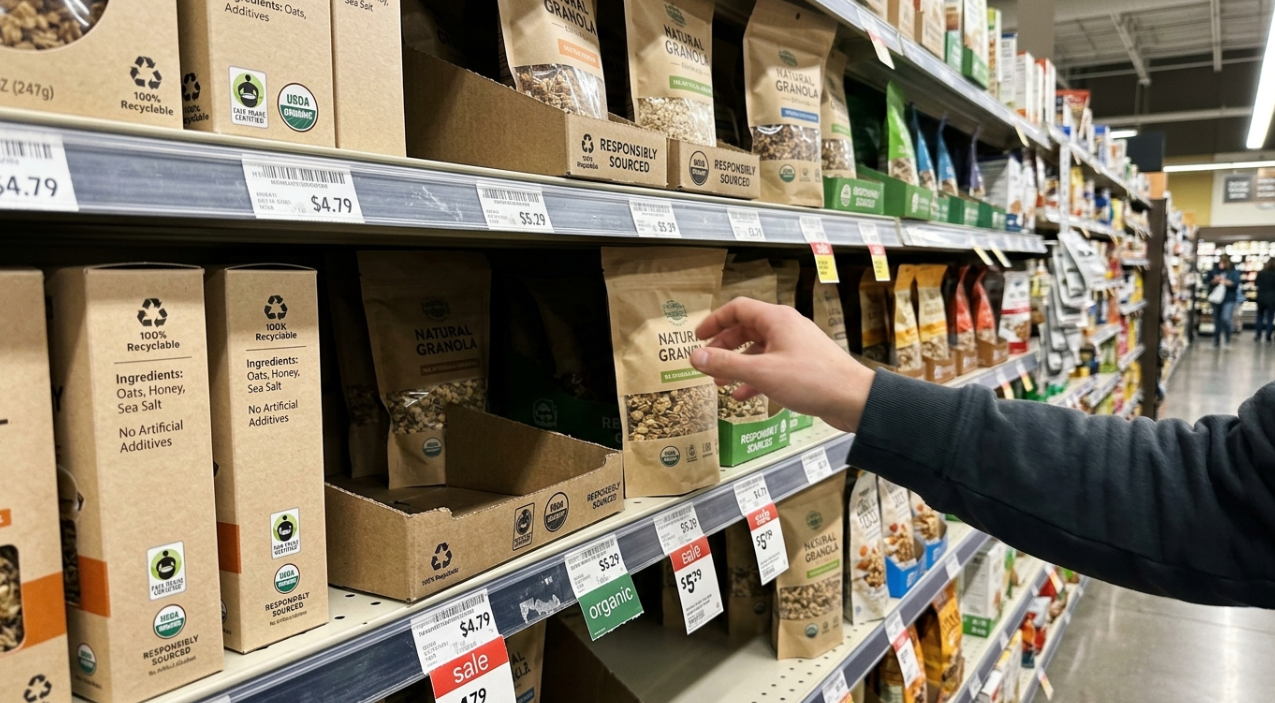
For CPG and retail brands specifically, the retail activation gap is where sustainability work often falls apart. A consultancy that understands sustainability but not the shelf, the shopper journey, the retailer sell-in story, and point-of-sale conversion isn’t enough.
Understanding why consumers intend but don’t act is the starting point for any serious sustainability commercialization program. Without diagnosing real barriers (price, convenience, trust, habit, perceived performance tradeoffs), even brilliant brand work stays stuck in strategy.
Explore brand activation services to see how Grounded World connects commercial innovation strategy to channel execution.
Frequently Asked Questions
What does a commercial innovation consultancy do?
It helps organizations turn ideas, sustainability investments, purpose platforms, or product concepts into market adoption and measurable business outcomes. This includes consumer insight, concept validation, claims substantiation, channel activation, and impact measurement.
How is commercial innovation different from product innovation?
Product innovation focuses on designing and building new offerings. Commercial innovation goes further: it addresses whether those offerings will be adopted, how to position and price them, how to substantiate claims, and how to activate demand through sales, retail, digital, and stakeholder channels.
How much does a commercial innovation consultancy cost?
Pricing varies widely. Boutique firms may scope diagnostic projects starting in the low five figures. Premium design consultancies can charge six figures per project. Enterprise transformation programs from large firms often reach six to seven figures. Public pricing is rare, so request a scoped proposal before comparing.
What should I ask before hiring a commercial innovation consultancy?
Focus on commercial outcomes (what business result are we accountable to?), consumer barriers (how will you diagnose the intention-action gap?), claims substantiation (how will we avoid greenwashing risk?), and activation deliverables (what will we have at the end besides a strategy deck?).
What is sustainability commercialization?
It’s the process of turning sustainability investments, claims, products, or purpose platforms into consumer demand and business growth. This requires bridging the gap between what consumers say they value and what they actually buy.
How do commercial innovation consultancies help avoid greenwashing?
The best firms build claims discipline into the process from the start: evidence mapping, legal review, consumer interpretation testing, channel-specific claim adaptation, and ongoing monitoring. They avoid broad, unqualified claims and instead create specific, comparative, evidence-backed messaging.
Should I hire a boutique consultancy or a large firm?
It depends on the job. Boutique firms offer specialization, agility, and direct access to senior talent. Large consultancies bring enterprise-scale transformation capability and cross-functional reach. For sustainability commercialization specifically, a specialist boutique often delivers more relevant, action-oriented work than a generalist firm.
What metrics should commercial innovation consulting track?
Go beyond impressions and workshop attendance. Track purchase intent, conversion rate, retailer adoption, repeat purchase, claim comprehension, internal toolkit usage, trust metrics, and impact outcomes tied to the sustainability or purpose work.
If your sustainability, purpose, or social impact work isn’t translating into market demand, start with a commercial diagnosis. Request a discovery call with Grounded World to identify the gaps between strategy and adoption.