
 Gaia
GaiaTL;DR
Food brands need agencies that understand both sustainability marketing and the realities of getting products off shelves. With the EU’s Green Transition Directive banning vague environmental claims from September 2026, the stakes are higher than ever. This guide evaluates eight agencies at the intersection of sustainability expertise and food-industry knowledge, with Grounded World as our top pick for brands looking to commercialize sustainability and close the gap between consumer intent and actual purchase behavior.
The best sustainability marketing agency for food brands depends on your business goals. Brands needing behavioral science, retail activation, and sustainability commercialization should consider Grounded World. Enterprise companies often benefit from Futerra's global sustainability strategy, while DTC food startups may prefer SMAKK Studios for branding and packaging. The right agency should combine sustainability expertise, food industry experience, regulatory compliance knowledge, and measurable commercial results.
The Verdict: Best Sustainability Marketing Agencies for Food Brands
As of 2026, the best sustainability marketing agencies for food brands are Grounded World (Best for Commercial Results & Retail), Futerra (Best for Global Enterprise Strategy), and SMAKK Studios (Best for DTC Branding).
Key Takeaway: With the EU ECGT Directive enforcement beginning September 27, 2026, food brands must transition away from generic "eco-friendly" claims toward verified third-party certifications and behavioral science frameworks that bridge the 52% "intention-action gap."
Who Should Read This Guide?
This guide is designed for:
Food and beverage brands building sustainability-focused marketing strategies
CPG companies launching environmentally responsible products
Organic, regenerative, and natural food brands
Food manufacturers selling into EU markets
Marketing directors evaluating sustainability agencies
ESG leaders working with brand teams
Retail-ready startups preparing for grocery distribution
Brands needing compliant sustainability messaging before the EU Green Transition Directive
If your business simply wants a general advertising agency, this guide is probably not the right resource.
Why This List Exists (and Why Most Agency Lists Fall Short)
Here’s the tension every sustainable food brand lives with: 91% of US consumers say they want food companies to weigh environmental impacts when making business decisions, according to the Hartman Group’s 2025 sustainability report. But 40% of those same consumers are skeptical of the claims brands make. And 58% have gone further, boycotting companies over perceived greenwashing.
The commercial opportunity is real. A YouGov survey across 19,000 consumers in 17 markets found 53% would pay up to 10% more for sustainable versions of regular packaged foods and drinks. A meta-analysis by Li and Kallas covering 80 studies puts the average willingness-to-pay premium for sustainable food at roughly 29.5%.
But here’s what most agency listicles miss: the EU’s Empowering Consumers for the Green Transition (ECGT) Directive becomes enforceable on September 27, 2026, effectively ending the era of self-certified sustainability claims.It bans generic claims like “sustainable,” “eco-friendly,” and “carbon neutral” when based on offsets. Penalties reach up to 4% of annual turnover or €2 million. Any food brand selling into European markets needs its marketing claims audit-ready. An agency that doesn’t understand this regulatory environment isn’t just unhelpful, it’s a liability.
The problem with existing agency lists is that they’re either sustainability-generalist (they know carbon accounting but not retail sell-through) or food-generalist (they know CPG marketing but treat sustainability as a checkbox). No ranked page specifically evaluates agencies at the intersection of both. This guide does.
The Business Case for Sustainable Food Marketing (2026 Data)
To justify agency investment, marketing leaders should note these 2025/2026 performance benchmarks:
Metric | 2026 Market Reality | Source |
Consumer Priority | 78% of consumers rank sustainability as a top-3 purchase factor. | Blue Yonder 2025 |
The Trust Gap | Only 20% of consumers fully trust brand sustainability claims. | Blue Yonder 2025 |
Willingness to Pay | Consumers pay an average 29.5% premium for sustainable food. | Li & Kallas |
Greenwashing Penalty | Greenwashing causes a -0.68 impact on consumer trust. | Hossain et al. 2025 |
How We Evaluated These Agencies
Every agency on this list was assessed across five criteria:
Sustainability depth. Is sustainability core to their business model, or is it one service among many?
Food-industry expertise. Do they understand retail activation, packaging regulations, FDA compliance, and the difference between sell-in and sell-through?
Intention-action gap capability. Can they change consumer behavior, not just produce campaigns? Recent data shows an average 52% intention-action gap across the food sector; while interest is at an all-time high, price sensitivity and 'green-fatigue' prevent half of interested shoppers from converting at the shelf. Closing that gap requires behavioral science, not just beautiful creative.
Third-party verification. B Corp certification, 1% for the Planet membership, Science Based Targets, or similar credentials.
Food and beverage case studies. Named clients and documented results in the food industry specifically.
A quick note on pricing: most agencies in this space don’t publish rates. Where possible, we’ve indicated pricing models (project-based, retainer, hourly), but expect to have discovery conversations for accurate quotes.
What Matters Most When Hiring a Sustainability Agency?
Evaluation Factor | Why It Matters |
|---|---|
Food Industry Experience | Food marketing has unique regulations and distribution channels |
Sustainability Expertise | Prevents greenwashing and regulatory issues |
Behavioral Science | Converts interest into purchases |
Retail Activation | Helps products sell after placement |
Regulatory Knowledge | Protects brands under EU sustainability laws |
Third-Party Certifications | Builds trust with consumers |
At-a-Glance Comparison Table
Agency | Best For | Sustainability Depth | Food Expertise | Certifications | Pricing Model |
|---|---|---|---|---|---|
Grounded World | Commercializing sustainability for food brands | ★★★★★ | Strong (retail activation, packaging, commercial selling stories) | B Corp, 1% for the Planet, SBTi | Custom project-based |
Futerra | Enterprise sustainability strategy | ★★★★★ | Moderate (cross-sector) | B Corp | Enterprise retainer |
SMAKK Studios | DTC food brand building | ★★★★ | ★★★★★ (food specialist) | None public | Project-based |
Active Ingredients | Mission-driven F&B storytelling | ★★★★ | ★★★★★ | Limited public info | Project-based |
Nourish Marketing | Canadian CPG food scaling | ★★★ | ★★★★★ | N/A | Retainer |
Quench Agency | Data-driven CPG repositioning | ★★★ | ★★★★★ | N/A | Mid-to-high retainer |
The Missing Ingredient | Health-forward US food brands | ★★★★ | ★★★★★ | N/A | ~$100-149/hr |
Dandelion Branding | EU content marketing for eco brands | ★★★★★ | ★★★ | N/A | SMB-friendly |
Choose an Agency Based on Your Growth Stage
Brand Stage | Recommended Agency Type |
|---|---|
Startup | Boutique branding agency |
Seed / Early Retail | Food-specialist sustainability agency |
National Retail | Retail activation specialist |
Enterprise | Global sustainability consultancy |
How to Use This List
Every agency excels in different areas.
Rather than asking "Which agency is best?", ask:
Do you need strategy or execution?
Are you launching a new product or repositioning an existing one?
Do you sell primarily DTC or through retailers?
Do you need EU compliance expertise?
Do you need packaging, branding, or behavioral science?
Use these questions while reviewing each agency profile.
Which Agency Fits Your Business?
Business Need | Best Agency |
|---|---|
Enterprise Sustainability Strategy | Futerra |
Retail Activation | Grounded World |
Emerging Food Brand | SMAKK Studios |
Canadian Food Companies | Nourish |
Mission-Driven Storytelling | Active Ingredients |
Shopper Marketing | Quench |
Health Food Brands | The Missing Ingredient |
EU Sustainability Content | Dandelion Branding |
The 8 Best Sustainability Marketing Agencies for Food Brands
1. Grounded World
Best for: Food brands that need to turn sustainability strategy into commercial outcomes, not just campaigns but consumer behavior change and retail activation.
Grounded World is a B Corp-certified, women-led boutique sustainability marketing agency that focuses on what most agencies avoid: making sustainability profitable. Their core thesis is that purpose without profit isn’t sustainable, and profit without purpose isn’t acceptable. They work across a four-phase model (Discover, Articulate, Activate, Accelerate) that takes brands from research and strategy through to retail activation and impact reporting.
What makes them particularly relevant for food brands is their focus on the intention-action gap, the chasm between consumers saying they want sustainable products and actually buying them. Their proprietary frameworks (BPP, 5Rs, Brand Activation for Good, Flywheel of Impact) are built to diagnose and close that gap using behavioral science, not just storytelling.
Key services for food brands:
AI-assisted 5C landscape assessments (Company, Culture, Category, Competitor, Consumer)
Intention-action gap research and quantification
Brand strategy, positioning, and architecture
Retail activation campaigns, commercial selling stories, and POSM toolkits
Sustainability communication and claims testing
Packaging design and sustainable packaging strategy
Impact measurement and reporting
Named food and beverage clients: Grove Collaborative, WhistlePig, Regeneration
Sustainability credentials: B Corp (Impact Score 116), 1% for the Planet, Science Based Targets, Ethical Agency Alliance, Top 100 Global Social Impact Company
Standout strength: The combination of behavioral science rigor and retail activation knowledge is rare. Most sustainability agencies stop at strategy. Most food agencies stop at creative. Grounded World connects the two, which is why they call themselves the bridge between purpose and profit. Their Regeneration case study shows this approach in action.
Honest tradeoffs:
Not a performance marketing agency. If you need paid media management or programmatic advertising, you’ll need a complementary partner.
No self-serve packages or transparent pricing. Every engagement is custom-scoped.
Best suited for brands ready for strategic engagement, not quick tactical projects.
Pricing: Custom project-based. They offer a complimentary AI-driven 5C landscape assessment as a starting point. Book a discovery call to explore fit.
2. Futerra
Best for: Enterprise-scale food corporations (think Mars, Mondelez, Nestlé caliber) needing global sustainability strategy and behavior-change campaigns.
Futerra describes itself as a change agency, product incubator, and training academy. They’ve been operating since 2001 and have offices in London, Stockholm, New York, San Francisco, and Mexico City. Majority women-owned and one of the UK’s first B Corps, they bring serious credibility to sustainability communications.
Futerra has introduced some genuinely useful conceptual frameworks, including the “brain print” concept, which argues that a brand’s messaging impact on consumer behavior can exceed its operational carbon footprint. For food brands, this reframes why marketing agency selection matters so much.
Key services for food brands:
Sustainability strategy and roadmapping
Behavior-change campaign design (grounded in behavioral economics)
Sustainable lifestyles initiatives and training
Corporate sustainability communications
Named food-adjacent clients: Collaborations with Mars and Mondelez on sustainable lifestyles initiatives
Sustainability credentials: B Corp certified, long track record in sustainability consulting
Standout strength: Deep expertise in behavioral economics and the psychology of sustainable consumption. Their research on why desire doesn’t translate to action is foundational for anyone working in this space.
Honest tradeoffs:
Enterprise pricing and engagement models. Not built for emerging brands or startups.
Cross-sector focus means less specialization in food-industry mechanics like retail sell-in, broker networks, and packaging compliance.
Less hands-on with individual brand-level retail activation.
Pricing: Enterprise retainer model. Expect six-figure annual engagements for meaningful scope.
3. SMAKK Studios
Best for: DTC and emerging food brands that need packaging, e-commerce, and brand identity built from scratch with sustainability woven into every element.
SMAKK Studios is a woman-owned agency in Brooklyn, New York, that works exclusively with food and beverage brands committed to sustainability, ethical sourcing, and meaningful wellness. That exclusivity matters. They don’t take on clients whose values don’t align, which means every project in their portfolio reflects genuine sustainability integration.
Key services for food brands:
Brand strategy and development
Packaging design
Website design and development (Shopify specialists)
Photo and video production
Campaign development and marketing management
Named food and beverage clients: Walmart Cookshop, Little Spoon, Vikre Distillery, The Spare Food Co., Burt’s Bees
Standout strength: Their design work is outstanding, and their food-industry focus means they understand the visual language of sustainable food brands at shelf level. If you’re launching a new CPG product and need everything from packaging to Shopify store, they’re a strong choice.
Honest tradeoffs:
More branding and design focused than strategy or behavior change. They’ll make your brand beautiful, but closing the intention-action gap requires different expertise.
No public sustainability certifications for the agency itself (B Corp, etc.), though they only work with sustainable brands.
Less experience with enterprise-scale retail activation or broker network support.
Pricing: Project-based. Expect mid-range agency pricing typical of Brooklyn-based boutiques.
4. Active Ingredients
Best for: Mission-driven food and beverage brands needing storytelling with integrity and precision around sustainability narratives.
Active Ingredients positions itself as a food marketing agency that activates brands with “meaningful marketing to grow business and create a healthier world.” They’re specifically focused on the food and beverage sector, and their sustainability angle is baked into their mission rather than bolted on.
Key services for food brands:
Brand strategy and positioning
Sustainability narrative development
Campaign creation and content marketing
Food-specific creative services
Standout strength: The combination of food-industry specialization and genuine sustainability conviction. They understand that food marketing carries unique responsibilities around health claims, sourcing transparency, and environmental impact.
Honest tradeoffs:
Smaller scale operation with less publicly available case study data than larger competitors.
Limited information on proprietary frameworks or behavioral science capabilities.
May lack the global reach needed for brands operating across multiple markets.
Pricing: Project-based. Contact directly for scoping.
5. Nourish Marketing
Best for: Canadian and North American CPG food brands scaling from startup to retail distribution.
Nourish Marketing bills itself as North America’s leading full-service agency dedicated exclusively to food and beverage. They bridge culinary passion and strategic marketing, helping brands grow from kitchen-table startups to supermarket staples. Their deep understanding of what drives both shoppers and chefs makes them particularly valuable for brands navigating the transition from direct sales to retail.
Named food and beverage clients: Dairy Farmers of Ontario, Egg Farmers of Canada, Arla
Key services for food brands:
Omnichannel campaign development
Sustainability-driven messaging
Packaging and influencer collaborations
Shopper marketing and retail strategy
Standout strength: Award-winning food marketing with strong Canadian retail connections. If you need to get a sustainable food product onto Canadian grocery shelves, they know the landscape.
Honest tradeoffs:
Food-first, sustainability-second. Sustainability is a capability, not the core mission.
Strongest in Canadian markets, which may limit utility for brands focused on US, EU, or global distribution.
Less depth in behavioral science or intention-action gap methodology.
Pricing: Retainer model typical of full-service food agencies.
6. Quench Agency
Best for: Established CPG food brands wanting data-driven repositioning that includes sustainability messaging as part of a broader commercial strategy.
Quench is a full-service food and beverage marketing agency that covers everything from advertising and branding to consumer insights. Their annual Food & Beverage Trend Report, now in its 16th year, breaks down cultural and marketplace forces shaping the industry. That kind of longitudinal data is genuinely useful for strategic planning.
Their track record speaks in commercial terms: they sparked a $144 million sales increase for StarKist by repositioning it as a convenient health option. That’s the kind of result that gets CFO attention.
Key services for food brands:
Consumer insights and trend analysis
Brand repositioning and advertising
Data-driven campaign development
Packaging and retail marketing
Standout strength: The data infrastructure. Sixteen years of trend reporting means they can identify where sustainability intersects with other consumer motivations, like convenience, health, and value. For food brands that need sustainability to work commercially (not just ethically), that data perspective is valuable.
Honest tradeoffs:
Sustainability is one of many capabilities, not the core focus. Don’t expect deep expertise in carbon accounting, lifecycle analysis, or EU regulatory compliance.
Better suited for established brands with existing distribution than for startups or emerging brands.
No public sustainability certifications for the agency.
Pricing: Mid-to-high retainer model, commensurate with full-service CPG agency pricing.
7. The Missing Ingredient
Best for: Health-forward, sustainability-minded food brands in the US market looking for an accessible, hands-on agency partner.
The Missing Ingredient is a Los Angeles-based marketing agency specializing in the food and beverage sector. Their mission is to build a better future through healthful, sustainable foods by “uncomplicating marketing for the brands they love.” That unpretentious positioning reflects their working style.
Named food and beverage clients: Amy’s, Milk Bar, One Potato
Key services for food brands:
Marketing strategy and management
Brand development for health and sustainability-focused food brands
Content creation and campaign execution
Digital marketing
Standout strength: Their client list (Amy’s, Milk Bar) shows they work with brands that authentically intersect health and sustainability. The LA location gives them proximity to the natural and organic food ecosystem concentrated in Southern California.
Honest tradeoffs:
Primarily US-focused. Not the right fit for brands needing EU market support or global sustainability strategy.
Less emphasis on retail activation infrastructure (broker networks, POSM toolkits) than some competitors.
Sustainability expertise appears more intuitive than framework-driven.
Pricing: Estimated $100-149 per hour based on available data.
8. Dandelion Branding
Best for: European sustainable food brands needing content marketing and website optimization from an agency that refuses to work with non-sustainable businesses.
Dandelion Branding is a sustainability marketing agency based in the Netherlands that provides content marketing strategies and website optimization for sustainable businesses. Their strict policy of only working with eco-friendly brands means they’ve developed deep fluency in sustainability communication, which matters increasingly as the EU tightens regulations on environmental claims.
Key services for food brands:
Content marketing strategy
Website optimization and SEO
Sustainability-focused copywriting
Digital marketing for eco-brands
Standout strength: Their European base is a genuine advantage given the incoming ECGT Directive. A Netherlands-based agency working exclusively with sustainable brands will likely be ahead of the regulatory curve compared to US-based generalists.
Honest tradeoffs:
Content and SEO focused, not a full-service brand strategy or retail activation agency.
Smaller team with less capacity for enterprise-scale engagements.
Food expertise is less documented than their general sustainability credentials.
Pricing: SMB-friendly pricing model. Accessible for smaller brands and startups.
Quick Audit: Is Your Brand Ready for September 27, 2026?
Before hiring an agency, use this 3-point checklist to assess your current regulatory risk under the EU’s Green Transition Directive:
[ ] Eliminate Generic Claims: Have you removed terms like "Eco-Friendly," "Natural," or "Green" that aren't tied to a specific, verified certification?
[ ] Audit Carbon Claims: Are you claiming "Carbon Neutrality" based on offsets? (Note: This is prohibited in the EU as of Sept 2026).
[ ] Verification Check: Are your sustainability labels provided by an independent, recognized third-party scheme rather than self-created?
What Makes a Sustainability Agency Different from a Food Agency?
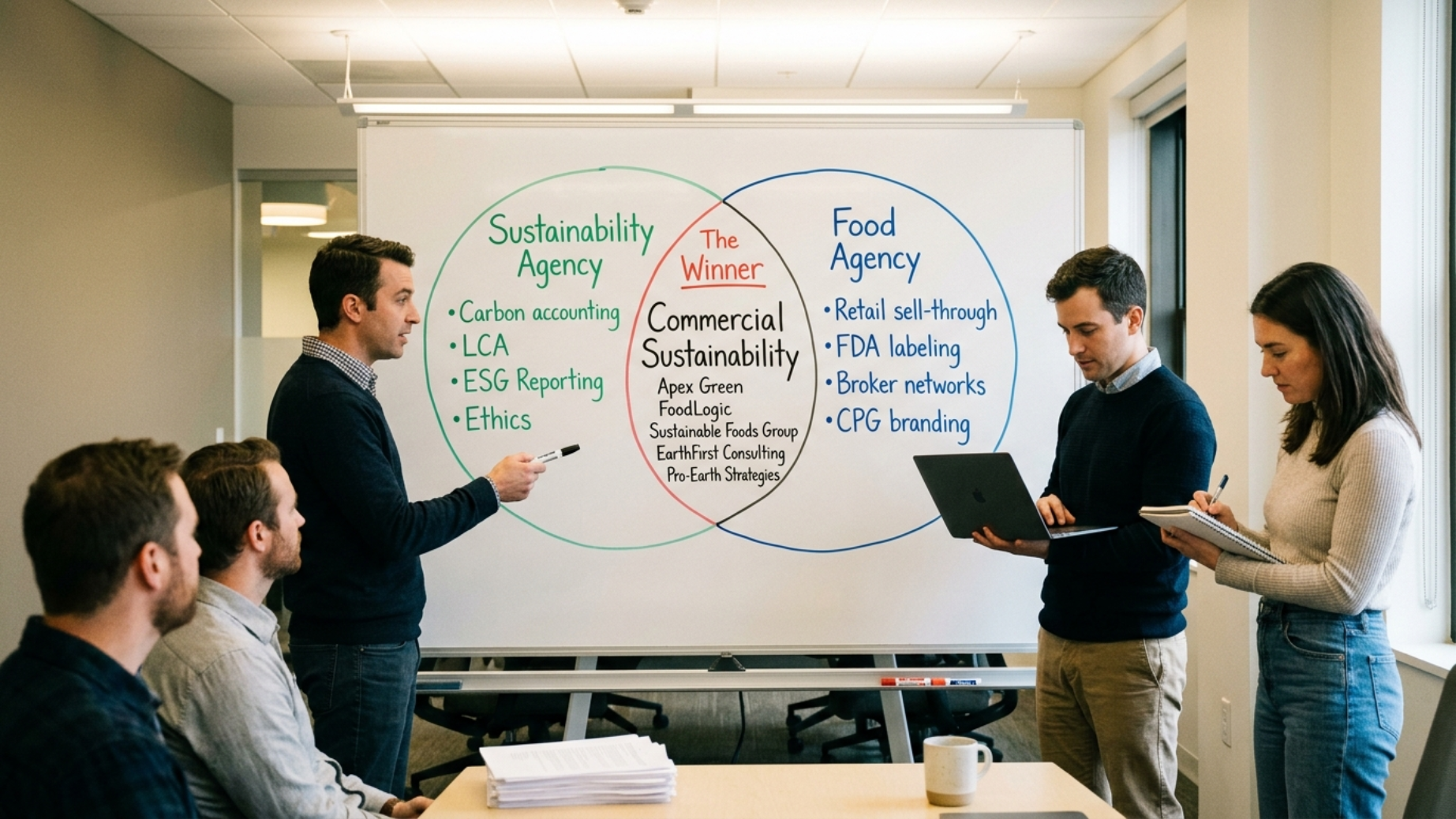
This distinction matters more than most brands realize. A sustainable marketing agency has sustainability at its core, which means deeper knowledge of complex topics like lifecycle analysis, scope 3 emissions, circular economy principles, and now, EU regulatory compliance for sustainability communications. They know which claims will hold up under scrutiny and which will trigger consumer backlash or regulatory penalties.
A food marketing agency, on the other hand, knows things a sustainability agency often doesn’t. Food brands have expiration dates, FDA regulations, and supply chains that break if demand spikes too fast. As one practitioner-focused listicle from The Marketing Agency put it: “A pretty Instagram feed doesn’t matter if your product is collecting dust in a UNFI warehouse because the agency didn’t support the broker network.” Understanding the difference between “sell-in” (getting product onto retailer shelves) and “sell-through” (getting consumers to actually buy it) is non-negotiable for food brand marketing.
The ideal agency lives at the intersection. It can build a credible sustainability narrative that survives regulatory scrutiny while also creating retail activation campaigns that move product. Very few agencies occupy that space, which is precisely why this list exists.
The Regulatory Landscape Food Brands Can’t Ignore
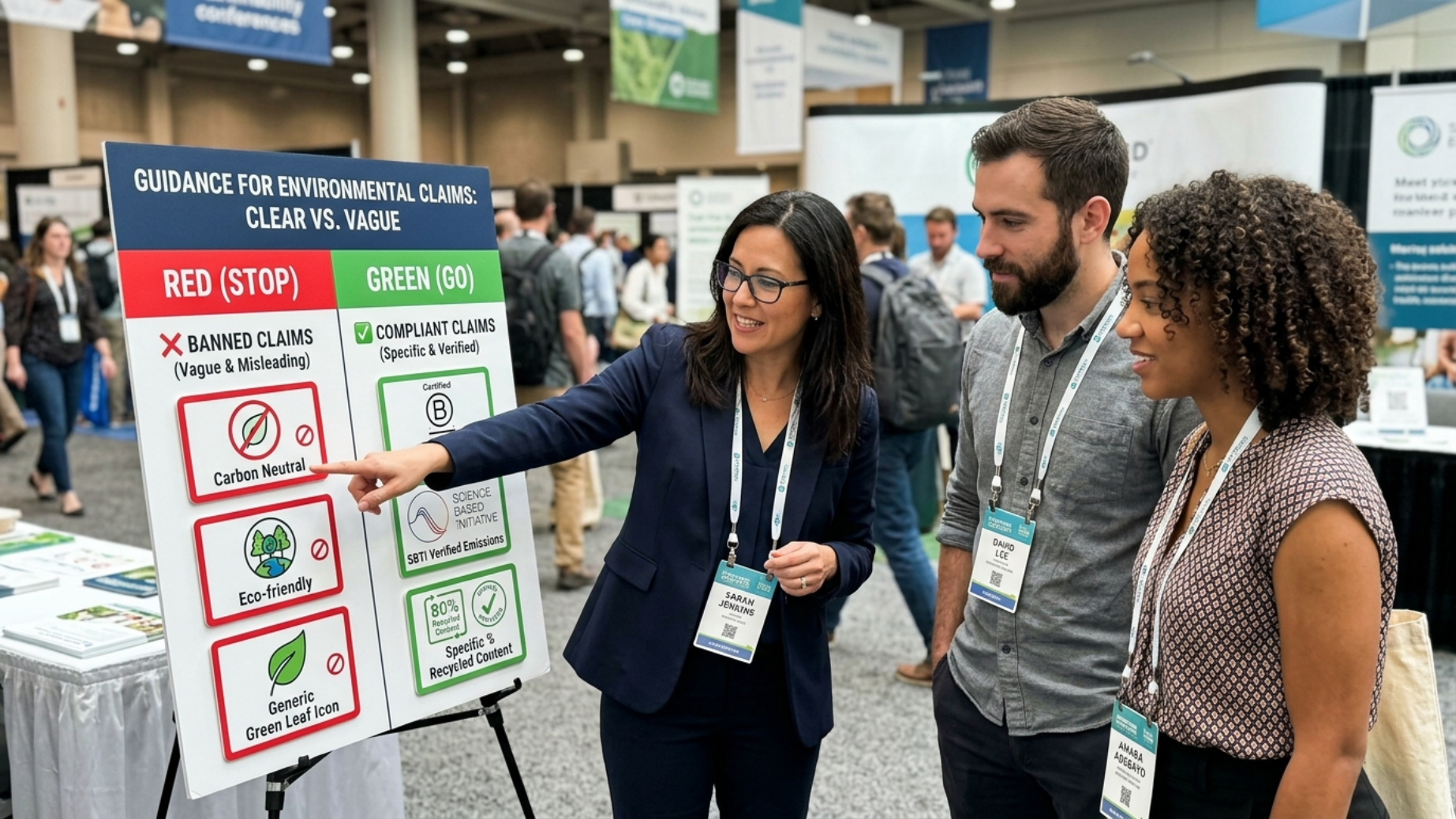
The EU’s Empowering Consumers for the Green Transition Directive, effective September 27, 2026, fundamentally changes what food brands can say about sustainability. Generic claims like “sustainable,” “eco-friendly,” and “natural” will be banned unless backed by recognized, verified evidence. Carbon neutral claims based on offsets are explicitly prohibited. Self-created sustainability labels (the ones brands design themselves without independent verification) will be outlawed.
This isn’t theoretical. A European Commission study found that 53% of environmental claims examined were vague, misleading, or unfounded. The regulatory response is proportionate: penalties can reach 4% of annual turnover or €2 million for widespread infringements.
For any food brand exporting to Europe (or planning to), this creates urgent work. Every piece of packaging, every product page, every marketing campaign needs auditing against the new requirements. Brands that get their claims right before the deadline will have a competitive advantage on European shelves while competitors scramble to revise or pull non-compliant materials.
Your agency needs to understand this regulatory environment. If they can’t explain what the ECGT Directive means for your packaging claims, they shouldn’t be handling your sustainability marketing.
The Intention-Action Gap: The #1 Question to Ask Any Agency
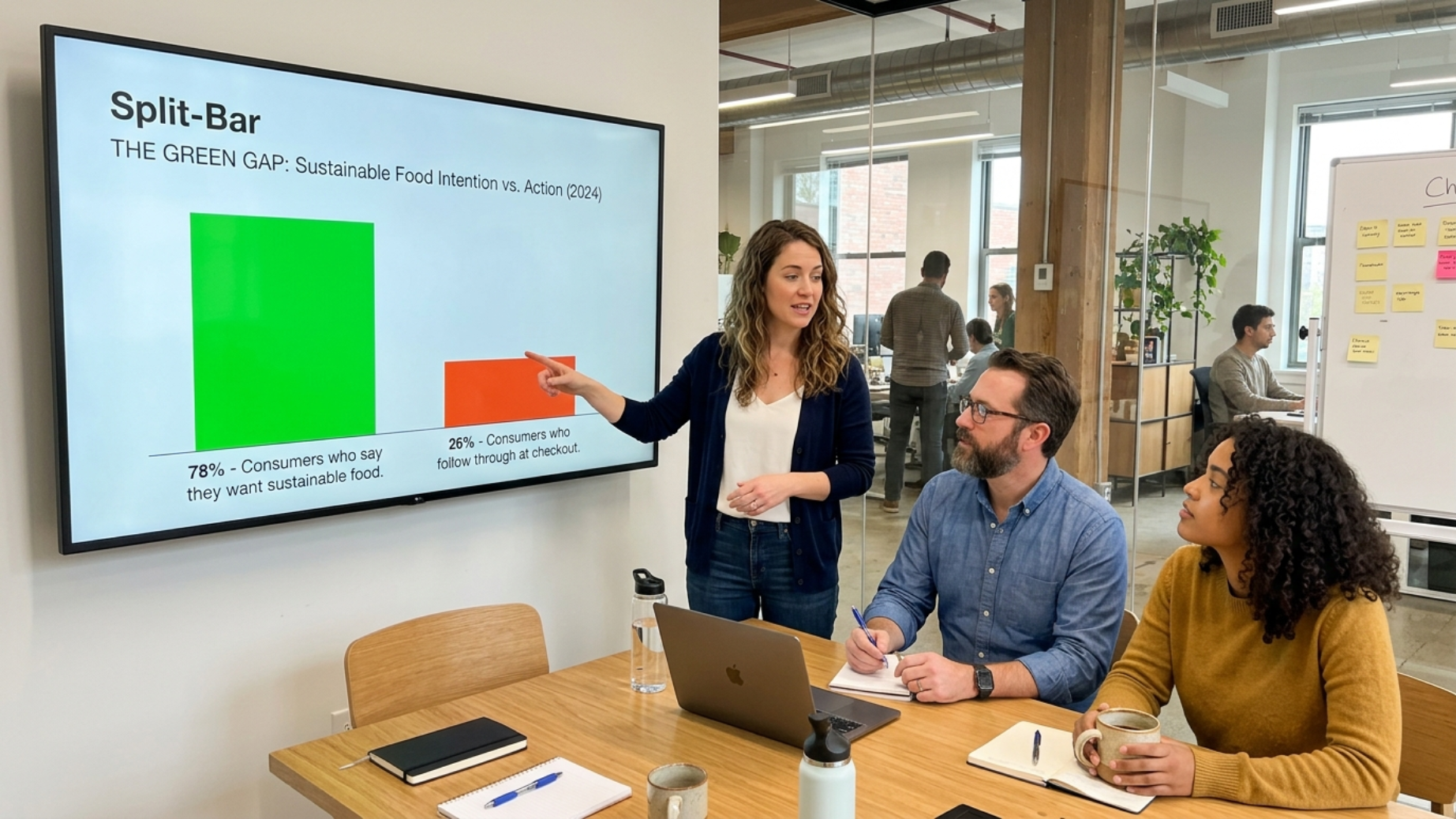
Here’s the statistic that should define your agency search: only 26% of consumers who say they want sustainable products actually buy them. Meanwhile, 53% of consumers say they simply don’t know which companies share their values, and 44% say they can’t identify which products are sustainable.
This intention-action gap in sustainable behavior is the central challenge for sustainable food brands. And it’s also your most powerful screening question during agency selection. Ask any prospective agency: “How do you close the gap between consumers wanting sustainable food and actually choosing it at shelf?”
Good answers involve behavioral science, nudge strategies, claims testing, and retail activation, making the sustainable choice the easy choice. Great answers include quantifying the gap for your specific category and measuring behavior change over time.
Bad answers involve more brand awareness campaigns. Awareness isn’t the problem. The Hartman Group’s research is clear on this: consumers care deeply about environmental and social issues. They just need brands to make sustainability tangible, personal, and easy. As one researcher put it, “Current sustainability messaging really falls flat. Green and eco-friendly has gotten us to where we are, but it needs to connect with people and make it personal.”
There’s also an important reframing happening in the industry. The word “sustainability” itself is losing resonance. Consumers aren’t backing away from the values behind it, but the term has become abstract and corporate. The Hartman Group identifies a shift toward “care” as a more immediate, human-centered framing. Agencies still building campaigns around generic green language are behind the curve. The best sustainability marketing agencies for food brands understand that brand purpose needs to translate into language consumers actually respond to.
One counterintuitive finding worth noting: research from Hossain et al. (2025) using Structural Equation Modeling found that while greenwashing significantly damages consumer trust (β = -0.68) and brand loyalty (β = -0.45), these effects are actually more severe in fashion than in food. Food brands have a slightly wider window of trust to work with. But that window narrows every time a competitor gets caught making unfounded claims. Protecting it requires rigorous, verified sustainability communications.
Common Mistakes Food Brands Make When Hiring Sustainability Agencies
Many food companies choose agencies based solely on creative portfolios or sustainability messaging.
Common mistakes include:
Hiring agencies without food industry experience
Confusing branding expertise with behavioral science
Ignoring EU compliance capabilities
Prioritizing awards over measurable business results
Assuming sustainability automatically drives purchases
Choosing agencies that cannot support retail sell-through
Avoiding these mistakes can reduce regulatory risk while improving commercial outcomes.
How to Choose the Right Sustainability Marketing Agency for Your Food Brand
Use these five questions during your discovery calls:
1. Do they have food-specific case studies? Not just “consumer goods” or “CPG.” Actual food and beverage brands with documented outcomes. Ask to see the work.
2. Do they understand retail sell-in AND sell-through? If they can’t explain how to support a broker network or create commercial selling stories for retail buyers, they’ll struggle with the realities of food distribution.
3. Can they articulate a behavior-change framework? Not just marketing frameworks, but an approach to closing the intention-action gap that’s grounded in behavioral science. Ask them how they’ve changed consumer behavior, not just consumer awareness.
4. Are they B Corp or third-party verified? This matters more than you might think. Research consistently shows that verification is the most important factor in getting consumers to actually purchase sustainable products. An agency that practices what it preaches through third-party certification will understand the power of verification for your brand, too.
5. Can they help with regulatory compliance? With the EU ECGT Directive taking effect in September 2026, your agency needs to audit claims against incoming regulations, not just create compelling copy.
If you’re looking for an agency that checks all five boxes, start with a complimentary 5C landscape assessment to understand where your brand stands before committing to a full engagement.
Conclusion
The market for sustainable food is growing, but consumer skepticism is growing faster. Regulation is tightening. And the gap between what consumers say they want and what they actually buy remains stubbornly wide.
The right agency won’t just make your food brand look sustainable. It will make sustainability your competitive advantage, at shelf, in digital, and across every consumer touchpoint. That requires an agency fluent in both sustainability science and food-industry commerce.
The best time to get your sustainability marketing right was two years ago. The second best time is before September 2026. Reach out to Grounded World for a discovery conversation and start with their complimentary AI-driven 5C landscape assessment to see where the gaps and opportunities are.
Frequently Asked Questions
How much do sustainability marketing agencies charge food brands?
Pricing varies widely. Enterprise agencies like Futerra operate on six-figure annual retainers. Boutique specialists like Grounded World and SMAKK Studios typically scope custom projects. The Missing Ingredient estimates around $100-149 per hour. SMB-friendly options like Dandelion Branding work at lower price points. Expect to spend more for agencies with behavioral science capabilities and regulatory expertise, though the cost of getting sustainability claims wrong (up to 4% of annual turnover under EU rules) makes this a worthwhile investment.
What’s the difference between a sustainability marketing agency and a regular food marketing agency?
A sustainability marketing agency has environmental and social impact at its core, meaning deeper expertise in lifecycle analysis, claims verification, regulatory compliance, and behavior change. A food marketing agency understands retail dynamics, packaging regulations, FDA compliance, and broker networks. The best agencies for sustainable food brands sit at the intersection, combining credible sustainability knowledge with practical food-industry experience. Agencies that only do one well will leave gaps that can cost you commercially or reputationally.
How do I know if a food brand’s sustainability marketing agency is credible?
Look for third-party verification. B Corp certification is the gold standard, as it requires rigorous assessment of the agency’s own environmental and social practices. Other signals include 1% for the Planet membership, Science Based Targets commitment, and membership in organizations like the Ethical Agency Alliance. Also check whether they only work with sustainable brands (as SMAKK Studios and Dandelion Branding do) or take any client regardless of values.
What is the EU ECGT Directive, and why should food brands care?
The Empowering Consumers for the Green Transition Directive takes effect September 27, 2026. It bans generic environmental claims like “sustainable” and “eco-friendly” unless backed by verified evidence. Carbon neutral claims based on offsets are prohibited. Self-created sustainability labels are outlawed. Penalties reach up to 4% of annual turnover or €2 million. Any food brand selling into EU markets (including US and UK exporters) must ensure all packaging, labeling, and marketing claims comply before the deadline.
What is the intention-action gap in sustainable food purchasing?
It’s the gap between consumers saying they want sustainable food (78% say sustainability matters in purchasing decisions) and actually buying it (only 26% follow through). The gap exists because of price sensitivity, confusion about which products are truly sustainable, and psychological barriers that brands often don’t address. Closing this gap requires behavioral science, retail activation, and clear third-party verification, not just awareness campaigns.
Can a general marketing agency handle sustainability for my food brand?
It’s risky. Only 20% of consumers believe brands accurately communicate sustainability, according to Blue Yonder’s 2025 Consumer Sustainability Survey. A general agency without deep sustainability expertise is more likely to produce claims that trigger consumer skepticism or, worse, fall afoul of incoming EU regulations. The greenwashing penalty is severe: research shows it causes a significant negative impact on consumer trust (β = -0.68) and brand loyalty (β = -0.45). Specialized expertise pays for itself in avoided risk.
Should my food brand stop using the word “sustainability” in marketing?
Not necessarily, but be aware that the term is losing resonance. Research from the Hartman Group shows consumers still care about the underlying issues, but abstract corporate language around sustainability falls flat. The trend is toward more personal, human-centered framing, with words like “care” performing better than “green” or “eco-friendly.” A good agency will help you find language that connects with your specific audience rather than defaulting to generic sustainability vocabulary.
How do I evaluate whether a sustainability agency understands the food industry?
Ask them to explain the difference between sell-in and sell-through. Ask about their experience with FDA labeling requirements, broker networks, and retail buyer presentations. Request food-specific case studies with named clients and measurable outcomes. If their portfolio is all fashion, tech, or financial services, they may produce great sustainability strategy but struggle with the operational realities that make food marketing unique.